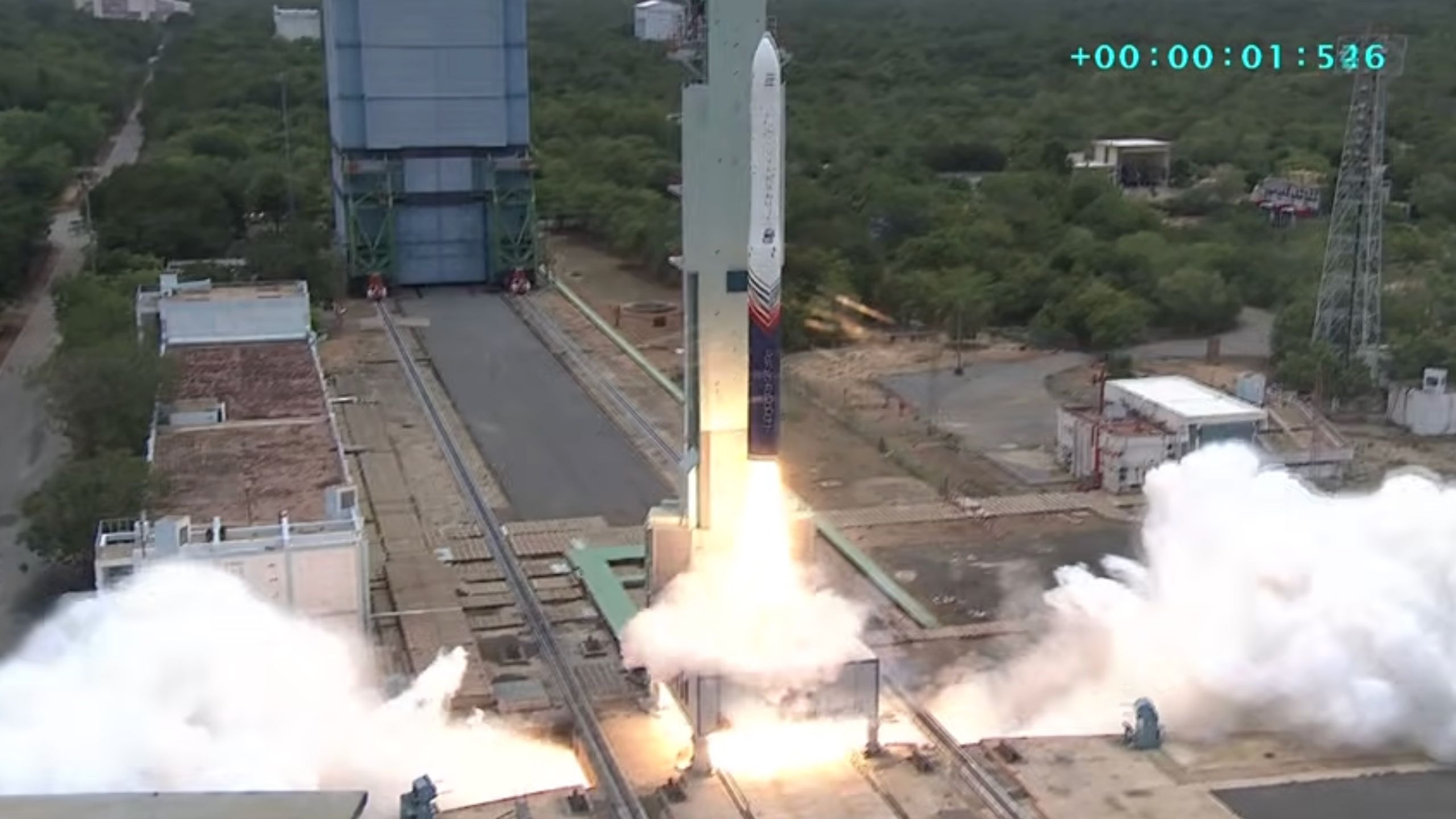
In a landmark event for India's burgeoning space industry, Skyroot Aerospace successfully launched the Vikram-1 rocket on July 18, 2026, marking the first time a privately developed Indian rocket has reached orbit. The Vikram-1's journey began at the Satish Dhawan Space Centre in Sriharikota, where it soared into the sky, carrying a range of innovative payloads and marking a significant milestone in India's quest to expand its presence in the global space sector.
The Vikram-1, developed by Hyderabad-based Skyroot Aerospace, lifted off at 12:05 p.m. local time, following a brief delay to address a technical issue. The 72-foot-tall rocket, designed to carry payloads up to 350 kilograms (about 770 pounds) to low Earth orbit, achieved an orbit approximately 450 kilometers high with a 60-degree inclination, as confirmed by Skyroot Aerospace and U.S. military tracking data.
The mission, aptly named 'Aagaman,' meaning 'arrival' in Sanskrit, carried several customer payloads and in-orbit experiments, including technology demonstration payloads from Grahaa Space, Cosmoserve, and DCubed, along with Skyroot's own SCOPE satellite. Among the unique cargo was a miniature 18-karat gold rocket adorned with sculptures of eminent Indian physicists and space icons.
Pawan Kumar Chandana, co-founder and CEO of Skyroot Aerospace, expressed his pride in the company's achievement, stating, "What the world witnessed today is the result of years of work by our team, our partners, and suppliers across the country." He emphasized the significance of this success in demonstrating India's capability to produce world-standard launch vehicles.
This historic launch is a testament to the rapid growth of India's private space sector, which has flourished since the government opened the industry to private players in 2020. The Indian space economy, valued at approximately $8.4 billion, is home to over 400 space startups and aims to increase its market share fivefold by 2033.
Skyroot Aerospace, founded in 2018 by former Indian Space Research Organisation (ISRO) scientists, represents a new wave of private enterprises that are reshaping India's space ambitions. After achieving a $1.1 billion valuation earlier this year, Skyroot has emerged as India's first space 'unicorn.' The company's rapid development and successful launch highlight the potential of India's private sector to contribute significantly to the global small satellite launch market.
The Vikram-1's successful flight follows India's impressive achievements in the space domain, such as its 2014 Mars orbiter mission and a lunar landing in 2023. Former ISRO chairman K. Sivan praised the role of startups in driving innovation and growth, noting that the current successes are the "fruits of the seeds sown" when the sector was opened to private entities.
Looking ahead, Skyroot Aerospace has ambitious plans to enhance its capabilities further. The company is preparing for additional development flights to ensure the Vikram-1's reliability and to establish a steady launch cadence. Skyroot is also working on the Vikram-2 rocket, which is expected to debut in 2027 with the capacity to carry payloads up to 1,000 kilograms, further solidifying its position in the market.
India's Prime Minister Narendra Modi lauded the Vikram-1 launch as a "defining moment" in the nation's space journey, highlighting the growing involvement of private players as a catalyst for innovation and opportunity for young Indian entrepreneurs.
As Skyroot Aerospace and other private firms continue to push boundaries, India's role in the global space economy is poised for significant expansion, offering promising opportunities for collaboration and competition on the international stage.