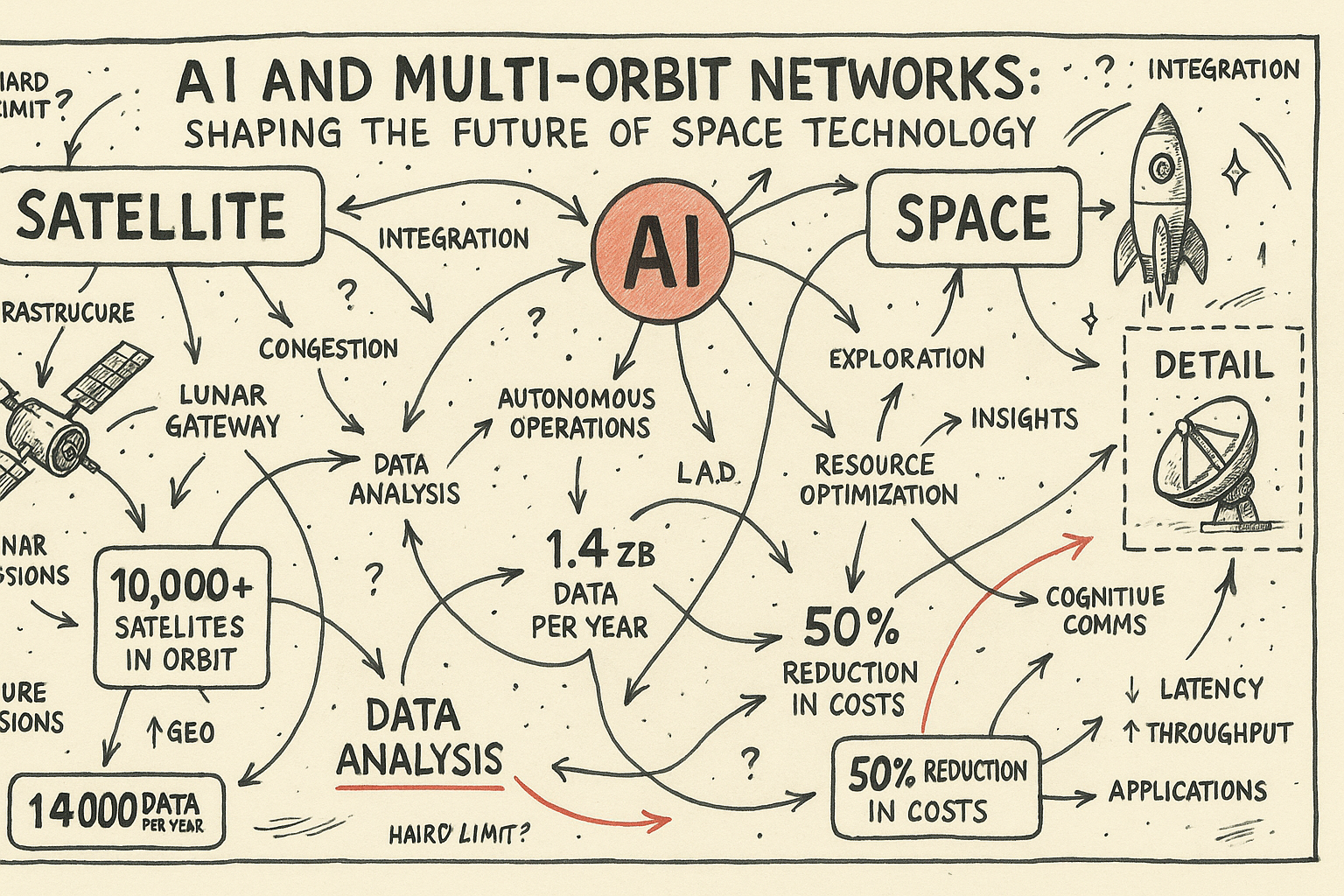
The landscape of space technology is undergoing a transformative phase characterized by strategic alliances and technological advances that are setting the stage for the future. Recent developments showcase a remarkable alignment between artificial intelligence (AI) and satellite technology, as well as the increasing complexity of multi-orbit networks. These trends are not only enhancing operational capabilities but also redefining competitive dynamics in the space sector.
AI-Equipped Satellites: A New Frontier
The announcement of a $1 billion contract between Loft Orbital and Marlan Space to deploy 50 AI-equipped low Earth orbit (LEO) satellites marks a significant milestone (Source 1). These satellites promise enhanced data processing and decision-making capabilities, potentially transforming how satellite data is utilized in various sectors, from environmental monitoring to defense.
This move underscores an important shift: the integration of AI into space infrastructure is not just a technological upgrade but a paradigm shift. By enabling satellites to process data onboard, latency issues can be minimized, and more autonomous operations can be achieved. This is particularly crucial in scenarios requiring real-time responses, such as disaster management or military operations.
Multi-Orbit Networking: The Next Step
Concurrently, the advancements in multi-orbit networking are paving the way for more resilient and versatile satellite communications. Companies like XipLink and AvL Technologies are securing defense contracts to enhance multi-orbit capabilities in Asia and Poland, respectively (Sources 4 and 5). These contracts highlight the growing importance of having a flexible and robust space communication infrastructure.
The collaboration between Cailabs and RBC Signals to develop a global optical ground station network further illustrates the push toward more advanced ground-support systems (Source 6). Optical communication is poised to offer higher bandwidth and lower latency compared to traditional radio frequencies, making it a key component in the future of satellite networks.
Strategic Alliances: A Competitive Edge
As the space sector becomes increasingly competitive, strategic alliances are emerging as a critical factor. The partnership between AT&T and Amazon Leo exemplifies this trend, as they work to integrate fiber-to-space technology to challenge SpaceX's Starlink (Source 3). By combining terrestrial and space-based resources, these alliances aim to deliver superior connectivity solutions.
Similarly, Blue Origin's strategy to leverage talent from Amazon's satellite division highlights the importance of human capital in expanding orbital operations (Source 2). This talent acquisition strategy not only bolsters Blue Origin's capabilities but also signifies a broader trend of cross-industry expertise contributing to space advancements.
The Role of Innovation and Investment
In the backdrop of these developments is the significant investment in new technologies and platforms. York Space Systems' unveiling of the LX/V-CLASS spacecraft platform for very low Earth orbit (VLEO) operations points to the industry's commitment to innovation (Source 7). Such platforms are designed to take advantage of VLEO's unique benefits, including reduced latency and increased data throughput.
Moreover, the financial mechanisms supporting these advancements are evolving. Sophia Space and SLI's $300 million deal to fund an orbital computing constellation via a long-term operating lease is a novel approach that could reshape how space missions are financed (Source 8).
Looking Ahead: Implications and Challenges
The integration of AI and multi-orbit capabilities into space infrastructure holds immense potential but also presents challenges. Regulatory frameworks will need to evolve to address issues related to data privacy, orbital debris, and spectrum management. Additionally, the competitive landscape will likely drive further innovation, leading to more efficient and cost-effective solutions.
As these technologies mature, they will not only enhance connectivity and data processing but also broaden the scope of what is possible in space exploration and utilization. The convergence of AI, multi-orbit networks, and strategic collaborations is set to redefine the future of space technology, offering new opportunities and challenges for stakeholders across the globe.