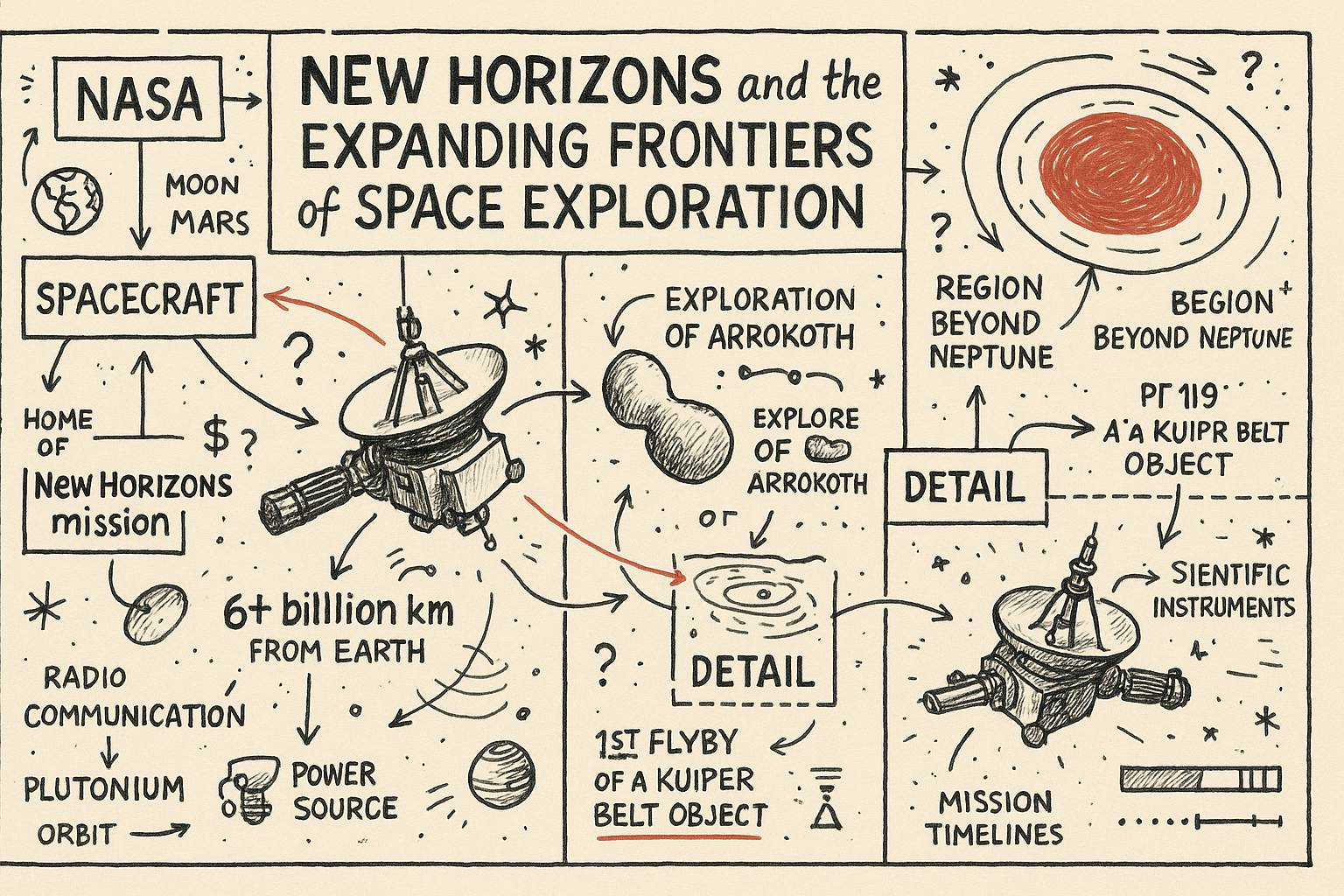
In the vast and uncharted realms of space, exploration continues to expand humanity's understanding of the universe. Recently, NASA's New Horizons spacecraft, renowned for its historic flyby of Pluto in 2015, has been revived from its longest hibernation period to date, marking a new chapter in its audacious mission beyond the Solar System. This event coincides with other significant astronomical discoveries that together paint a picture of a universe far more complex and mysterious than ever imagined.
The New Horizons mission, now operating approximately 9.5 billion kilometers from Earth, is poised to transmit invaluable data from the Kuiper Belt, a region rich with primordial remnants from the solar system's formation. This data promises to unveil new insights about the composition and behavior of these ancient celestial bodies. The spacecraft’s reawakening highlights the technological resilience and scientific ambition that characterized its journey through space. As New Horizons ventures further into the unexplored expanses, it continues to redefine the boundaries of human knowledge about the heliosphere and its interactions with interstellar space.
Concurrently, a potentially groundbreaking discovery has emerged from the analysis of a brown dwarf system, CD-35 2722, where astronomers have identified what might be the first exomoon ever detected outside our solar system. This candidate exomoon, orbiting a brown dwarf, challenges traditional notions of moon formation and planetary systems, suggesting that moons could exist in a wider array of cosmic environments than previously thought.
Adding to the cosmic revelations, the European satellite Euclid has discovered 31 new quasars, two of which are the oldest and most distant ever observed. These quasars date back to a time when the universe was a mere 5% of its current age, providing a rare glimpse into the early cosmic epoch. Such discoveries are pivotal in understanding the formation of galaxies and the role of quasars in galactic evolution.
Meanwhile, closer to home, astronomers have identified four previously unseen white dwarfs within 65 light-years of Earth. This discovery underscores the complexity of our cosmic neighborhood and aligns with theoretical models predicting a more substantial population of such stellar remnants than observed.
The interconnectedness of these discoveries reveals a universe teeming with dynamic and diverse phenomena. The New Horizons mission exemplifies humanity's quest to push the boundaries of exploration, emphasizing the necessity of long-term planning and resilience in space missions. The potential identification of an exomoon challenges existing paradigms about celestial bodies, while the discovery of ancient quasars and nearby white dwarfs reshapes our understanding of cosmic history and stellar evolution.
These findings collectively suggest that space exploration is entering an era where traditional models are being overturned by new data, prompting a reevaluation of our place in the cosmos. As technology advances and telescopes become more sophisticated, the scope and scale of space exploration are set to expand even further, potentially leading to more transformative discoveries.