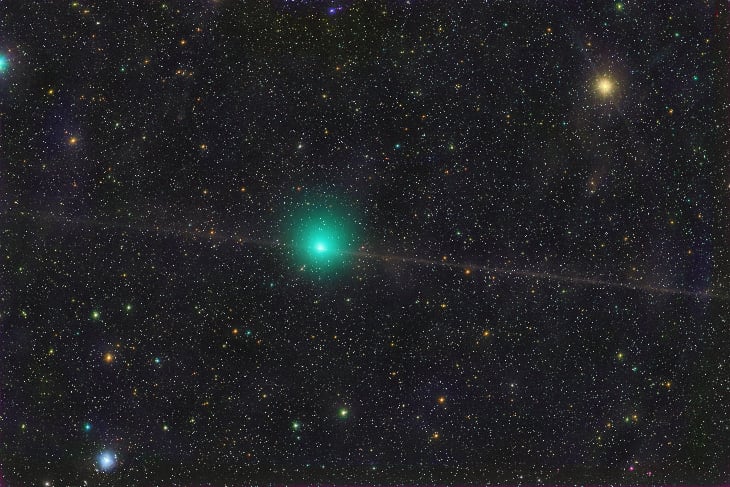
Comet 10P/Tempel, a periodic celestial visitor, is captivating skywatchers this summer as it brightens and becomes visible in the predawn sky. Discovered on July 4, 1873, by German astronomer Wilhelm Tempel, this comet is a familiar sight in the cosmos, making its rounds every 5.4 years. In 2026, Comet 10P/Tempel offers one of its most favorable appearances in decades, enchanting observers with its greenish glow as it traverses the sky.
This year, the comet is part of the Jupiter-family comets, a group of comets whose orbits are influenced by the gas giant Jupiter. Originally hailing from the Kuiper Belt, Comet 10P/Tempel's orbit was reshaped by Jupiter, granting it a shorter, more frequent path around the Sun. With an orbital period of 5.37 years and an inclination of 12 degrees to the ecliptic plane, the comet's path brings it relatively close to Earth every few years.
Currently, Comet 10P/Tempel can be spotted in the constellation Capricornus, moving southeast into Piscis Austrinus. For observers in the Northern Hemisphere, the comet is best viewed in the early morning hours, reaching its highest point in the southern sky at about 30-40 degrees above the horizon. As it approaches perihelion on August 2, it will be 1.4 astronomical units (AU) from the Sun and 0.414 AU from Earth on August 3. This proximity offers a rare opportunity for enthusiasts to witness the comet's journey.
At its peak brightness, Comet 10P/Tempel is expected to reach a magnitude of around 8, making it visible through binoculars or small telescopes, though not to the naked eye. In a telescope, the comet appears as a fuzzy, greenish blob, resembling a globular cluster that refuses to come into sharp focus. Its dust trail, a striking feature seen in images, is composed of particles shed over many orbits, creating a bright streak against the night sky.
Notably, the comet's path this year is running nearly parallel to Earth's orbit, enhancing its visibility. This apparition is considered the most favorable since 1967, thanks to its proximity and brightness. As the comet continues its southward trek post-perihelion, it will move about half a degree per day across the Capricornus/Piscis Austrinus border, providing ample opportunity for observation throughout late July and early August.
Comet 10P/Tempel's passage offers more than just a visual spectacle; it serves as a reminder of the dynamic nature of our solar system. Its periodic visits provide scientists with opportunities to study its composition and behavior, contributing to our understanding of cometary science and the history of the solar system. Comets like 10P/Tempel are relics from the early solar system, offering clues about the materials and processes that shaped the planets and other celestial bodies.
While this year's apparition of Comet 10P/Tempel is drawing attention, it is not the first time this comet has been in the spotlight. It was originally intended as the destination for the joint NASA/ESA International Comet Mission. Although those plans changed, the comet remains an object of interest for astronomers and space missions.
As the comet brightens and moves across the sky, skywatchers are encouraged to seize the opportunity to observe this periodic visitor. With its current visibility and favorable position, Comet 10P/Tempel is a testament to the wonders of our solar system, inviting both seasoned astronomers and casual stargazers to look skyward and explore the beauty of the cosmos.