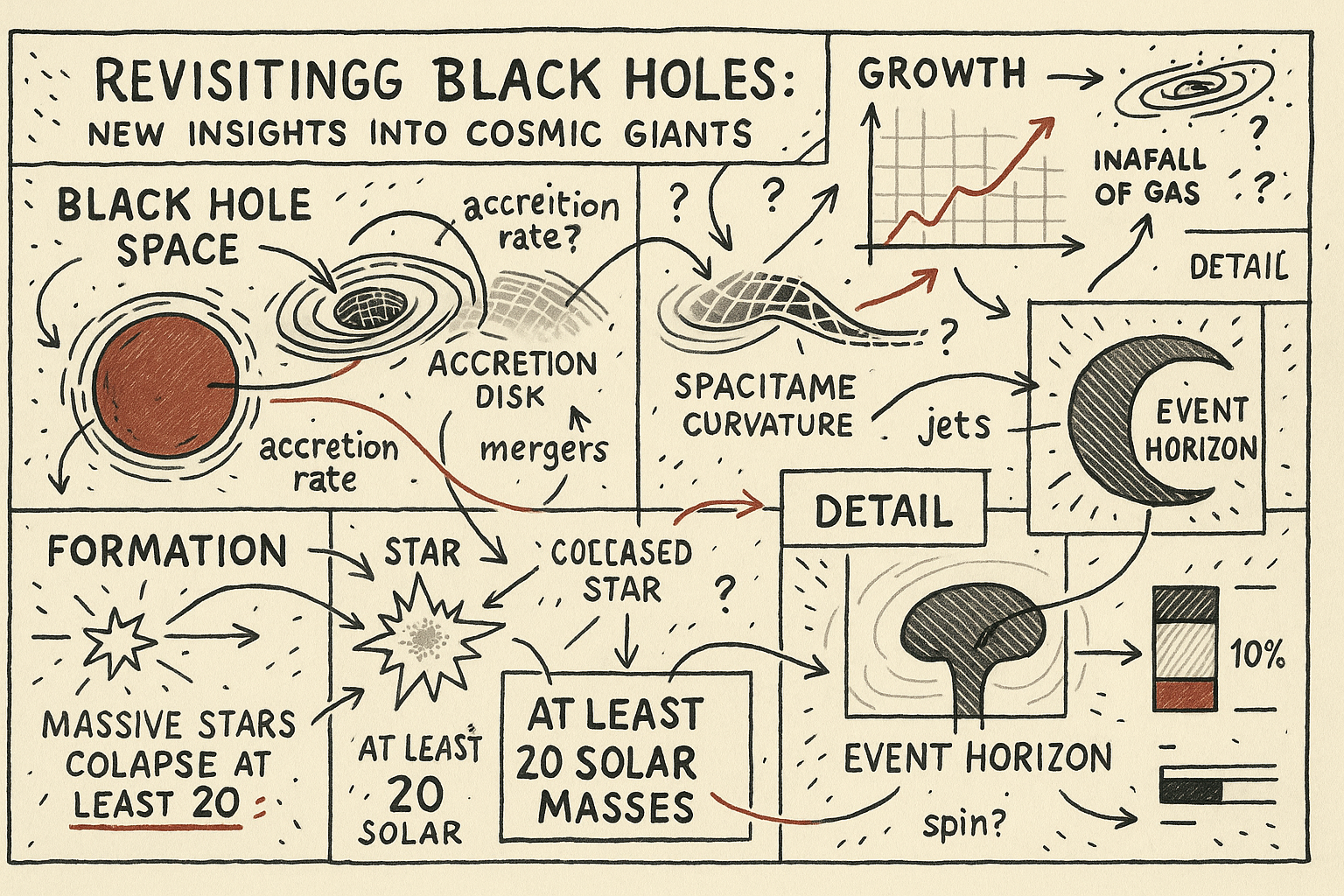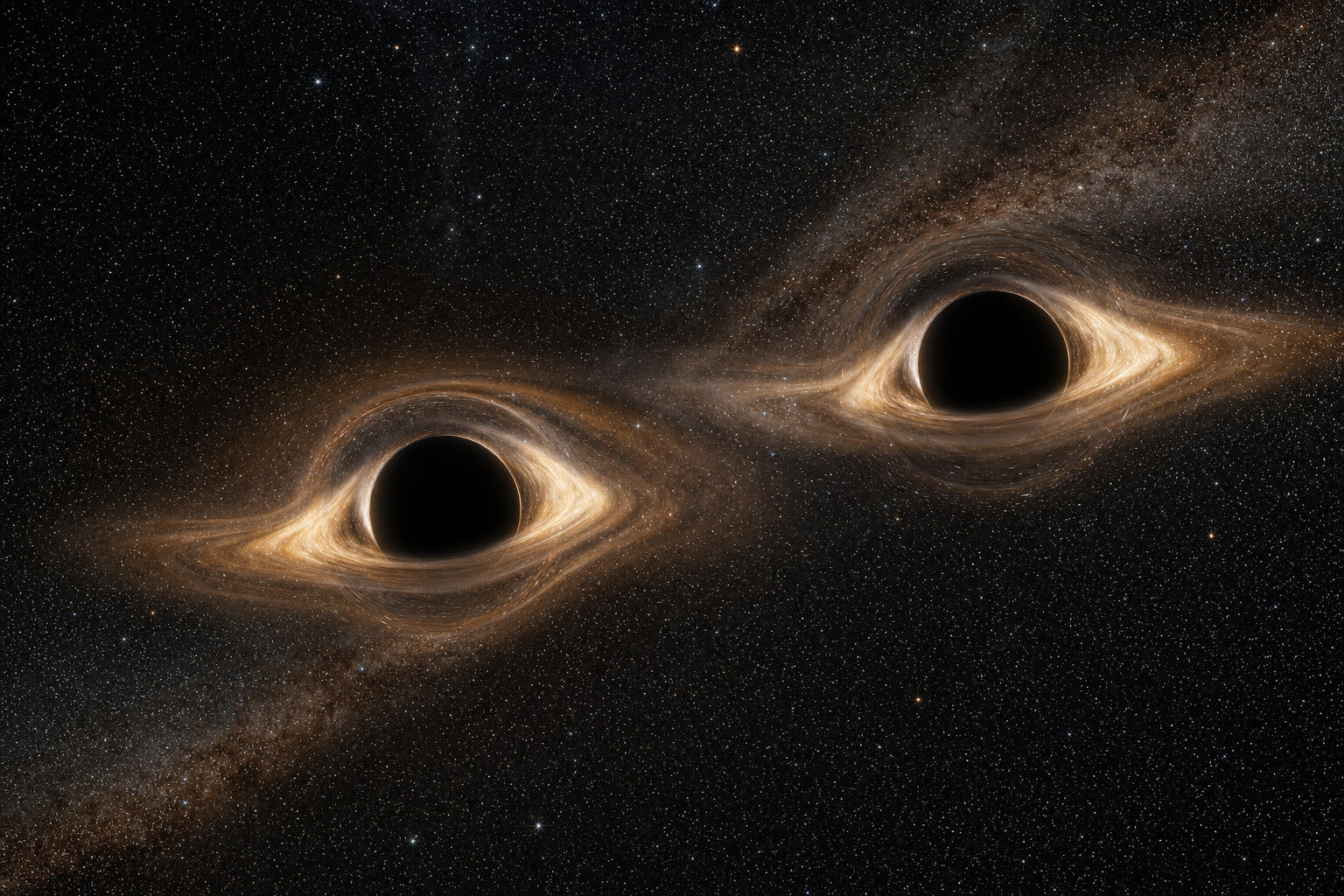
In the vast expanse of the universe, black holes are some of the most enigmatic entities, capable of consuming everything that crosses their path. Recent studies have shed light on the nature of black hole collisions, suggesting that these massive entities may not only merge repeatedly but also follow certain thermodynamic principles.
The Tale of Repeating Mergers
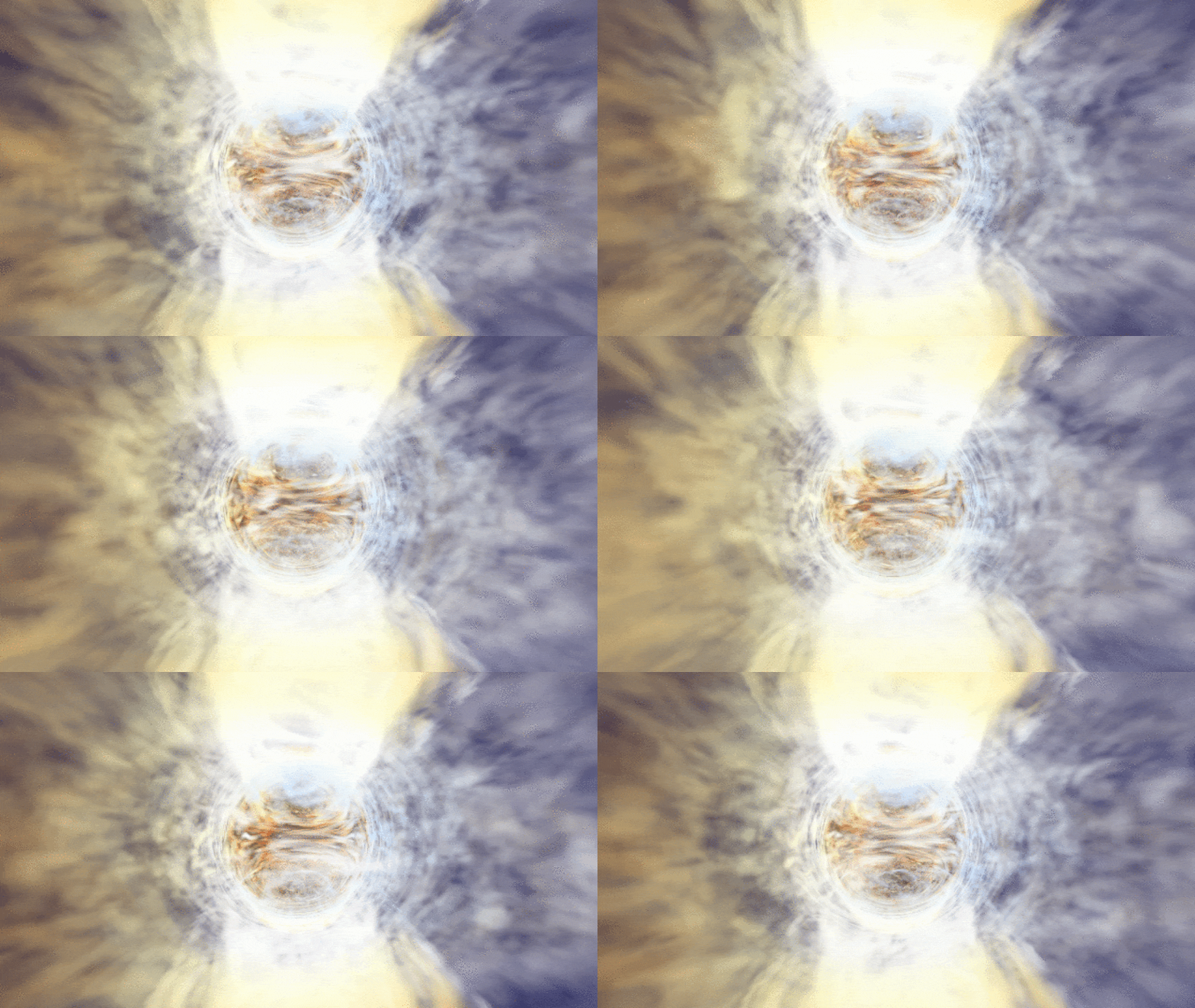
Black hole mergers, among the universe's most energetic phenomena, occur when two black holes spiral inward and collide, emitting gravitational waves detectable from billions of light-years away. The study of these waves has led scientists to propose that some black hole collisions are not isolated events but part of a series of repetitive mergers. This process, known as hierarchical merging, might be more common than previously thought, especially in densely populated galactic regions.
Researchers, including Salvatore Vitale from MIT and Cailin Plunkett, have been delving into the gravitational wave signals to discern whether observed black holes are first-generation—those formed from the collapse of massive stars—or if they have merged before. According to Plunkett, there's growing evidence that a significant number of observed black holes are products of repeated mergers. "We’re finding that, for some of these merging black holes, it’s not their first rodeo," Plunkett remarked, highlighting the frequency at which these events occur across the cosmos.
Deciphering the Spin
The spin of a black hole provides critical clues about its history. A black hole formed from a supernova—a first-generation black hole—typically has little to no spin due to mass and angular momentum loss during the progenitor star's death. However, when two black holes merge, the resulting black hole is expected to have a significant spin. As Vitale points out, "They would be spinning very fast, at about 70 percent their maximum possible spin,” indicating a lineage from previous mergers.
Thermodynamics and Black Holes
In a parallel line of inquiry, a team from Penn State, led by Monica Rincon-Ramirez, has explored the possibility that black hole collisions adhere to thermodynamic principles. Their research, published in Physical Review Letters, suggests that the dynamics of black hole mergers might be simplified through thermodynamic laws. Rincon-Ramirez likens the aftermath of a black hole merger to a "ringing bell," which stabilizes over time and can be described by just two parameters: mass and spin.
The incorporation of thermodynamics into the study of black holes is a relatively recent development. Historically, black holes were thought to be beyond the scope of thermodynamics until Stephen Hawking's groundbreaking work demonstrated that they could emit radiation. This connection between thermodynamics and black holes could offer a more intuitive understanding of these cosmic giants, potentially simplifying the complex equations derived from Einstein's theory of general relativity.
Implications and Future Directions
The implications of these findings are profound for the field of astrophysics. Understanding the nature of black hole mergers, whether through the lens of hierarchical merging or thermodynamics, could unlock answers to some of the most fundamental questions about the universe. For instance, how do black holes grow and evolve over cosmic timescales? And what role do they play in the grand tapestry of the cosmos?
As gravitational wave observatories like LIGO, Virgo, and KAGRA continue to capture data, the catalog of black hole mergers will expand, providing further opportunities to test these theories. The potential to use "ringing" black holes to verify aspects of general relativity under extreme conditions is one of the many promising avenues for future research.
In conclusion, the study of black holes is entering a new era, where repeated mergers and thermodynamic principles might hold the key to understanding these mysterious entities. As scientists continue to unravel the secrets of black holes, our comprehension of the universe's most formidable forces grows ever deeper.