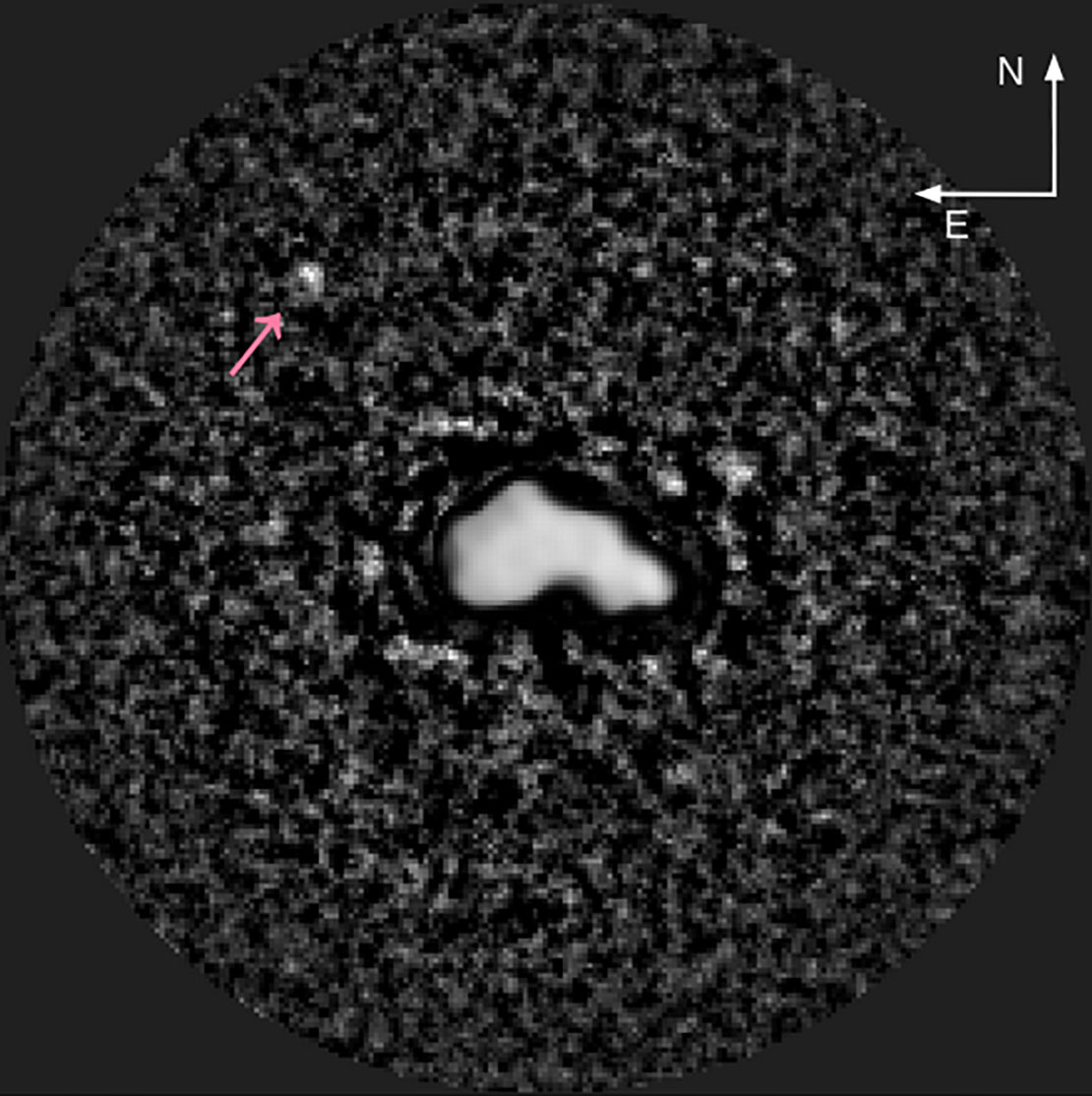
An international research team has made a groundbreaking discovery regarding asteroid (44) Nysa, one of the largest and most luminous bodies in the main asteroid belt. The asteroid, which has fascinated astronomers for over a century due to its unique brightness and enstatite-like surface composition, has been revealed to have a three-lobed structure accompanied by a small moon, known as S/2026 (44) 1. This discovery was made possible by high-resolution images obtained using some of the world's most advanced telescopes, including contributions from Italy's Istituto Nazionale di Astrofisica (INAF).
The study, which has been accepted for publication in Astronomy & Astrophysics, utilized advanced adaptive optics technology to capture the most detailed images of Nysa to date. Instruments such as the SHARK-VIS on the Large Binocular Telescope in Arizona and the SPHERE/ZIMPOL at the Very Large Telescope of the European Southern Observatory (ESO) in Chile played crucial roles in acquiring these images. The data revealed significant surface features, including two prominent valleys encircling the asteroid, interpreted as 'necks' connecting the separate lobes.
Kate Minker from the Lowell Observatory, the lead author of the study, stated, "The images reveal an extraordinarily unusual object." The findings suggest that Nysa could either be a contact binary system consisting of three interconnected components or an extremely irregular coherent body, unlike any previously observed asteroid. These insights were derived from a combination of adaptive optics images and in-depth photometric observations from global observatories, allowing scientists to construct a detailed three-dimensional model of Nysa.
The model strongly supports the existence of three distinct lobes linked by narrow connecting regions. This peculiar configuration sets Nysa apart from other asteroids, challenging previous assumptions that depicted Nysa as having a more elongated or potentially bilobed shape. The discovery of its small moon further adds to the complexity of Nysa's structure, providing additional data points for understanding its formation and evolutionary history.
Historically, asteroids in the main belt have been the subject of extensive study due to their potential to offer insights into the early solar system. Nysa, first discovered in 1857, has been of particular interest because of its high albedo and unique spectral characteristics. These properties suggested a complex evolutionary history that this latest research helps to unravel. The presence of its moon could indicate a history of collisional events or gravitational interactions that have shaped its current form.
Looking forward, the study of Nysa could provide a template for understanding other complex asteroid systems in the solar system. The methodologies employed, particularly the use of adaptive optics and photometric modeling, could be applied to other celestial bodies, expanding our understanding of their physical characteristics and evolution. These techniques are essential for future explorations, especially as missions aim to gather more data from asteroids, whether for scientific inquiry or resource utilization.
This discovery underscores the importance of international collaboration and technological advancement in astronomy. The ability to peer deeper into the cosmos and reveal the intricate details of such objects as Nysa is a testament to the capabilities of modern observational techniques. As technology continues to evolve, the astronomical community can anticipate further revelations from the asteroid belt and beyond, each discovery adding a piece to the puzzle of our solar system's history.