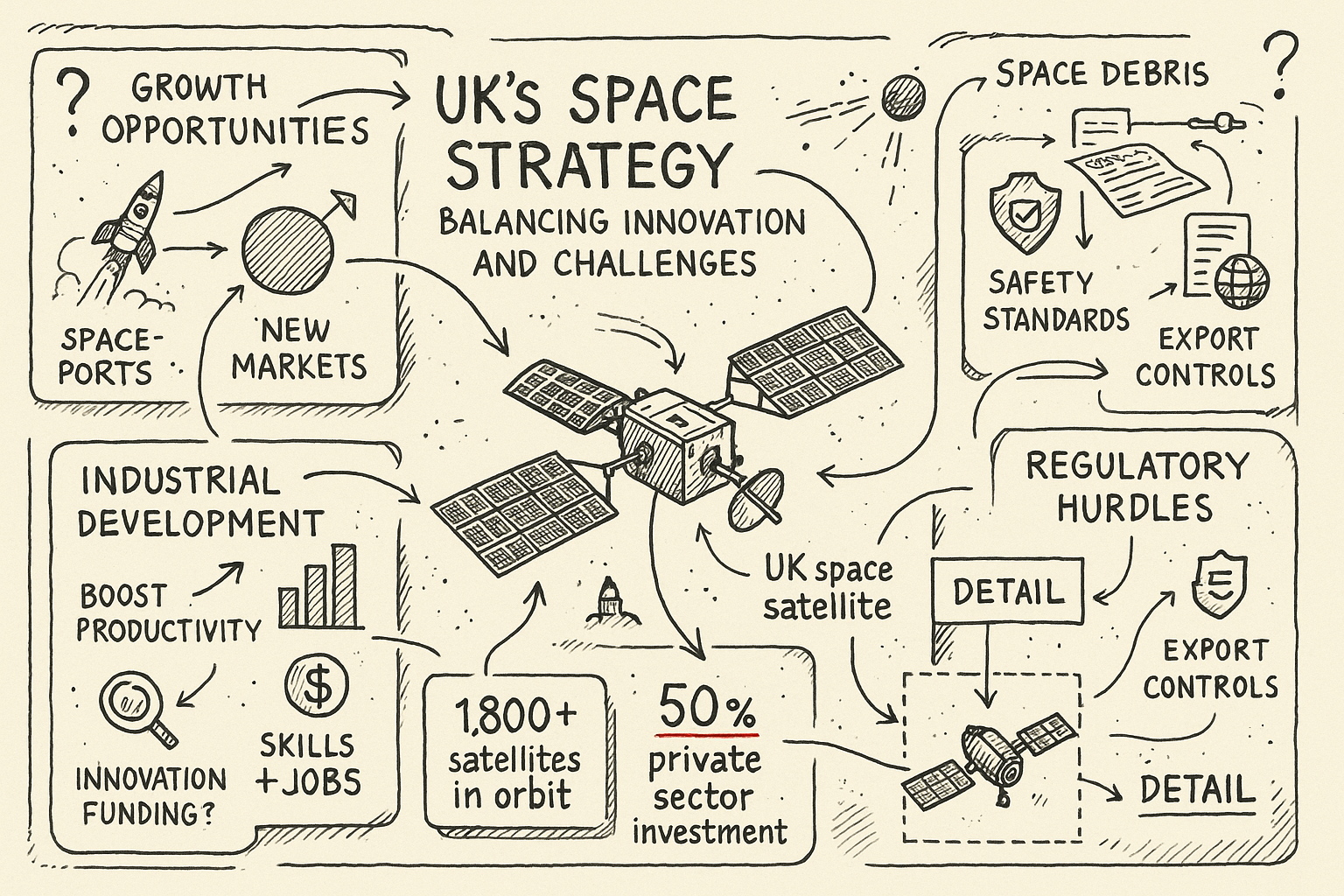
The United Kingdom's space ambitions have recently been marked by both promising initiatives and significant challenges. As the space sector rapidly evolves, the UK finds itself at a crossroads, highlighting the complexities inherent in balancing innovation with financial and strategic realities.
The Promise of VLEO and Strategic Investments
One of the most significant developments is the UK Space Agency's unveiling of a £62 million domestic funding package aimed at bolstering satellite communications and space capabilities. This initiative, announced at the Farnborough International Airshow, is a strategic move to enhance the UK's position in the global space race, particularly in the realm of Very Low Earth Orbit (VLEO) technologies.
VLEO, characterized by satellites orbiting at altitudes less than 450 kilometers, presents unique advantages such as improved data resolution and reduced latency in communications. Juniper Research projects a burgeoning investment in VLEO, potentially reaching $10 billion by 2031. This trend underscores a crucial shift towards leveraging lower orbital paths for technological superiority.
Financial Challenges and Strategic Missteps
However, the UK's path to space supremacy is not without its hurdles. A stark reminder of the financial volatility in space investments is the reported £340 million paper loss on the UK's stake in Eutelsat OneWeb. This loss highlights the unpredictable nature of satellite investments and raises questions about the sustainability of such ventures.
Compounding this issue is the missed deadline by the UK Space Agency to award a crucial £75.6 million contract for a space debris removal mission. The delayed contract represents a significant setback in addressing the growing issue of space debris, which poses a threat to both current and future space operations.
Strategic Partnerships and Future Prospects
Despite these challenges, the UK is actively forging strategic partnerships to bolster its space capabilities. The collaboration with Space Florida, as part of the £62 million funding initiative, is a testament to the UK's commitment to fostering international cooperation. Such alliances are essential in pooling resources and expertise, thereby accelerating technological advancements.
Moreover, companies like NewOrbit are urging the UK government to focus investments on VLEO capabilities, reflecting a broader industry consensus on the strategic importance of these technologies. As Eutelsat explores the development of a new 528-satellite constellation beyond OneWeb, the potential for innovation remains significant, albeit fraught with uncertainties.
Historical Context and Future Implications
The UK's space strategy is reminiscent of historical precedents where technological ambition was met with financial and logistical challenges. The current scenario echoes past efforts in the aerospace sector, where initial setbacks often paved the way for breakthroughs.
Looking ahead, the UK must navigate these complexities by refining its investment strategies and leveraging international partnerships. The emphasis on VLEO and the pursuit of cutting-edge technologies like quantum optical communications, as evidenced by SES and Airbus's EAGLE-1 project, will be pivotal in shaping the future landscape of the UK's space endeavors.
In conclusion, while the UK's journey in the space sector is marked by both triumphs and tribulations, the underlying commitment to innovation and strategic collaboration holds promise for a resilient and forward-looking space strategy.