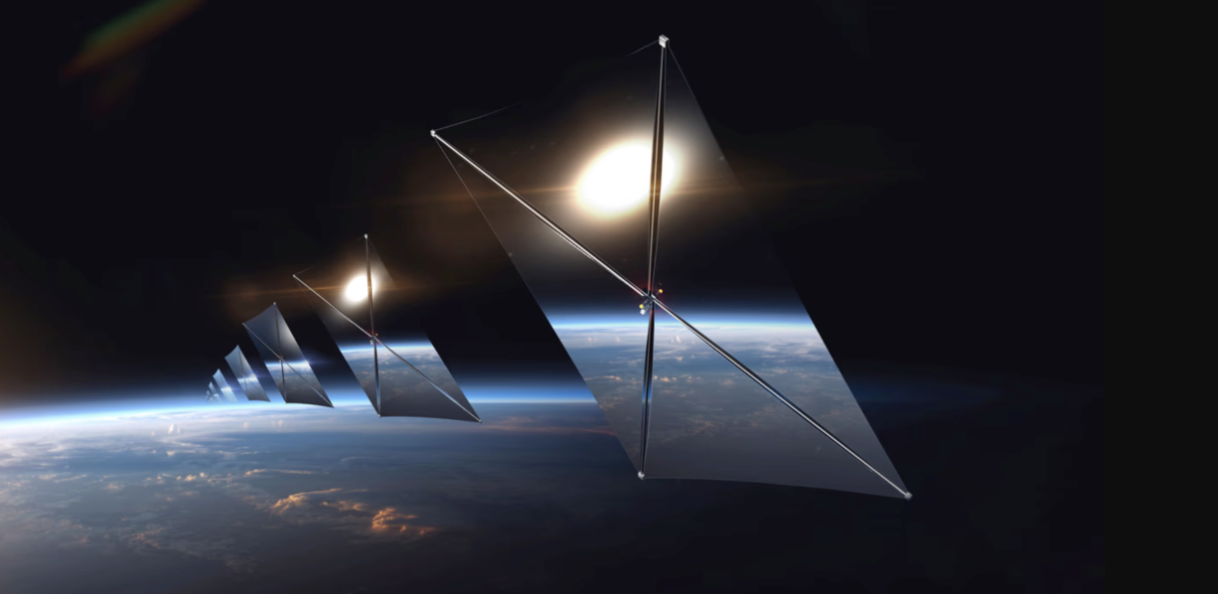
In a move that has sparked considerable debate within the astronomy community, a Californian company, Reflect Orbital, has unveiled plans to deploy a constellation of massive mirrors in orbit to beam sunlight to Earth after dark. Their pilot satellite, Eärendil-1, marks the beginning of a potentially transformative era for artificial night lighting.
Eärendil-1, currently in orbit at an altitude of roughly 600 kilometers, carries an 18 by 18 meter reflector designed to illuminate a 2.5-kilometer patch on the ground. The satellite's primary purpose, as pitched by Reflect Orbital, is to provide nighttime illumination for applications ranging from solar farms to disaster zone lighting for rescue operations.
However, the implications of this technology extend far beyond its immediate practical uses. A recent paper, soon to be published in the Astrophysical Journal Letters, provides a detailed analysis of the potential impact of these orbital mirrors on the night sky. Led by researcher Gáspár Bakos, the study models the atmospheric physics involved in how sunlight redirected by these mirrors would scatter through the Earth's atmosphere.
The findings are stark. A single 54-meter mirror, the proposed size for future satellites in the constellation, would outshine a full moon by about four magnitudes, appearing as a point of light with a magnitude of -16.7. The scattered glow from this light would significantly alter the night sky up to 34 kilometers away, making it brighter than moonlight and washing out all but the brightest stars.
If Reflect Orbital's long-term vision comes to fruition, with around 50,000 such mirrors in orbit, the impact would be even more pronounced. Operating 400 mirrors over the same area would create a glow visible from 80 kilometers away, resembling dusk shortly after sunset.
This development raises important questions about the governance of our shared sky. The Federal Communications Commission (FCC) approved Eärendil-1 in July, despite more than 1,800 public comments expressing concern. The approval highlights the need for comprehensive discussions about who gets to decide the appearance of our night sky and the potential environmental and cultural impacts of such artificial lighting.
The initiative also touches on broader themes of technological advancement versus environmental preservation. While the practical benefits of nighttime illumination for specific applications are clear, the broader implications for astronomy and biological ecosystems that rely on natural darkness cannot be overlooked.
Historically, the night sky has been a source of inspiration and discovery, guiding sailors, informing agricultural practices, and sparking the curiosity that drives scientific inquiry. The introduction of artificial satellites, and now potentially orbital mirrors, into this celestial landscape is a modern continuation of humanity's long-standing desire to harness and manipulate the environment.
As discussions continue, the case of Eärendil-1 serves as a reminder of the delicate balance between innovation and preservation. It underscores the importance of involving a broad range of stakeholders, including scientists, policymakers, and the public, in decisions that affect our shared natural heritage.
Moving forward, the challenge will be to find ways to integrate such technologies without compromising the integrity of the night sky. This will require careful planning, international cooperation, and perhaps new regulatory frameworks that consider both the potential benefits and drawbacks of space-based illumination.
Reflect Orbital's venture into orbital illumination is a bold step into uncharted territory, highlighting the need for ongoing dialogue and thoughtful consideration of its far-reaching consequences.