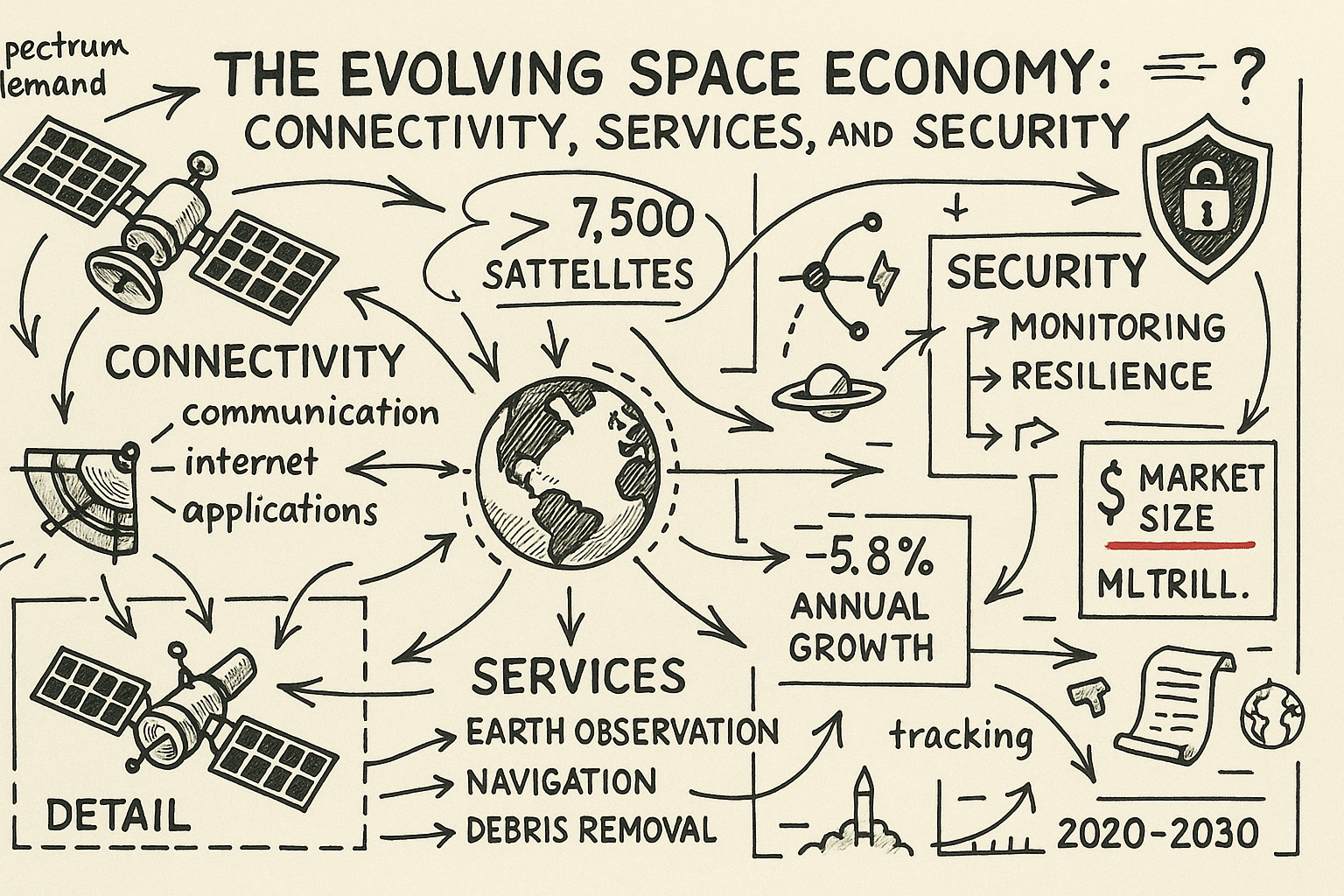
The space economy is undergoing a transformative phase, driven by advancements in satellite technology, in-orbit services, and space awareness initiatives. This evolution is not only altering how we connect and communicate across vast oceans but also redefining our approach to global security and environmental monitoring.
At the heart of this change is the expansion of maritime satellite services. According to a report by Novaspace, revenues in this sector are expected to reach $3.79 billion by 2035. This growth is primarily fueled by Next-Generation Satellite Operators (NGSO) reshaping maritime connectivity. Such advancements are crucial as ships require reliable communication channels for navigation, safety, and operational efficiency. The ability to maintain seamless connectivity in open waters can enhance trade efficiency and safety, potentially leading to unprecedented economic benefits for maritime industries.
In parallel, the in-orbit services market is projected to generate $3 billion over the next decade. This burgeoning sector includes satellite servicing, debris removal, and technology demonstrations, which are essential for maintaining and extending the life of existing satellite infrastructure. The significance of this cannot be overstated as it reduces the need for frequent launches, thereby lowering costs and minimizing space debris.
Investments in Space Awareness and Security
While connectivity and serviceability are pivotal, the emphasis on space security is equally critical. Neuraspace's recent $18 million funding round highlights the growing demand for space awareness and defense capabilities. As more nations and companies venture into space, the risk of collisions and conflicts increases. By expanding sovereign space awareness, Neuraspace aims to enhance Europe’s ability to monitor and manage space traffic, ensuring the safe and sustainable use of the space domain.
Furthermore, Xona’s spectrum approval for a 250-satellite navigation network marks a significant development in the realm of global positioning systems. This network promises to deliver stronger signals, improving accuracy and reliability. Enhanced navigation capabilities are vital not only for civilian applications but also for military operations, underscoring the strategic importance of satellite networks in modern defense.
Environmental Monitoring and Data Utilization
The role of satellites in environmental monitoring is underscored by the National Oceanic and Atmospheric Administration's (NOAA) decision to purchase data from Spire Global’s Hyperspectral Microwave Sounder (HyMS). This technology allows for detailed atmospheric observations, crucial for weather forecasting and climate studies. By investing in advanced data acquisition, NOAA is poised to enhance its predictive capabilities, providing critical insights that can inform policy and disaster response strategies.
Collectively, these developments paint a picture of a rapidly evolving space economy that is becoming increasingly integral to global infrastructure. The interplay between connectivity, serviceability, security, and environmental monitoring showcases the multi-faceted nature of this industry.
Surprising Insights and Future Implications
One of the more surprising insights from this analysis is the extent to which private investments are driving public sector capabilities. Historically, government agencies led space endeavors, but the current landscape sees private companies not only participating but also leading innovation and expansion.
As we look to the future, the implications of these advancements are vast. Enhanced connectivity and navigation can drive economic growth, while improved space awareness and environmental monitoring can safeguard our planet. The integration of these technologies into everyday life will likely redefine societal norms, much like the internet did in the late 20th century.
In conclusion, the space economy's trajectory is set on a path of rapid growth and diversification. Stakeholders across industries must adapt to these changes, leveraging new technologies to maintain a competitive edge and ensure sustainable development.