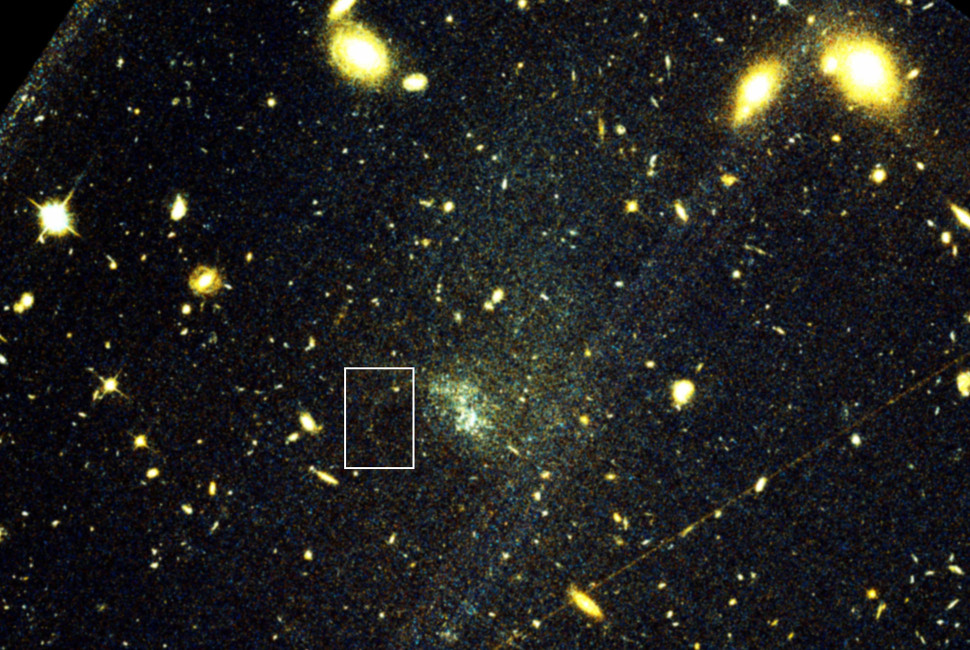
A groundbreaking study has identified a faint stream of stars in the ultra-diffuse galaxy Ugc 9050-Dw1, located 115 million light-years from Earth, and used it to estimate the galaxy's dark matter content. This is the first time such a method has been applied to a galaxy outside the Milky Way, marking a significant milestone in the field of astrophysics.
Ugc 9050-Dw1, a galaxy with a diffused appearance, recently revealed its secrets through observations made by the Hubble Space Telescope. The discovery was led by astronomers Julie Kiel Holm and Sarah Pearson from the University of Copenhagen and the Technical University of Denmark. Their findings were published in the journal Nature on August 12, 2026.
The stellar stream was first noticed by astronomer David Hendel, who detected a slight arc amidst the darkness of the galaxy using meticulously analyzed images captured by Hubble. This arc, identified as a stellar stream, is the remnant of a globular cluster that has been partially torn apart by the gravitational forces of Ugc 9050-Dw1.
In the Milky Way, numerous stellar streams have been observed, typically originating from globular clusters. However, observing such streams in other galaxies has proven challenging due to the extremely faint light they emit, which often remains undetectable by even the most sophisticated telescopes. The discovery in Ugc 9050-Dw1 thus represents a significant achievement in observational astronomy.
Stellar streams are composed of stars that follow nearly identical orbits, shaped by the gravitational pull of their host galaxy. Tjitske Starkenburg, a co-author of the study, explained, "The stars of a stellar stream nearly all travel on the same orbit, and this orbit is shaped by the galaxy's gravity." By modeling this gravitational interaction, astronomers can estimate the total mass of the galaxy. Since the visible mass, such as stars, is already known, the remainder of the mass must be attributed to dark matter.
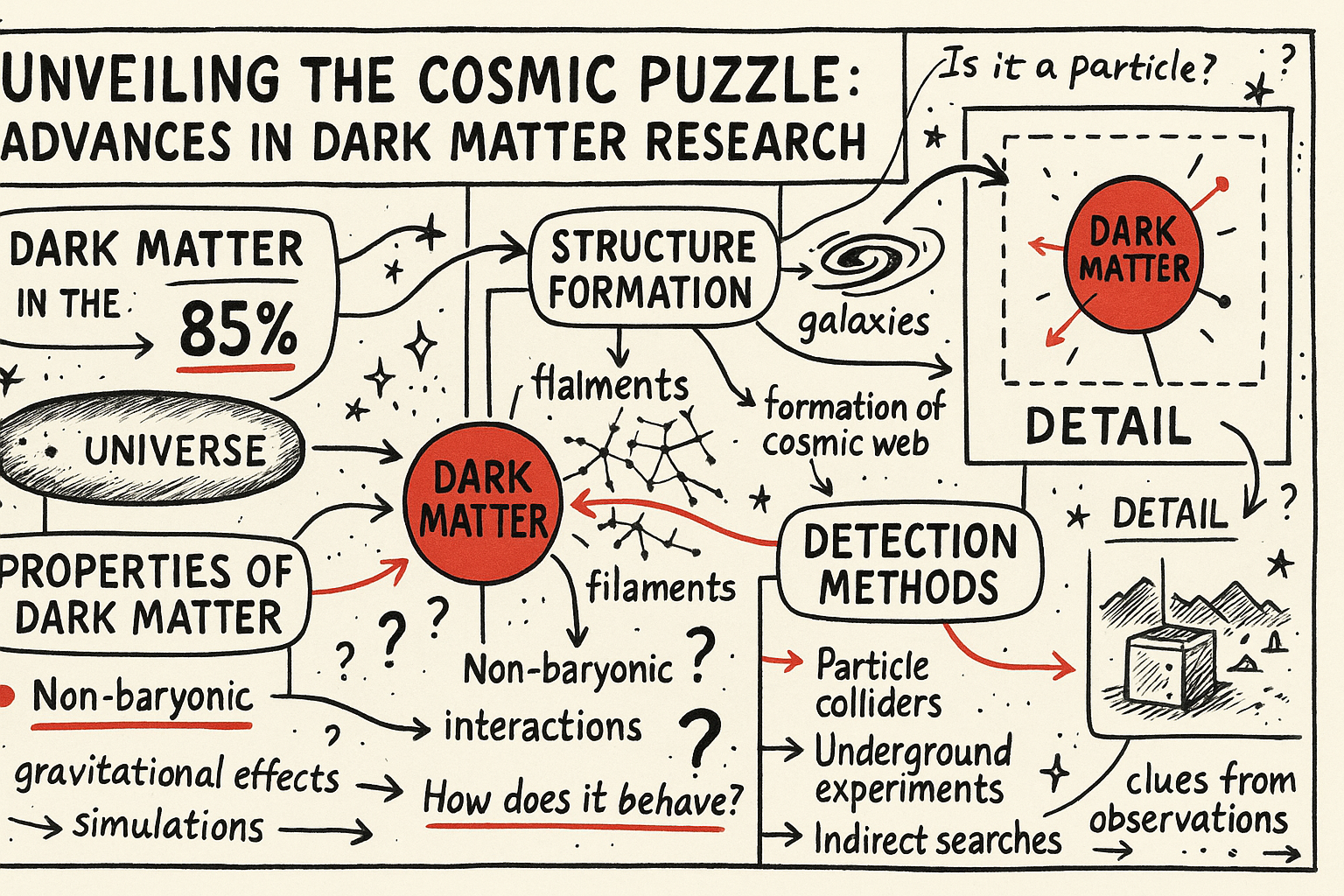
Dark matter, accounting for approximately 85% of the universe's mass, remains one of the most mysterious components of the cosmos. The new method applied to Ugc 9050-Dw1 aligns consistently with previous estimates of the galaxy's dark matter content, validating the technique's accuracy and potential for broader application.
Historically, the content of dark matter in galaxies has been estimated through a variety of indirect methods, often relying on the motion of stars and gas within galaxies. The innovative approach used by Kiel Holm and her colleagues provides a new avenue for understanding dark matter, offering a more direct measurement through the dynamics of stellar streams.
As researchers continue to refine these methods, the potential for uncovering the nature of dark matter increases. Future studies may expand this approach to a wider range of galaxies, potentially transforming our understanding of dark matter distribution across the universe.
The successful identification of a stellar stream in Ugc 9050-Dw1, combined with the precise estimation of its dark matter content, underscores the importance of advanced observational tools like the Hubble Space Telescope. As astronomical technology continues to advance, the prospects for new discoveries in dark matter research are promising.
In conclusion, the identification of a stellar stream in Ugc 9050-Dw1 represents a significant step forward in the study of dark matter. By leveraging this methodology, astronomers can gain deeper insights into the elusive components of the universe, potentially unlocking the mysteries of dark matter in galaxies beyond our own.