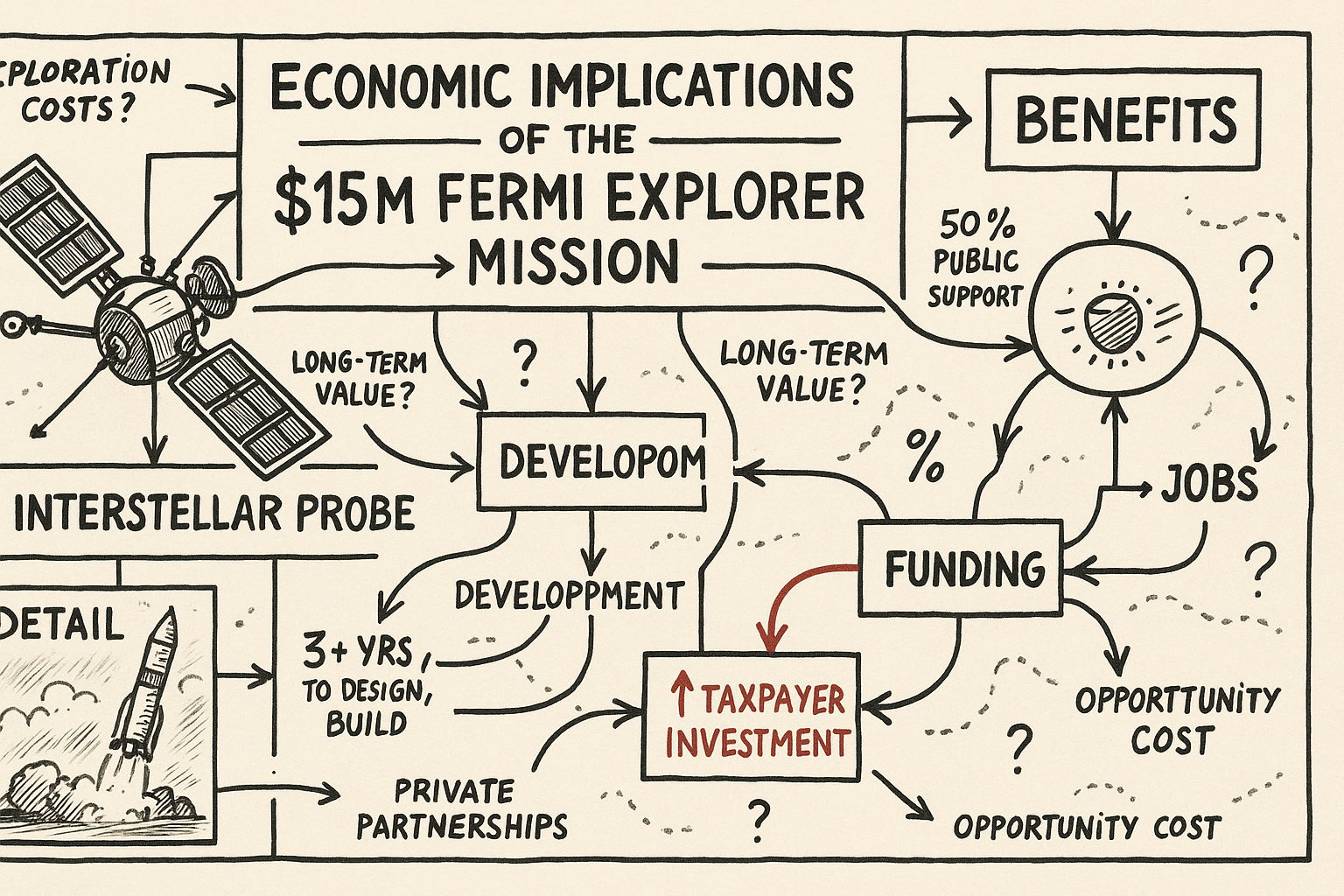
In the realm of space exploration, the notion of sending a probe to another star system has long been the domain of science fiction. However, the Fermi Explorer mission, spearheaded by the Seattle-based nonprofit Starcloud, is turning this dream into a potential reality. Announced with a budget of just $15 million, this mission aims to reach Alpha Centauri, our closest stellar neighbor, an endeavor that challenges traditional economic paradigms in space exploration.
The audacity of this mission lies not only in its interstellar ambition but also in its budgetary constraints. Historically, such missions have been the preserve of government agencies with deep pockets, like NASA and ESA. In stark contrast, Starcloud's approach reflects a growing trend of democratization in space exploration, where private entities and nonprofits seek to achieve ambitious goals at a fraction of the cost.
The Role of Economic Innovation
In recent years, the landscape of space exploration has been transformed by technological advancements and innovative economic models. The Fermi Explorer mission exemplifies this shift. By leveraging cutting-edge technologies, such as Juno Propulsion's non-toxic rotating detonation rocket engines, the mission hopes to achieve its objectives without the massive budgets traditionally required for space missions.
Moreover, the mission's financial strategy involves crowdfunding and strategic partnerships with commercial entities, a model that has proven successful in other high-risk, high-reward sectors. This approach not only reduces financial barriers but also fosters a sense of global participation in humanity's quest for the stars.
Historical Context and Future Implications
To fully appreciate the economic innovations driving the Fermi Explorer mission, it's essential to consider the historical context. The Apollo program, which sent humans to the Moon, was a monumental achievement of its time, costing approximately $25 billion in 1970s dollars. Adjusted for inflation, this figure dwarfs the Fermi Explorer's budget, highlighting a paradigm shift towards more cost-effective exploration strategies.
The implications of this shift are profound. Should the Fermi Explorer mission succeed, it could pave the way for similar low-cost missions, potentially democratizing access to space exploration. It may also inspire a new generation of innovators and entrepreneurs to pursue ambitious projects, knowing that economic barriers can be overcome with creativity and collaboration.
Surprising Insights and Challenges
One might assume that a mission with such a modest budget would face insurmountable challenges. However, the Fermi Explorer team is leveraging existing technologies in novel ways, reducing costs without sacrificing mission goals. This approach is reminiscent of the 'Silicon Valley' model, where rapid iteration and disruptive innovation lead to breakthroughs in seemingly insurmountable challenges.
Nevertheless, the mission is not without its skeptics. Critics argue that the timeline and budget are overly optimistic, and that unforeseen technical challenges could derail the project. Yet, the potential rewards are significant, not only in terms of scientific discovery but also in demonstrating the feasibility of economically sustainable interstellar exploration.
As we look to the future, the Fermi Explorer mission serves as a beacon of possibility. It challenges us to rethink our assumptions about what is possible in space exploration and encourages us to explore innovative economic models that can make the seemingly impossible, possible.