As the space economy continues to evolve, a significant trend is emerging that could redefine how data is transmitted and analyzed: the adoption of optical technologies. Recent developments highlight the role of optical innovations in transforming both space-to-ground communications and Earth observation capabilities.
Revolutionizing Communications with Optical Technologies
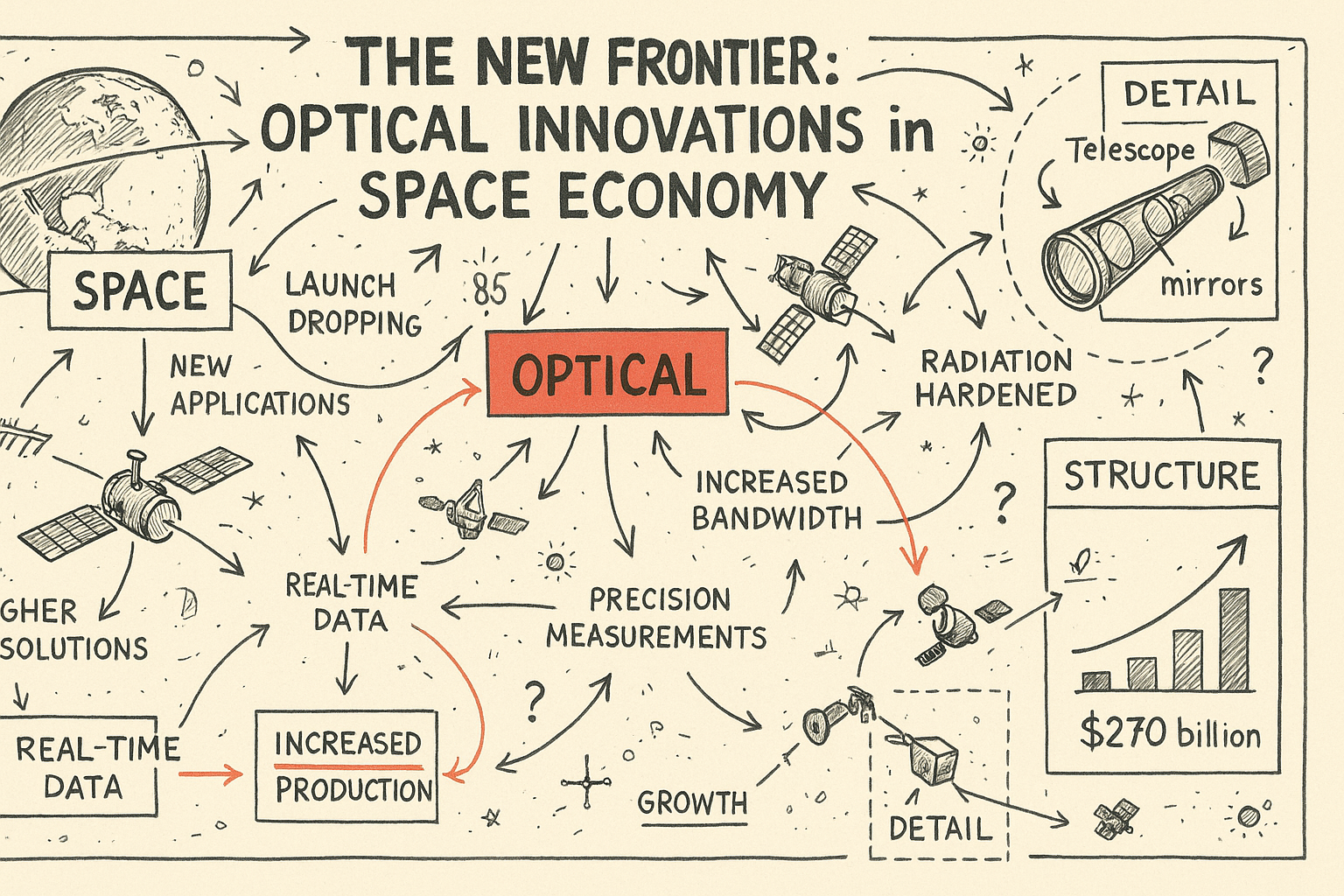
In the realm of satellite communications, Telesat is exploring a strategic collaboration with Cailabs to integrate space-to-ground optical connectivity. This move signals a shift towards more efficient and higher-capacity data transmission methods. Optical communications offer numerous advantages over traditional radio frequency (RF) systems, including higher bandwidth and reduced latency. As data demands continue to grow, these capabilities could prove essential for supporting advanced applications ranging from real-time data relay to high-definition video transmission.
Simultaneously, KSAT is advancing its Hyperion demonstration campaign for a hybrid RF/optical relay network. By combining these technologies, KSAT aims to create a robust communication infrastructure that can handle the increasing complexity and volume of space-derived data. Such innovations are crucial as the number of satellites in orbit continues to rise, necessitating more sophisticated data management solutions.
Enhancing Earth Observation Capabilities
On the Earth observation front, companies like Axelspace and Galaxia are making strides with optical payloads. Axelspace's partnership with Airbus Defence and Space to provide mid-resolution optical imagery is a strategic move to expand its market reach. This collaboration underscores the growing demand for optical data in monitoring environmental changes, urban development, and other critical areas.
Meanwhile, Galaxia's acquisition of Simera Sense's hyperspectral imager represents a leap forward in Earth observation technology. Hyperspectral imaging allows for the capture of data across a wide spectrum of wavelengths, providing detailed information about the Earth's surface. This capability is increasingly valuable for applications in agriculture, forestry, and mineral exploration, where precise data can lead to more informed decision-making.
Industrial Scale Production and Future Prospects
The French space agency CNES's search for partners to mass-produce compact optical telescopes further highlights the growing importance of optical technologies. By aiming for production volumes exceeding 1,000 units, CNES is looking to meet the burgeoning demand for optical instruments in satellite constellations. This initiative reflects a broader industry trend towards scalability and cost-efficiency, which are critical for sustaining growth in the competitive space market.
Looking ahead, the integration of optical technologies into the space economy could yield several surprising outcomes. For instance, the enhanced capabilities of optical systems may lead to the development of new commercial services, such as more accurate weather forecasting and improved disaster response. Additionally, as optical technologies mature, they could facilitate more ambitious space exploration missions, enabling more detailed study of celestial bodies and phenomena.
Conclusion
The convergence of optical technologies with satellite communications and Earth observation represents a pivotal moment for the space economy. These innovations not only promise to enhance existing capabilities but also open up new avenues for exploration and commercial opportunities. As the industry continues to evolve, staying at the forefront of optical technology will be key to unlocking the full potential of space-derived data.