INAF observes exceptionally fast jets from the stellar-mass black hole 4U 1543-47
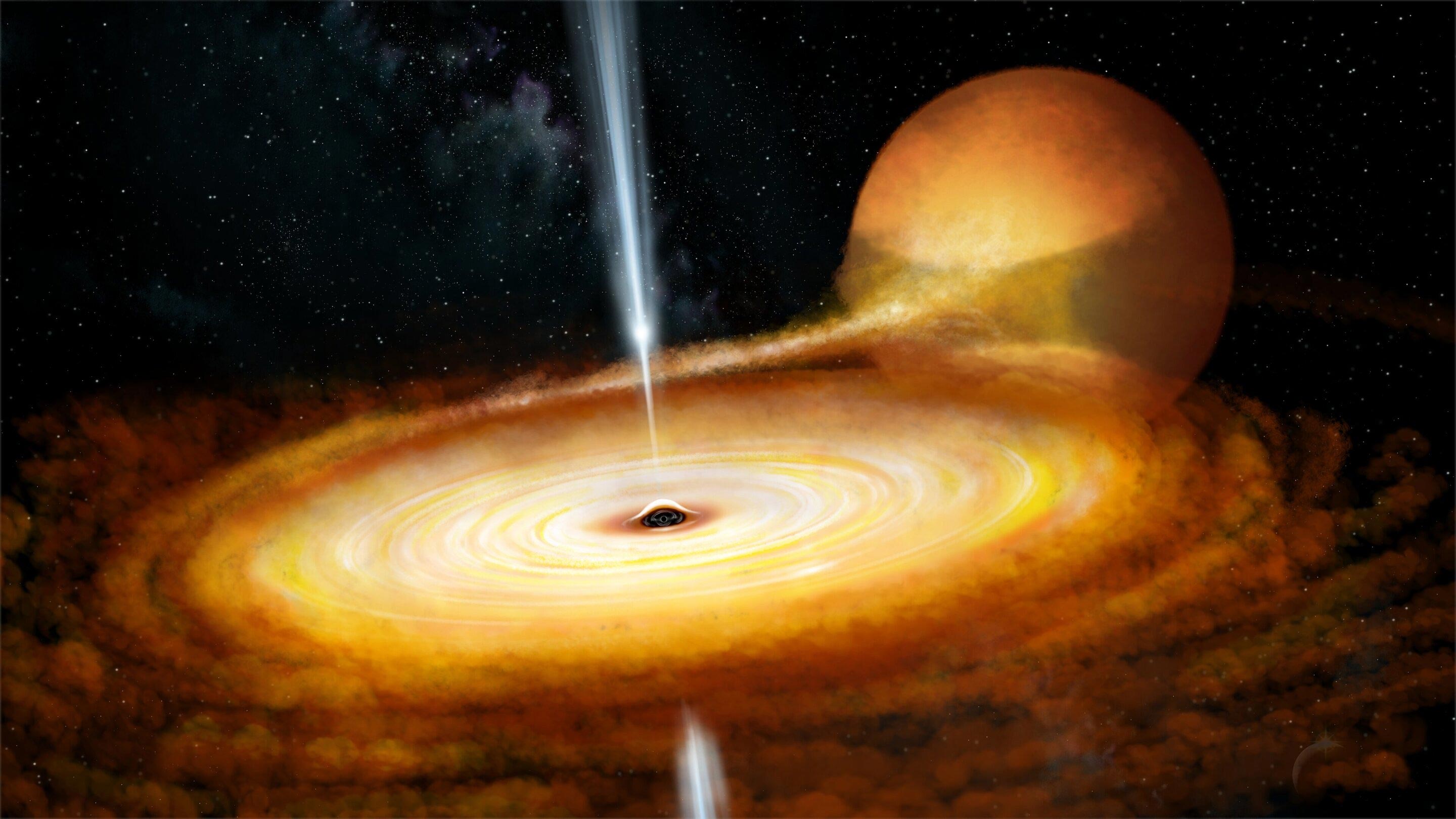
INAF researchers monitored the X‑ray binary 4U 1543-47 during a period of intense activity between 2021 and 2023 and identified two plasma jets whose apparent motion covered more than three light‑years in less than two years. The campaign combined X‑ray observations from several space telescopes and radio imaging from the MeerKAT radio telescope. The team reports that these jets have intrinsic speeds exceeding 97% of the speed of light and place very strict lower limits on their Lorentz factors, making them the fastest jets observed so far from a stellar‑mass accreting black hole.
The system 4U 1543-47 is a Galactic X‑ray binary that hosts a black hole with a mass of about ten times the mass of the Sun. For roughly thirty years astronomers had assumed that jets from stellar‑mass black holes in binaries were only “moderately” relativistic—moving at a fraction of light speed rather than the extreme speeds seen in active galactic nuclei (AGN). The new study, published in Nature Communications and summarized by Media INAF on 10 September 2026, shows that this assumption needs revision: the jets launched by 4U 1543-47 reached speeds previously observed mainly in AGN, tidal disruption events and gamma‑ray bursts.
By tracking the jets’ apparent motion and combining that with a measured distance and proper motion, the researchers constrained the jets’ Lorentz factor, a dimensionless measure of relativistic effects such as time dilation and beaming. The results indicate intrinsic velocities above 97% of the speed of light, implying Lorentz factors high enough that these jets are among the most relativistic observed outside the Solar System.
Francesco Carotenuto of INAF in Rome is quoted in the Media INAF report explaining the implication: the discovery demonstrates that accreting stellar‑mass black holes can launch jets with speeds close to those produced by supermassive black holes in AGN. According to the study, this provides new input to understand the engine that accelerates and launches relativistic jets across large mass scales, and to investigate whether the coupling between accretion disc and jet follows the same physical principles from stellar to supermassive black holes.
One key advantage of Galactic X‑ray binaries such as 4U 1543-47 is that they evolve on human timescales. The outburst and jet activity can be followed over months to years, allowing observers to study an entire cycle of state changes and jet launching that would take far longer for AGN. In the case of 4U 1543-47, the campaign lasted twenty months and used coordinated X‑ray and radio facilities to capture both the inner accretion behaviour and the extended radio jets.
The jets’ apparent speeds—described in the report as the largest observed for objects outside the Solar System—result from a combination of very high intrinsic velocity and favourable viewing geometry. When a jet moves toward us at relativistic speed, projection and light‑travel time effects can make its apparent motion across the sky exceed naïve expectations. By using distance and proper motion measurements, the team were able to convert the apparent motion into robust lower limits on intrinsic speed.
That jets from a roughly ten‑solar‑mass black hole can reach velocities traditionally associated with much larger systems raises several open questions. Are the acceleration mechanisms in stellar‑mass and supermassive black holes fundamentally the same, scaled by mass and magnetic field structure? How do accretion state transitions map onto the conditions for launching such extreme jets? The INAF team’s observations provide empirical constraints that theorists can use to test models of jet formation and particle acceleration.
Beyond advancing our understanding of jet physics, the result highlights the scientific value of coordinated multiwavelength monitoring. Combining space‑based X‑ray observatories with sensitive radio arrays like MeerKAT allowed precise tracking of jet evolution from the innermost accretion regions out to parsec scales. Continued monitoring of Galactic X‑ray binaries during outbursts will be essential to determine how common these ultra‑relativistic jets are among stellar‑mass black holes and to map the parameter space—mass, accretion rate, magnetic field—where they appear.
In summary, the INAF‑led study of 4U 1543‑47 demonstrates that stellar‑mass accreting black holes can launch jets with intrinsic speeds above 97% of light speed, challenging prior assumptions and offering a nearby laboratory to study the physics of relativistic jet production across cosmic scales.