NASA selects SpaceX Falcon 9 for StarBurst mission under VADR; launch not before 2028
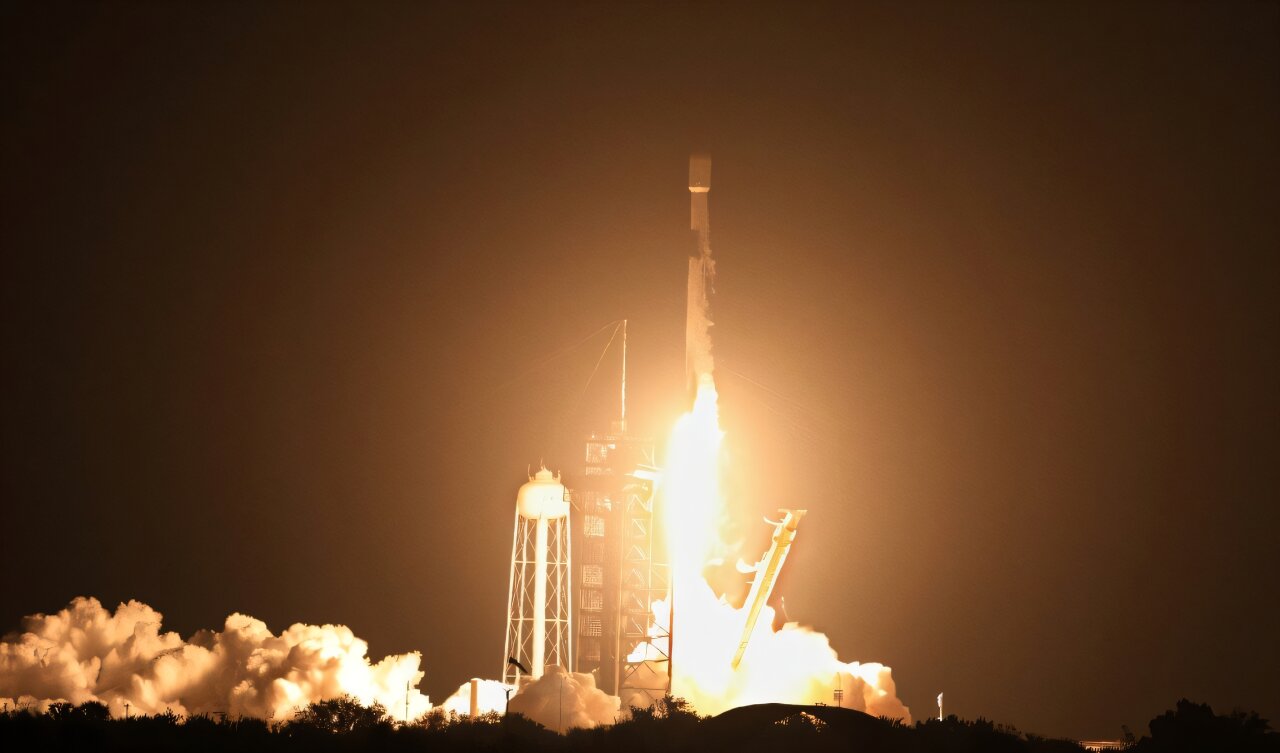
NASA has awarded SpaceX the launch service for StarBurst, a small gamma‑ray detector selected for the agency’s Astrophysics Pioneers Program. The launch was assigned through NASA’s Venture‑Class Acquisition of Dedicated and Rideshare (VADR) contract and is to fly aboard a Falcon 9 as a rideshare payload from Space Launch Complex 40 (SLC‑40) at Cape Canaveral, Florida, with a planned launch date no earlier than 2028.
StarBurst is designed as a compact observatory to detect and characterise short gamma‑ray bursts (SGRBs) — the very brief, intense flashes of high‑energy photons that are one of the signatures of neutron‑star mergers. Both the NASA news release and coverage in AstroSpace note that one of the principal astrophysical origins of SGRBs is the coalescence of two neutron stars; as they spiral together they emit gravitational waves and can produce relativistic jets that, if pointed toward Earth, generate a detectable gamma‑ray flash.
The mission concept emphasises wide sky coverage and fast detection. StarBurst’s primary instrument will use 12 scintillation detectors and will have an effective area more than five times that of the Gamma‑ray Burst Monitor (GBM) on NASA’s Fermi space telescope, according to AstroSpace. This increased collecting area is intended to improve the sensitivity to the prompt emission from SGRBs and to boost the probability of catching the initial flash associated with a neutron‑star merger.
AstroSpace reports that StarBurst will be capable of observing essentially the entire unocculted sky simultaneously — that is, all the sky not blocked by the Earth — enabling near‑continuous monitoring for transient high‑energy events. The mission is a product of the Astrophysics Pioneers Program, which NASA established to support lower‑cost, smaller astrophysics investigations that can complement larger flagship observatories.
The VADR contract used for this award is NASA’s vehicle for procuring dedicated and rideshare launch services for missions that are typically smaller in size and budget. NASA’s news release confirms SpaceX as the selected vendor and describes the launch assignment within the agency’s normal procurement framework for such missions.
StarBurst’s role in multimessenger astronomy — the joint study of astrophysical events using electromagnetic radiation, gravitational waves and particle signals — is explicit in both accounts. By detecting prompt gamma‑ray emission from short bursts, StarBurst can provide rapid alerts and localisation information that ground‑ and space‑based observatories, as well as gravitational‑wave detectors, can use to pursue follow‑up observations across the electromagnetic spectrum. Both sources highlight the connection between SGRBs and neutron‑star mergers, a relationship first definitively established in 2017 with the joint gravitational‑wave and gamma‑ray detection of GW170817/GRB 170817A.
Operational details published so far are focused on the detector design and launch assignment rather than a full mission timeline or science team roster. AstroSpace’s article provides the more technical description of the instrument: 12 scintillation detectors and an effective area exceeding Fermi‑GBM by a factor of five. NASA’s announcement frames the award in the context of procurement but does not list a firm launch date beyond the statement that the launch will not occur before 2028.
Placing this award in the context of current launch activity, NovΔ mAInd's launch database records SpaceX with 143 launches tracked and a 99.3% success rate, with a first flight on 2025-01-04 and the most recent on 2026-09-17; it lists Falcon 9 Block 5 | USSF-259 as scheduled for 2026-09-17 (this mission is recorded as having flown successfully into a Polar Orbit). The StarBurst assignment is another addition to SpaceX’s portfolio of rideshare and dedicated missions under commercial contracts.
For the astrophysics community, StarBurst is an example of how smaller, focused missions can provide high‑value data for time‑domain and multimessenger science. If the instrument achieves its targeted sensitivity and sky coverage, it could increase the sample of well‑localised SGRBs and speed the cadence of coordinated observations following gravitational‑wave alerts from ground‑based detectors. Both NASA’s release and the AstroSpace report present StarBurst as complementary to larger observatories rather than a replacement, emphasising its role in rapid detection and follow-up.
Looking ahead, the assignment to SpaceX under VADR underscores NASA’s continued reliance on commercial launch providers to place small, targeted science payloads into orbit. The schedule constraint — "not before 2028" — leaves room for mission development, integration into a SpaceX Bandwagon rideshare, and coordination with ground and space‑based follow‑up resources. As the mission progresses toward an integrated payload and a firm launch date, NASA and the StarBurst team will likely publish more detailed specifications, science objectives and plans for data distribution to the broader multimessenger community.