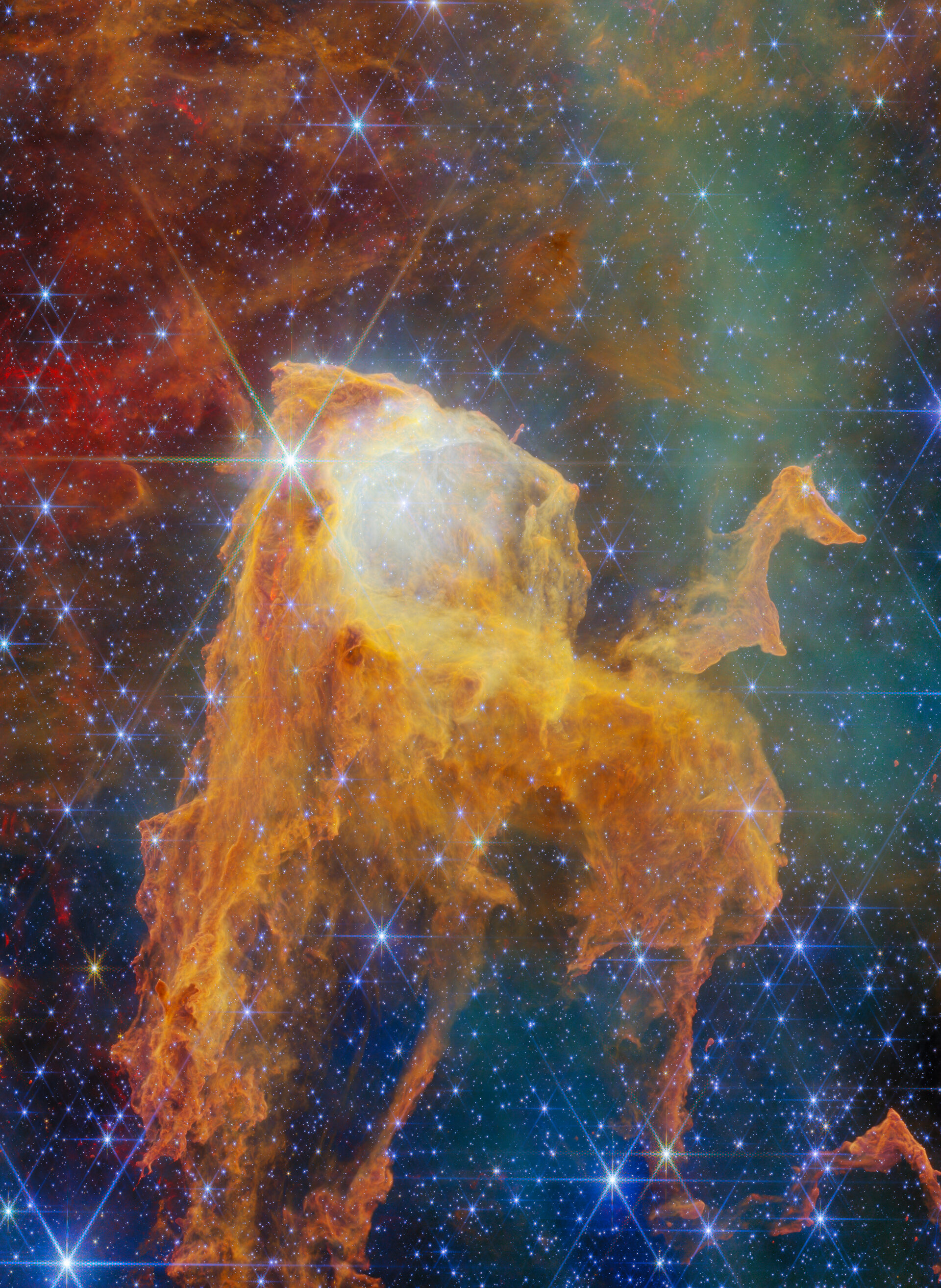
The James Webb Space Telescope (JWST) has provided new insights into the formation of star clusters within Messier 51 (M51), a galaxy located in the Canes Venatici constellation. This recent study, focusing on nearly 9,000 star clusters, was released on May 6, 2026, and highlights the capability of the JWST in studying complex cosmic structures.
M51, also known as the Whirlpool Galaxy, is a well-known spiral galaxy that serves as an exceptional laboratory for astronomers studying galaxy dynamics and star formation. The near-infrared image captured by the JWST reveals intricate details of the spiral arms of M51, which are home to numerous star clusters. These clusters are crucial to understanding the lifecycle of stars and the evolution of galaxies.
The data collected by the JWST is particularly significant for its contribution to our knowledge of massive star clusters. The study suggests that more massive star clusters tend to form in specific regions of the galaxy, providing astronomers with valuable clues about the conditions that lead to their formation. Such insights are important for constructing models of star cluster evolution and understanding the processes that govern the lifecycle of galaxies.
The JWST, operated by NASA, is equipped with advanced instruments that allow it to observe the universe in unprecedented detail. Its ability to capture near-infrared images is particularly valuable for studying regions of space that are obscured by dust and gas, making it possible to observe star-forming regions that are invisible to other telescopes.
This study of M51 is part of a broader effort by the JWST to understand the role of star clusters in galaxy evolution. By studying clusters in different environments and at various stages of their development, astronomers can gain a more comprehensive understanding of how galaxies like our own Milky Way have evolved over billions of years.
The findings from the JWST's observations of M51 not only enhance our understanding of star clusters but also demonstrate the telescope's potential to revolutionize our knowledge of the cosmos. As the JWST continues its mission, it is expected to provide even more groundbreaking discoveries that will shape our understanding of the universe.