Empa and Beyond Gravity build phononic payload adapter that redirects launch shocks
Swiss Federal Laboratories for Materials Science and Technology (Empa) and aerospace supplier Beyond Gravity have designed a prototype payload adapter that uses phononic crystals to protect satellites from intense launch vibrations, researchers reported on 24 September 2026.
The new device replaces the conventional rigid mechanical mounts that bolt a satellite to a rocket with a metamaterial structure that can control mechanical waves. Conventional payload adapters are intentionally stiff so the spacecraft does not move during ascent, but that stiffness also transmits longitudinal vibrations — the straight up-and-down shaking that can damage delicate payload elements such as mirrors or solder joints. Previous mitigation approaches used large rubber cushions or motorized dampers, which introduce weight penalties or reliability risks.
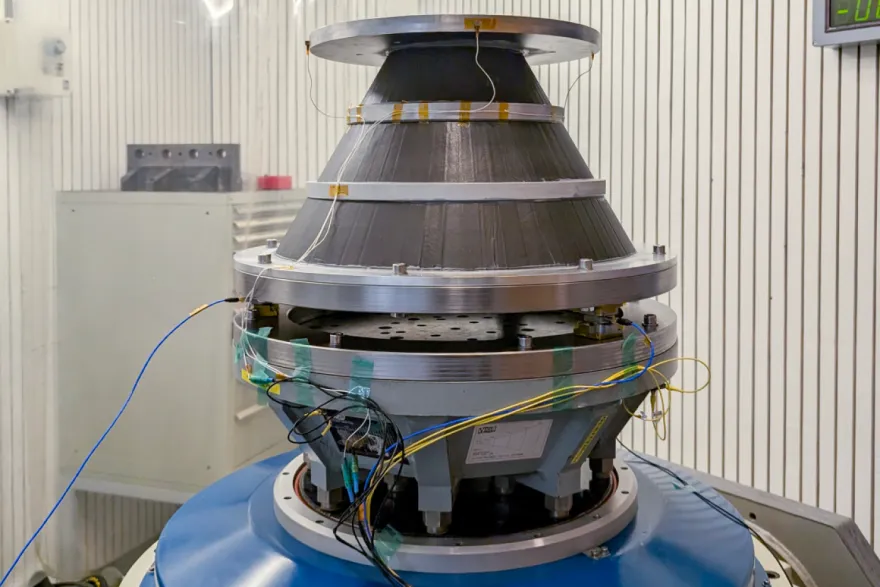
Empa and Beyond Gravity’s approach employs phononic crystals, metamaterials engineered to control, bend, or block mechanical waves in a manner analogous to how photonic crystals manipulate light. The prototype payload adapter is built to redirect sharp vertical shocks into rotational motion, moving the damaging kinetic energy away from the satellite’s internal structures and into a set of movable aluminum rings.
By converting translation into rotation, the adapter dissipates the energy of a shock so that the net stress transmitted to the satellite is reduced. The developers say the mechanism lowers the force delivered to internal systems after a shock passes through the adapter, which could relax structural reinforcement requirements on satellites. That reduction in required reinforcement has two practical implications spelled out by the team: it can free up mass and volume margins for the spacecraft, either lowering launch cost by increasing payload efficiency or enabling more useful or more delicate instruments on board.
The Empa–Beyond Gravity prototype specifically targets longitudinal vibrations, which are particularly harmful to precision hardware. The materials and mechanical concept aim to allow flight of fragile instruments that might otherwise be excluded from certain launch environments — the Universe Today report named thinner optics and sensitive quantum-computing sensors as examples of payloads that could benefit.
Phononic crystals achieve their behavior through deliberate internal structure rather than relying on bulk material damping. In this prototype, movable aluminum rings act as a mechanical sink for vertical shock energy. When a vertical shock arrives through the rocket structure and payload interface, the adapter redirects part of that energy into rotational motion of the rings; energy transferred into those rings is removed from the straight-line vibrations experienced by the attached spacecraft.
Empa is formally known as the Swiss Federal Laboratories for Materials Science and Technology; Beyond Gravity is an aerospace supplier collaborating with Empa on the design. The public description of the prototype emphasizes the metamaterial concept and the testable mechanism of energy redirection, but the report does not provide specific quantitative performance figures in terms of decibel reduction, transmitted acceleration levels, or ring rotational speeds.
Historically, launch vibration and shock have been persistent hazards for delicate payloads. Early satellites and scientific instruments required heavy structural reinforcement to survive ascent, reducing the fraction of launch mass devoted to instruments. Over time, progress in materials, structural design, and damping systems reduced some risks, but new sensitive technologies — for example, quantum sensors or extremely thin optics — place renewed pressure on launch-interface design. The Empa–Beyond Gravity phononic adapter proposes a fundamentally different tactic: change the way mechanical energy flows through the interface rather than only trying to absorb or isolate it with compliant components.
Several consequences follow if this concept proves effective in flight. Satellite designers could reduce structural mass dedicated to stiffness and shock tolerance, reallocating that mass budget to science instruments or communications hardware. Launch providers and integrators might gain an option to carry more mass-equivalent capability without increasing fairing volume. And some experiments or prototypes that today are considered too fragile for standard launches could become viable candidates for flight demonstrations.
That said, the prototype remains at the developmental stage. The report outlines the operating principle and the potential benefits, but it does not present flight test data or detailed numerical results in the public account. Translating a laboratory or ground-tested metamaterial concept into an operational payload adapter will require demonstration of reliability across the wide range of launch environments — from acoustic loads and multispectral vibration to pyro-shocks and thermal cycling — as well as validation that the rotational elements themselves do not create failure modes for the spacecraft or the launch vehicle.
Empa and Beyond Gravity’s work adds to a growing set of research directions that treat mechanical design as information flow control: by deliberately shaping how waves propagate through structures, engineers can achieve outcomes that passive bulk materials alone cannot. If the phononic payload adapter matures and is validated in real launches, it could change one of the fundamental constraints on spacecraft design: the need to trade instrument fragility for structural robustness to survive ascent.
For now, the key advance is conceptual and demonstrative: phononic crystals and metamaterials can be applied at the payload interface to redirect and dissipate vertical shock energy through controlled rotational motion in movable components, potentially lowering stress on satellites during the violent early minutes of a rocket launch.