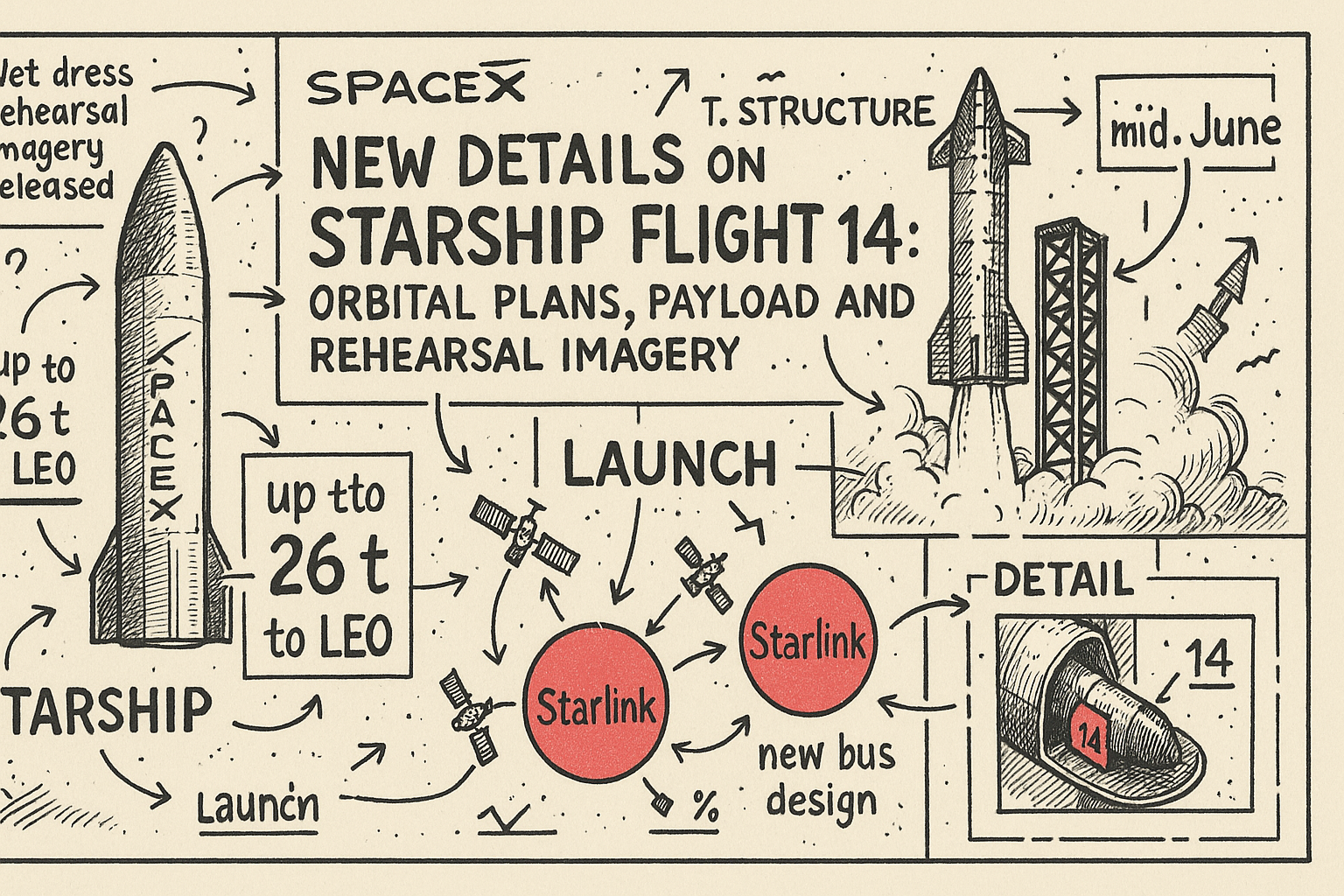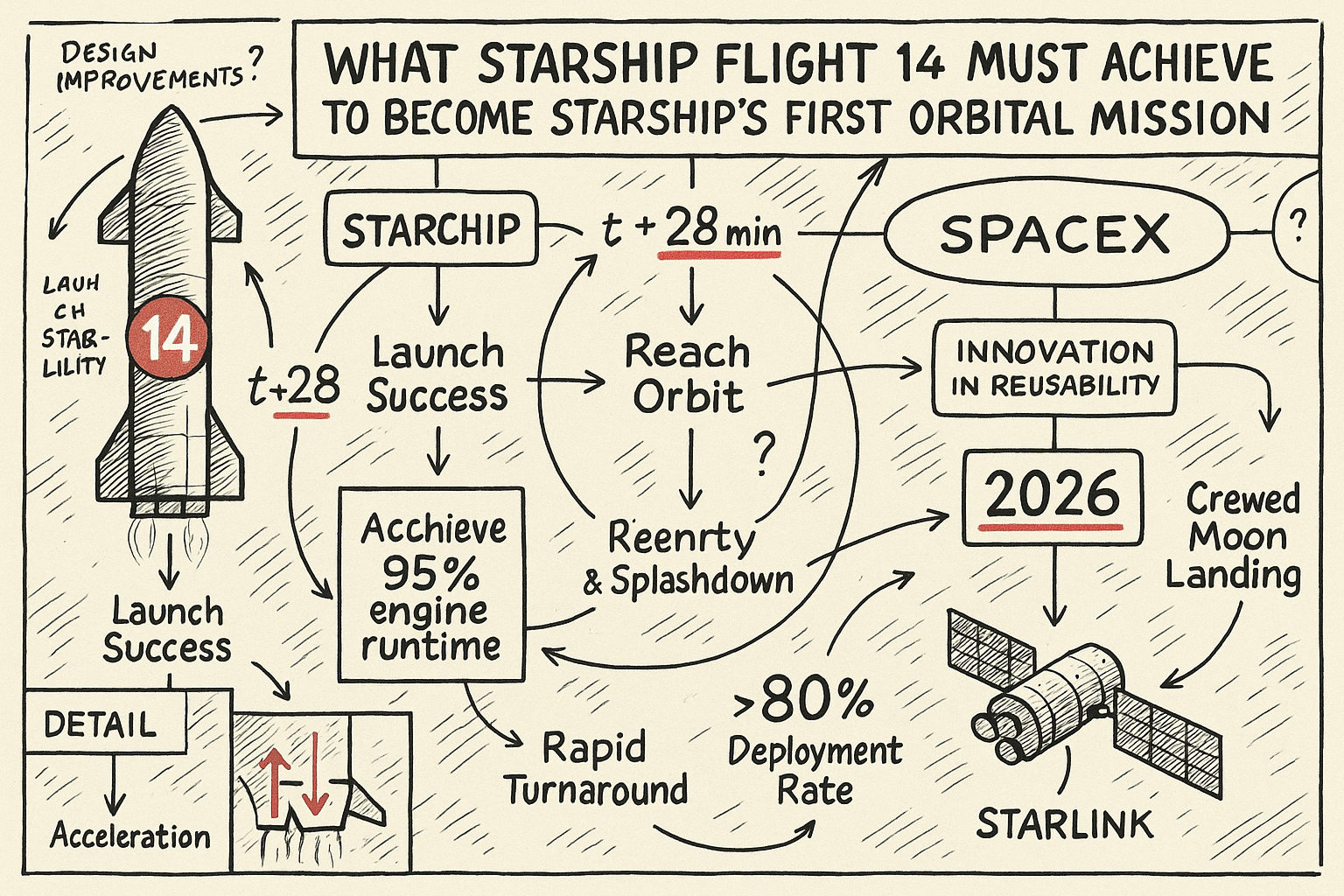
SpaceX is preparing Flight 14 of its Starship system as the first true orbital attempt in the program’s test campaign. Scheduled for Sept. 28, 2026, with a launch window centered around 14:15–15:30 UTC/CEST depending on reporting, the mission has a markedly different profile from prior test flights and carries a comparatively high operational objective: place the second stage into a roughly 275 km orbit, make about six Earth revolutions, deploy 26 Starlink V3 satellites, and splash down the vehicle off the coast of Chile after a flight approaching ten hours.
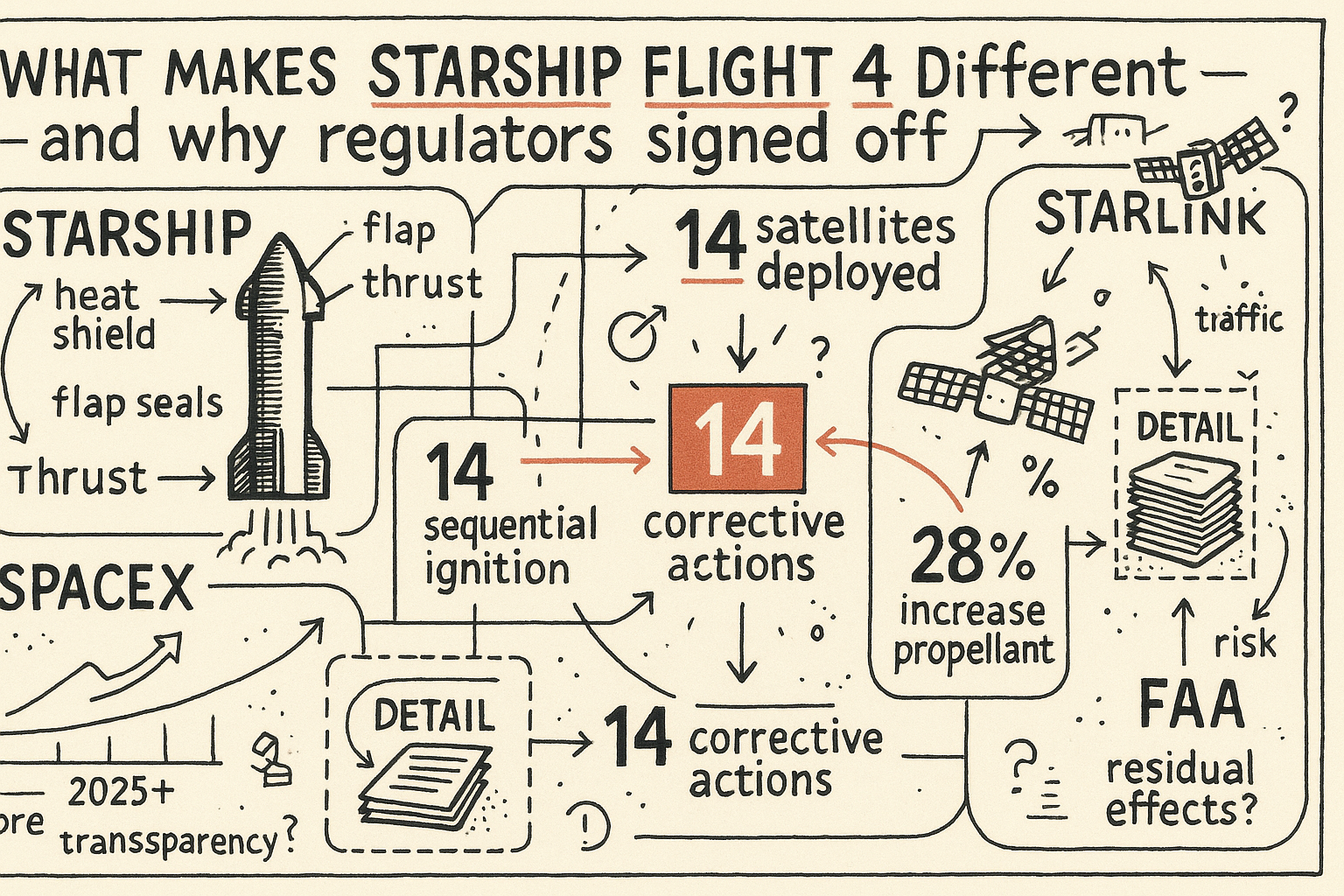
Regulatory sign-off has been a necessary precondition. The U.S. Federal Aviation Administration reviewed the revised mission profile for Flight 14 because it differs substantially from earlier flights and issued new flight permits on Sept. 26, 2026, clearing the mission to proceed. The FAA’s involvement reflects the mission’s expanded range of possible contingencies that the agency evaluated so it could respond to any issues arising from the extended orbital attempt.
Mission profile and objectives
Multiple independent outlets report the mission plan in consistent terms. The objective is to reach an approximately 275 km orbital altitude, complete about six orbits, and release 26 Starlink V3 satellites before the second stage reenters and splashes down in the Pacific. The total mission duration is reported as about 9 hours and 50 minutes (commonly rounded to roughly ten hours), with expected splashdown between 00:05 and 01:20 on Sept. 29 if the timeline proceeds as planned.
Flight 14 represents a step change from prior tests. Earlier Starship flights included dramatic first-stage recovery attempts and ended in a variety of outcomes; the program’s history has included both spectacular booster "catches" at the launch mount and previous vehicle losses. Flight 14’s aim to orbit, deploy an operational payload tranche of Starlink satellites, and perform a long-duration second-stage trajectory substantially raises the mission’s technical and regulatory stakes.
Payload and downstream operations
On-orbit deployment of 26 Starlink V3 satellites is central to Flight 14’s stated objective. SpaceX intends these to be released over the course of roughly six orbits. News outlets emphasize the operational nature of carrying active Starlink hardware on what remains officially an Integrated Flight Test (IFT-14), underlining how SpaceX is increasingly blending test objectives with commercial payloads.
The mission plan also includes recovery expectations for the Super Heavy booster. Unlike some prior flights in which the booster returned to the launch mount, reporting on Flight 14 indicates the Super Heavy is expected to splash down in the Gulf of Mexico rather than return to the launch site.
Why this flight matters
Observers frame Flight 14 as potentially transformational for Starship: succeeding in placing Starlink satellites into orbit and sustaining a multi-orbit second-stage mission would move the system from suborbital or limited orbital testing toward routine orbital operations. Outlets covering the flight note SpaceX’s long-running "fail fast, learn faster" approach and the program’s mix of high-profile recoveries and prior failures; Flight 14 is being positioned as a decisive test of whether Starship can transition into a practical orbital vehicle.
SpaceX and regulators have netted significant attention to the mission timetable. Local and international outlets note planned live coverage: Astrospace stated it would stream live from 12:00 Italian time on its YouTube channel for the Sept. 28 attempt. Space policy and space-technical sites emphasized that the FAA’s late-September permitting was a necessary step given the mission’s atypical profile.
As with all test flights in the Starship campaign, Flight 14 will be closely watched by engineers, policy makers and the satellite community. Its success criteria—orbital insertion, multi-orbit operations, deployment of 26 Starlink V3 satellites, and the planned splashdowns of both stages—are clearly articulated across multiple sources, and together define what would be a major milestone for the program.