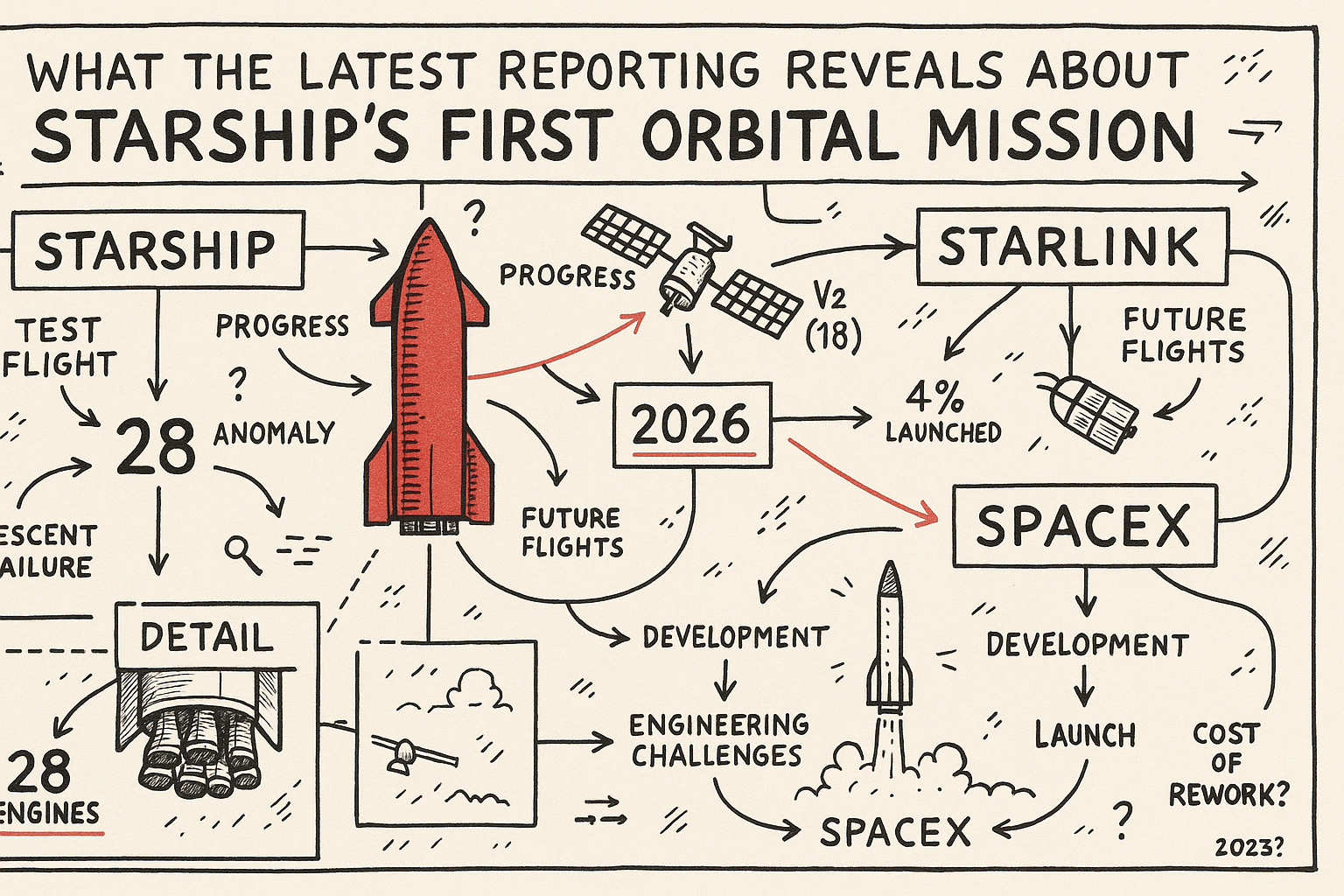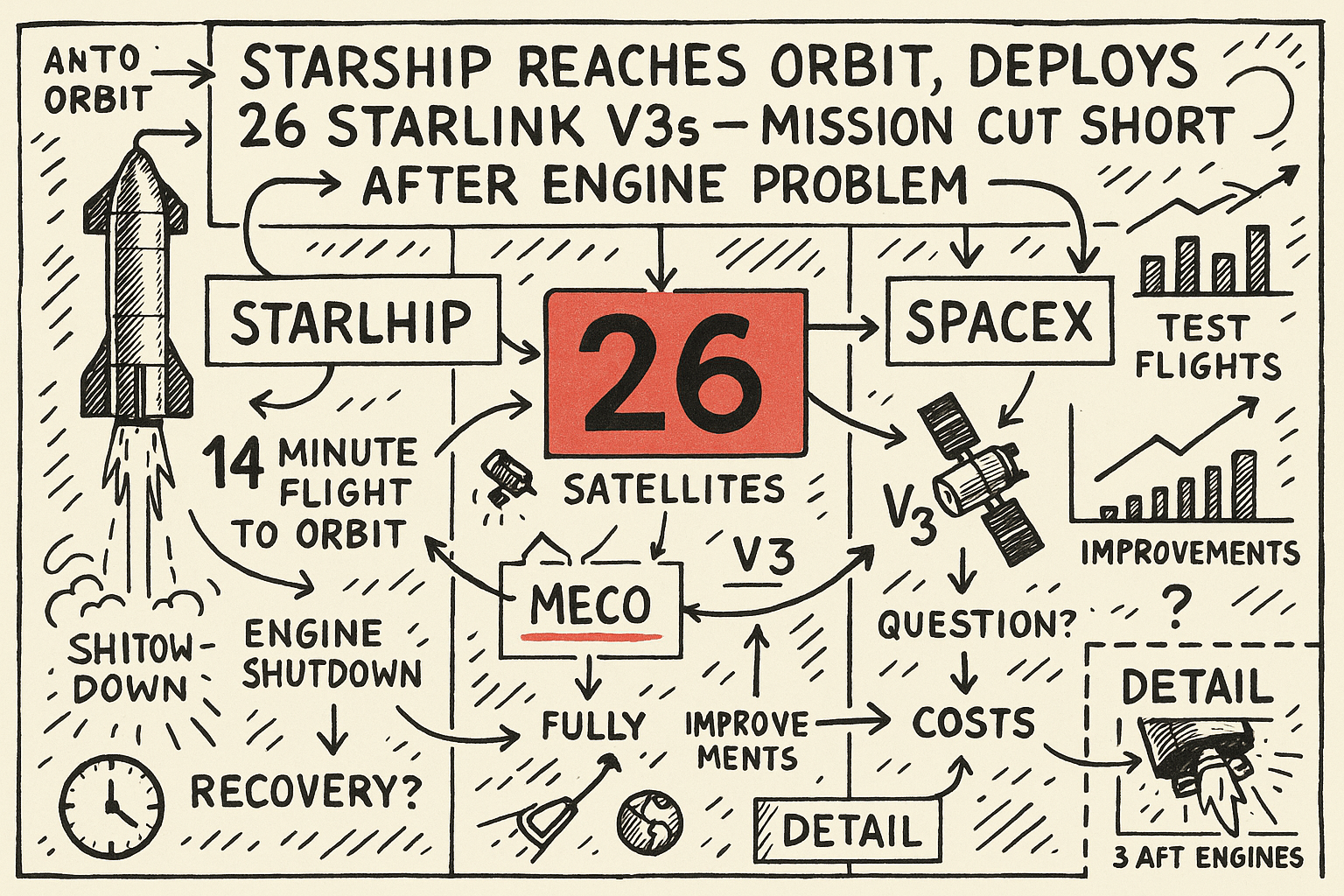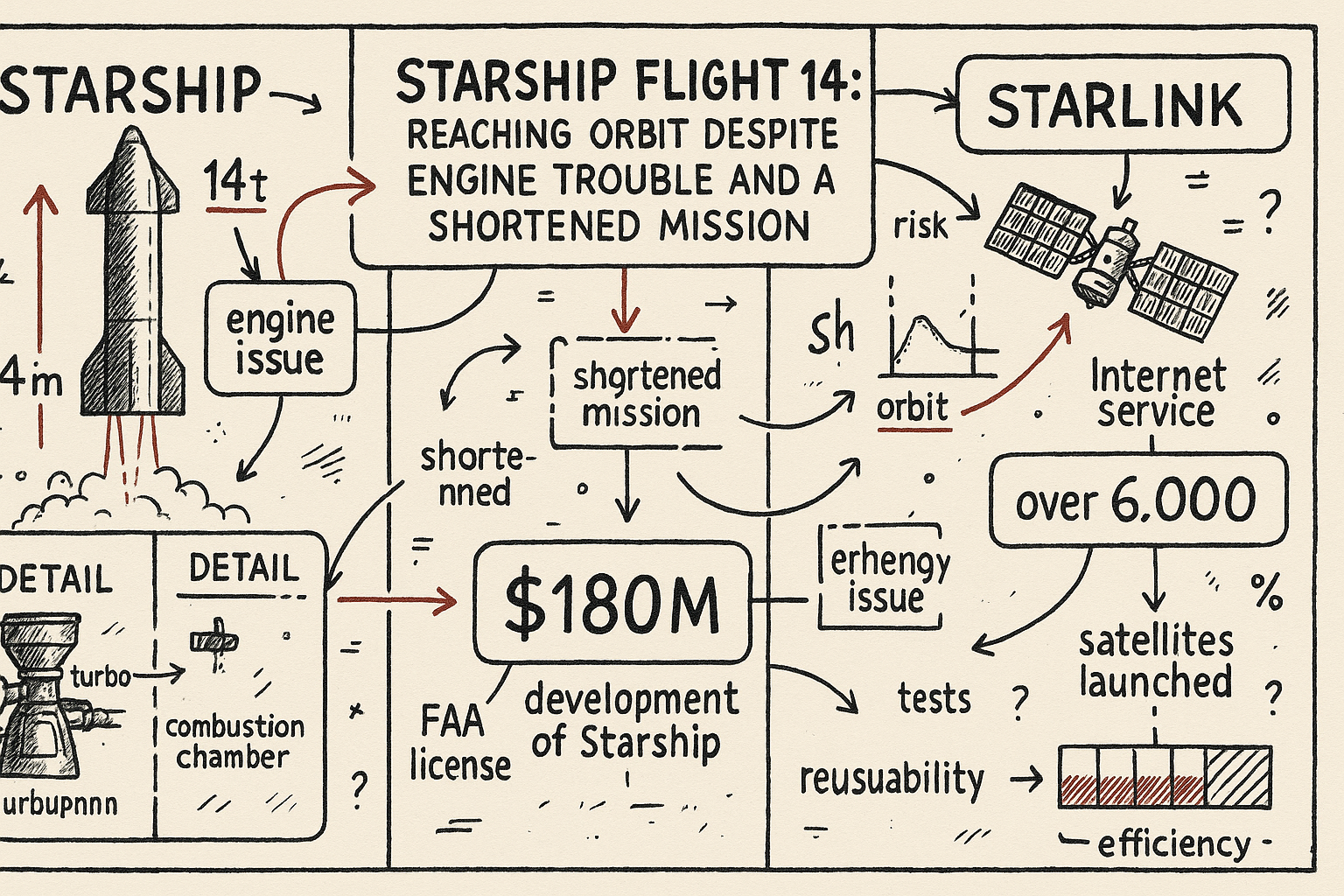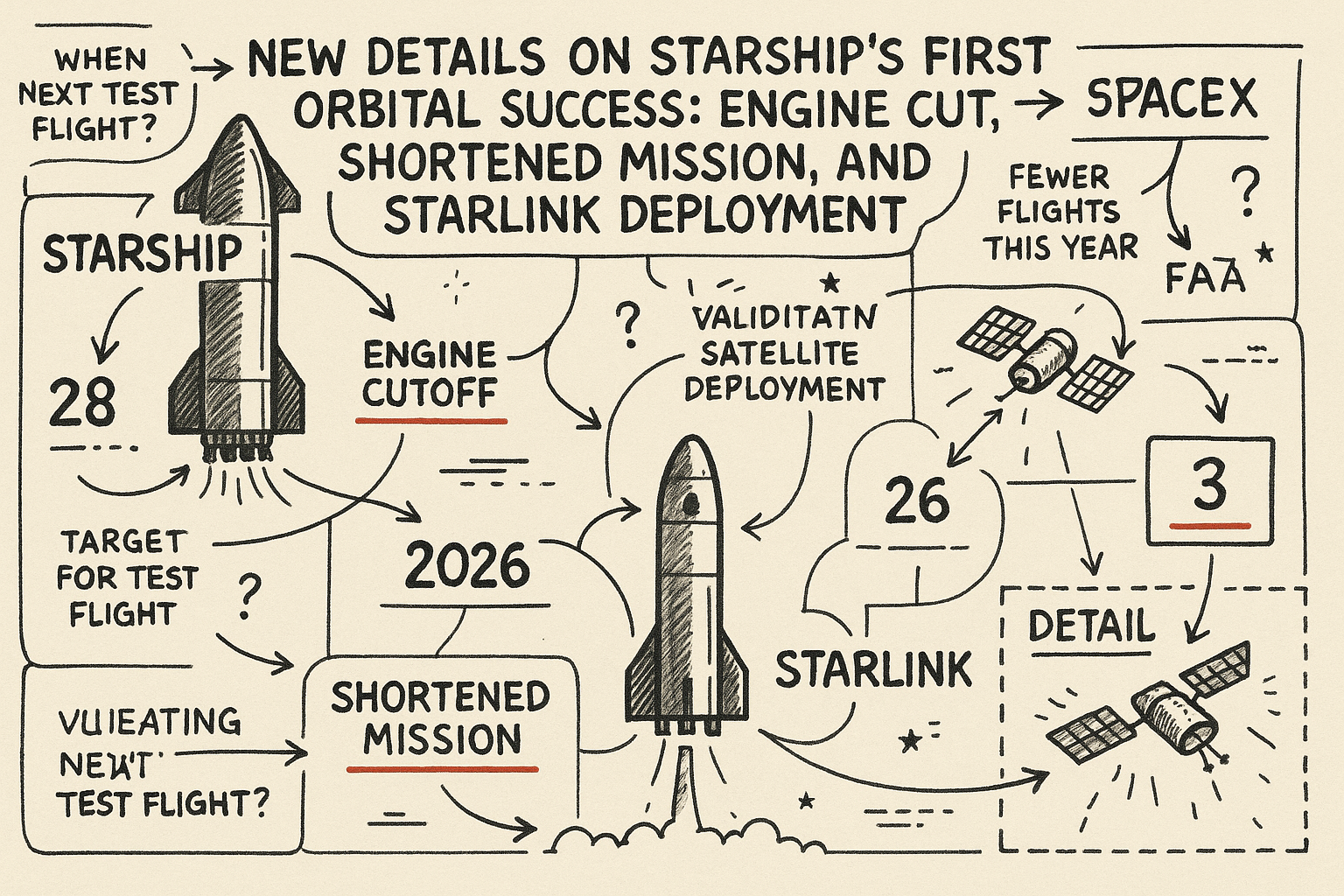
On September 28, 2026, SpaceX’s Starship achieved a milestone: the vehicle reached Earth orbit and deployed 26 Starlink V3 satellites. The flight, designated Integrated Flight Test-14 (IFT-14), marked the 14th test in the Starship program and the first time the vehicle placed payloads into orbit.
Multiple contemporary reports make clear that the mission did not follow the complete plan. SpacePolicyOnline summarized the sequence: one of the six engines on the second stage cut off early, and although SpaceX proceeded with the orbital insertion burn, the company elected to bring Starship back to Earth without completing the originally planned multi-orbit mission. The flight completed nearly two orbits before the decision to end the mission early, according to coverage from Phys.org.
What failed and what still worked
The two-stage Starship system comprises a first stage called Super Heavy (the Booster) and a second stage commonly referred to as Starship. Reports indicate the Booster experienced the loss of one engine out of its 33 shortly after liftoff; SpacePolicyOnline noted that this engine loss did not affect Booster performance for the flight. In the second stage, however, an early shutdown of one of six engines occurred during the orbital phase. That second-stage engine issue was directly tied to the decision to shorten the mission.
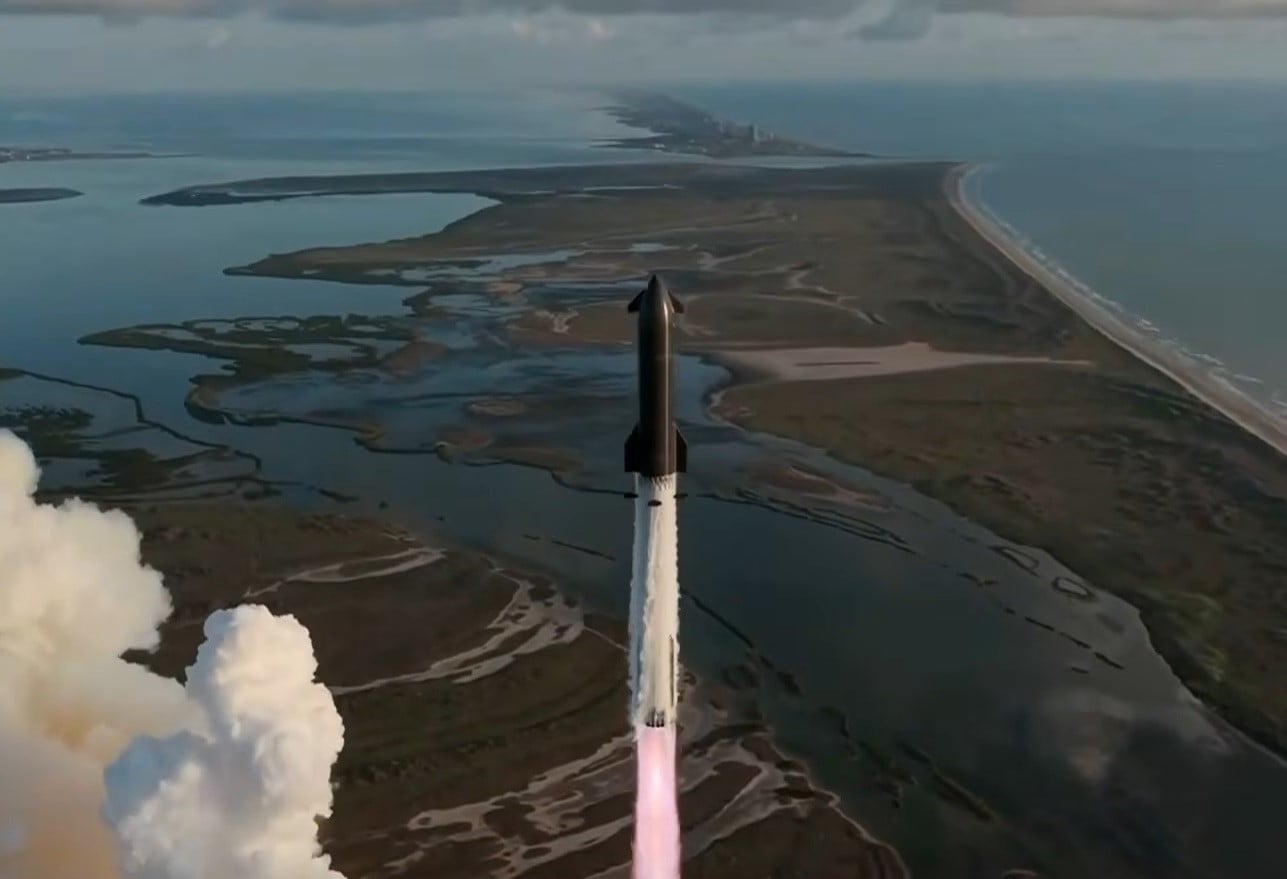
Despite the engine anomalies, the mission achieved important objectives. SpacePolicyOnline and Phys.org both report that the Starship vehicle rose from SpaceX’s Starbase complex on the Texas coast and completed nearly two orbits. The flight successfully deployed 26 operational Starlink V3 satellites — the first operational satellites of that new generation — into orbit, a first for Starship.
Flight profile and recovery
Phys.org described the vehicle as rising from the Texas launch pad at 7:50 a.m. CT (12:50 p.m. UTC) and noted the rocket’s height of 407 feet (124 meters). SpacePolicyOnline emphasized that SpaceX did not attempt to “catch” the Booster on the launch tower during this mission; the company has not tried that maneuver since IFT-8. Instead, the Booster performed a soft landing in the Gulf.
The decision to return Starship early came after the second-stage engine cut off early. SpacePolicyOnline indicates SpaceX executed the orbital insertion burn in spite of the engine anomaly, then opted to end the mission before completing all planned orbits. That conservative choice allowed deployment of the Starlink payload while avoiding an extended mission under degraded propulsion conditions.
Context in the test program
This flight was the 14th in Starship’s test program and the first to place operational payloads into orbit. Phys.org notes that the program’s previous 13 flights had been suborbital. Coverage across sources frames the orbital test as a key step for the massive vehicle as SpaceX continues development toward future missions to the Moon and Mars.
While the flight did not go exactly as planned, the combination of reaching orbit, deploying a new-generation Starlink batch, and recovering the Booster represents incremental progress in a program that aims to mature Starship’s capabilities. SpacePolicyOnline and Phys.org present the mission as both a milestone and a reminder that further work remains to demonstrate full reliability across all engines and to carry out the longer-duration mission profiles SpaceX had intended.