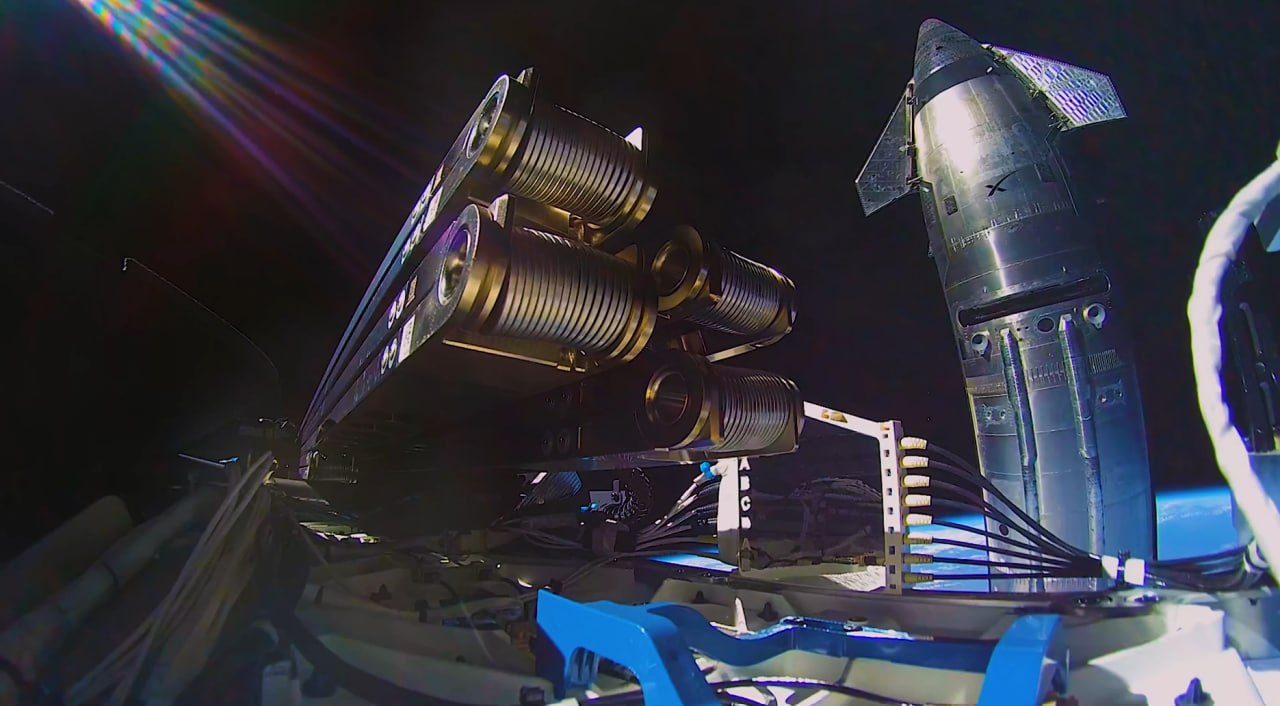
SpaceX completes Flight 14: orbital insertion and Starlink deployment despite anomalies
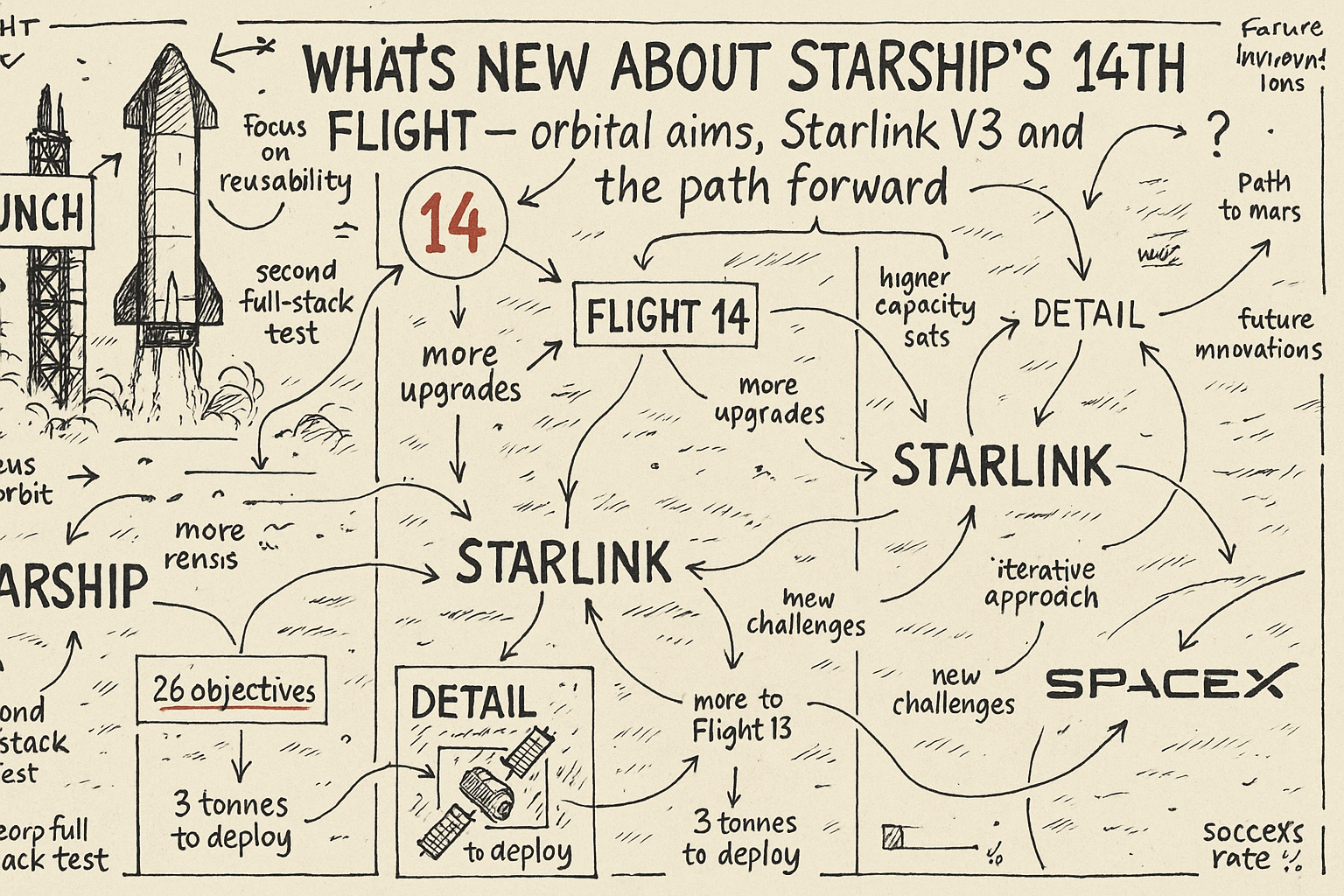
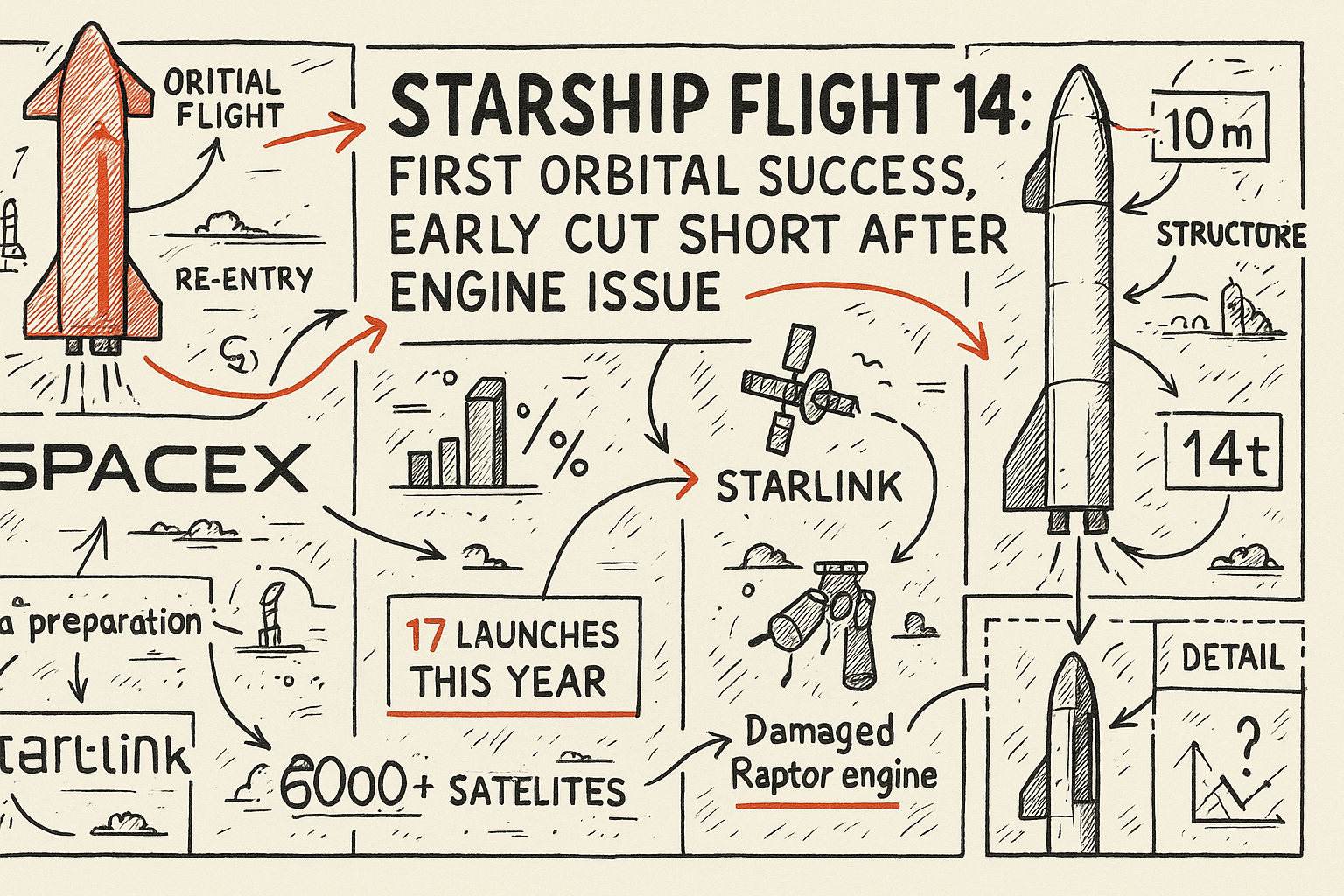
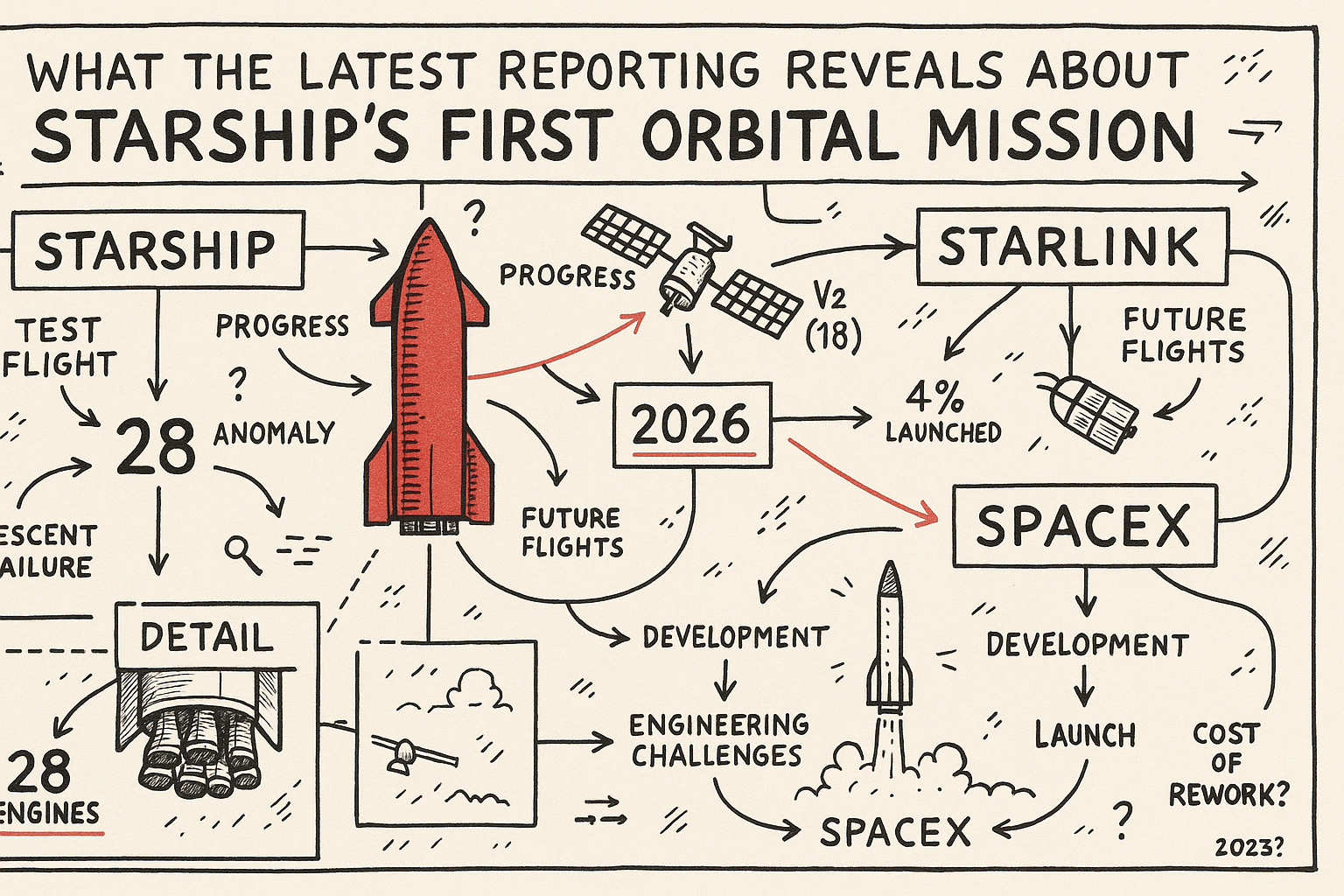
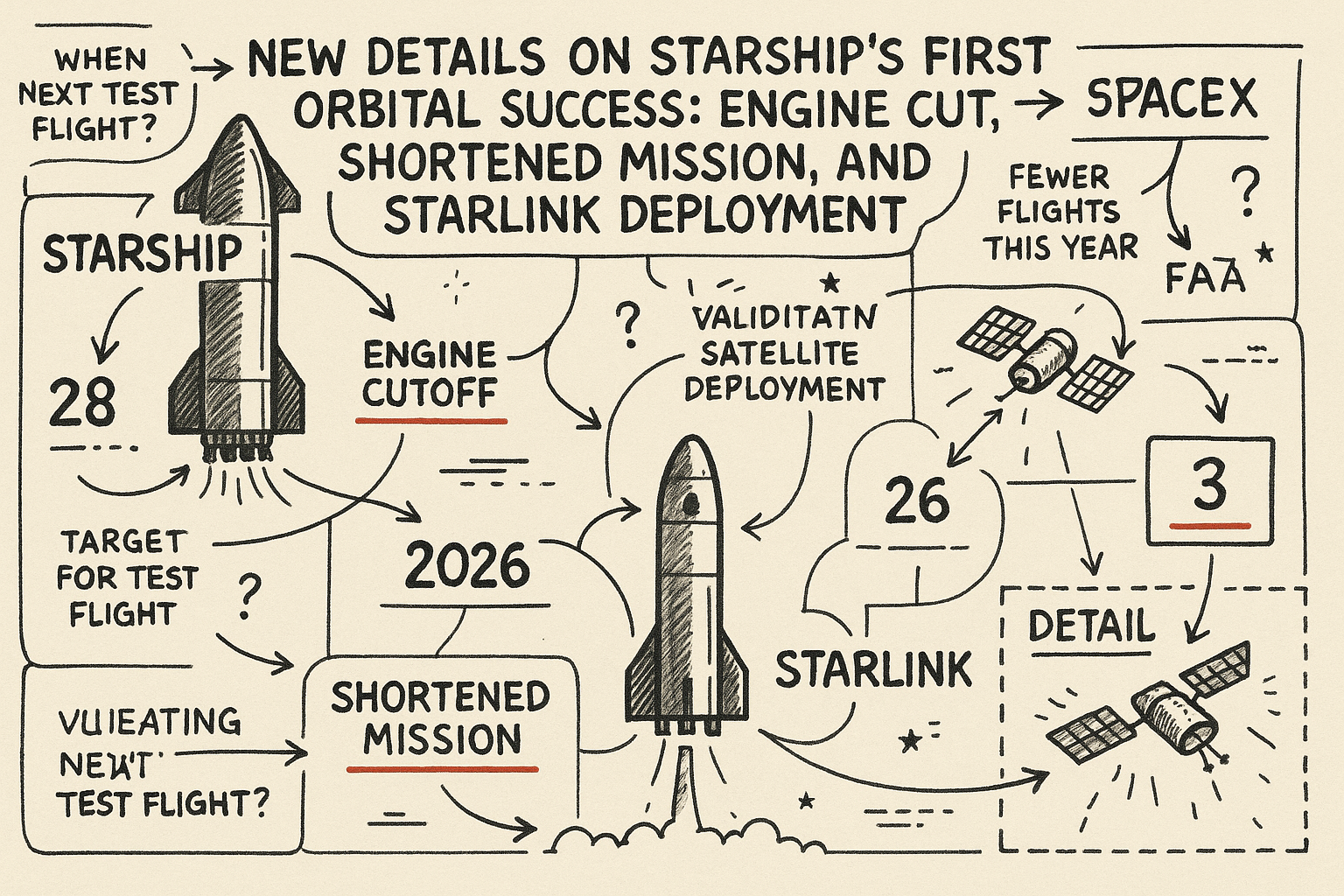
On 28 September 2026 SpaceX’s Starship Flight 14 — Ship 41 riding on Booster 21 from Starbase, Texas — achieved orbital insertion and released 26 operational Starlink V3 satellites into a 276 km orbit, according to telemetry and reports from AstroSpace. The mission marked the first time Starship completed a full orbital mission, transforming the vehicle from repeated test flights into an operational orbital launcher.
The flight was not problem-free. During ascent, at T+1 minute 16 seconds, one of the 33 Raptor engines on Booster 21 shut down unexpectedly. The remaining motors compensated and the vehicle continued its ascent, but the affected engine did not restart. During the boostback burn intended to return the Super Heavy, the booster operated with 11 of the 13 Raptor engines planned for that phase, as two engines remained out of service. Similar engine losses had appeared on the previous flight; AstroSpace reported that during the earlier mission SpaceX attributed problems to ice formation in propellant feed lines, although it is not yet known whether the same cause applied in Flight 14.
Separately, Ship 41 experienced an anomaly in orbit: one of its Raptor Vacuum engines shut down earlier than expected during the upper-stage operations. SpaceX commentators initially indicated that Ship 41 might not perform the burn necessary for orbital insertion. Engineers on the ground reviewed telemetry and took the decision to proceed with the burn despite the engine issue. Telemetry released by SpaceX shows that after 25 minutes and 15 seconds from liftoff the spacecraft began the burn that placed it into the 276 km orbit from which it later deployed the 26 Starlink V3 satellites.
The payload deployment constituted a significant operational milestone for SpaceX’s Starlink constellation: the satellites released by Ship 41 were operational V3 units. The deployment demonstrates Starship’s intended role not only as a heavy-lift vehicle for large single payloads but also as a mass-delivery platform for constellations.
Recovery and return phases also encountered difficulties. Booster 21’s return was affected by the persistent engine issues, which limited its maneuvering during the boostback and reentry sequence. AstroSpace’s coverage noted that problems during the Super Heavy return mirrored issues seen previously; the company will need to identify whether causes are systemic to the booster’s plumbing and thermal environment or incidental to that particular vehicle.
SpaceX described the decision to continue to orbital insertion after assessing telemetry as deliberate: the company had designed flight test campaigns to verify that Starship could be controlled and made safe in orbital conditions. AstroSpace emphasised the importance of maintaining control of the vehicle once in orbit to avoid hazards in space and on Earth. Flight 14's partial engine losses underline the program’s continued engineering challenges even as the architecture matures.
Looking forward, AstroSpace reported that SpaceX aims to increase the cadence of Starship launches and reduce turnaround time between missions. The company is also preparing for Starship operations from Launch Complex 39A in Florida, signalling intent to broaden the vehicle’s operational footprint beyond Starbase. AstroSpace suggested a new flight could occur as soon as the end of October, depending on mishap investigations and regulatory clearances.
Contextual coverage from other outlets supports the core facts: SpacePolicyOnline noted that Flight 14 did not go exactly as planned but succeeded in achieving orbit and deploying 26 Starlink V3 satellites, and NASASpaceFlight coverage highlighted that Booster 21 lost engines yet completed its key tasks and that Flight 15 preparations were already underway.
NovΔ mAInd's launch database: Starship | Starlink Group 31-1 (Starship Flight 14) — scheduled 2026-09-28, it flew successfully, orbit Low Earth Orbit, operator SpaceX.
Historically, Starship’s path to orbit has been iterative: the program’s first integrated flight test on 20 April 2023 lasted only minutes and did not achieve stage separation. Three and a half years and thirteen subsequent flights later, Flight 14 reached orbit and completed an operational deployment. The trajectory from short-duration demonstrators to an orbital delivery platform represents a distinct shift in the program’s status, even as recurring propulsion and plumbing anomalies persist.
Implications extend across commercial and institutional users. If SpaceX can raise launch cadence and reduce the interval between flights while resolving engine and plumbing anomalies, Starship is positioned to offer unique capabilities — very large payload mass-to-orbit and bulk deployment of constellation satellites. However, flight 14 highlights that system-level reliability must improve for routine operations, recovery ambitions, and missions with higher-risk payloads such as crewed flights or time-sensitive national assets.
SpaceX’s next technical tasks are clear from the Flight 14 experience: fully diagnose and fix causes of Raptor shutdowns on both booster and ship, verify Super Heavy return performance under partial-engine conditions, and continue incremental operationalization. The company’s ability to translate lessons from Flight 14 into faster, safer follow-on flights will determine whether Starship moves from milestone-driven demonstrations to the steady operational cadence SpaceX envisions.