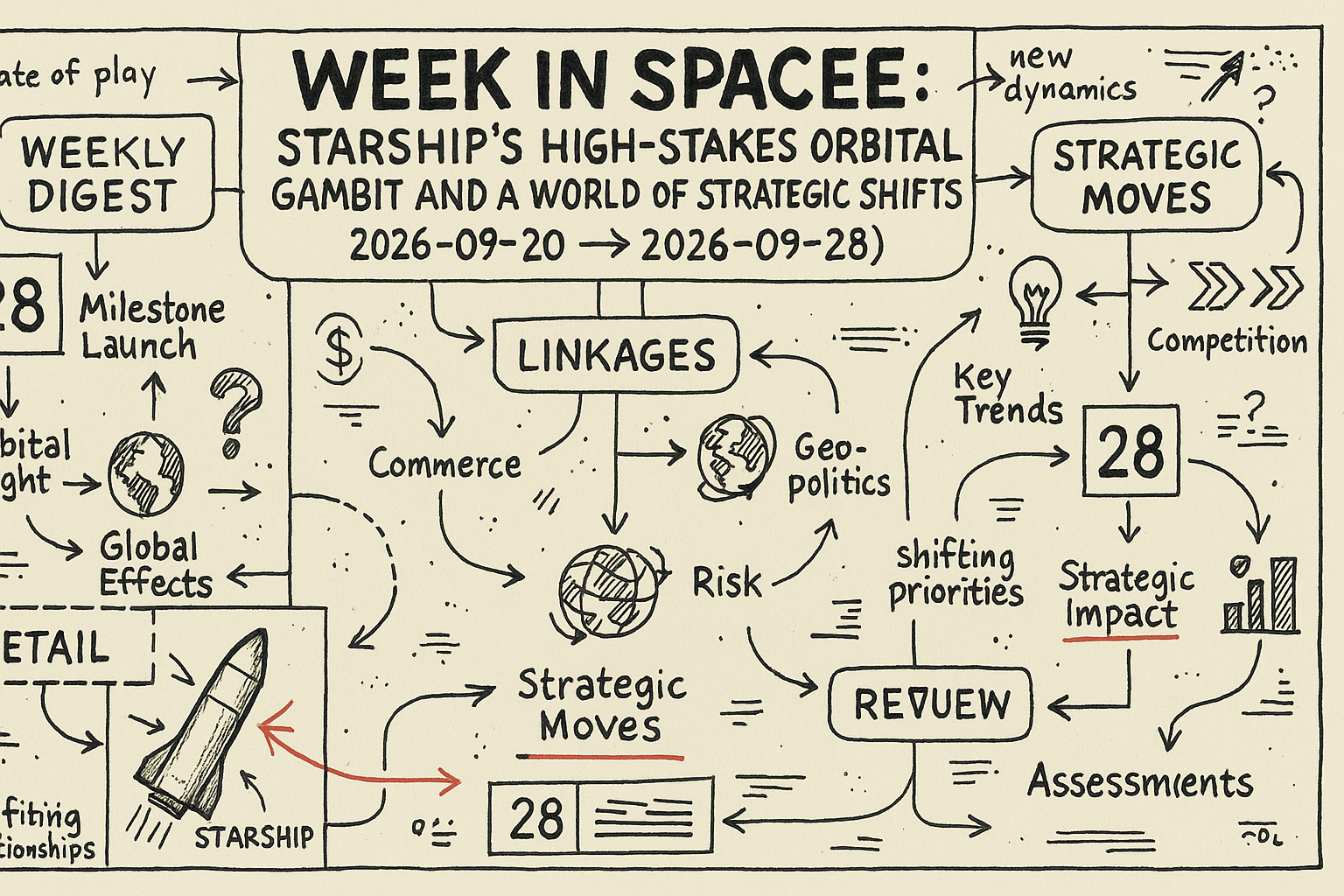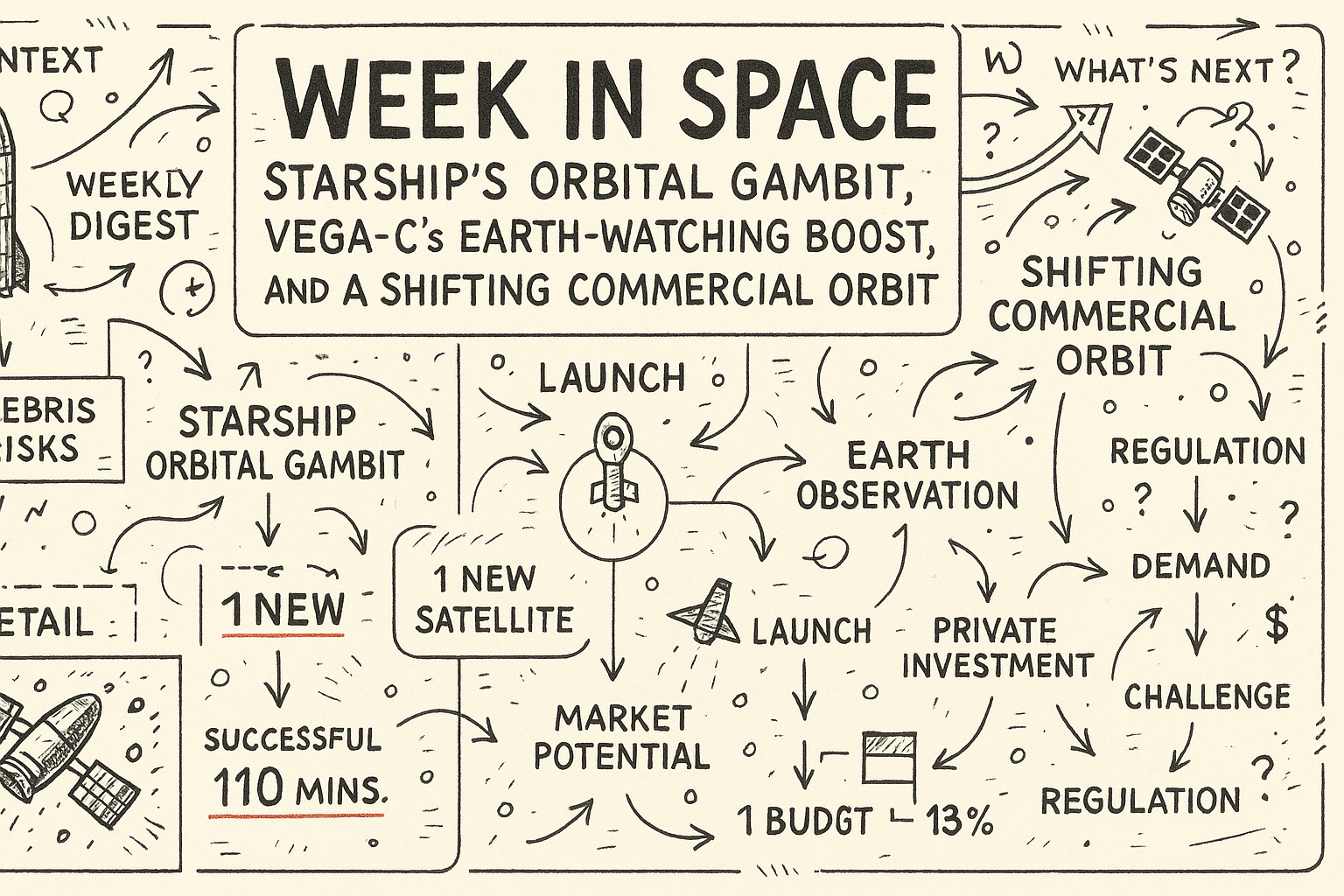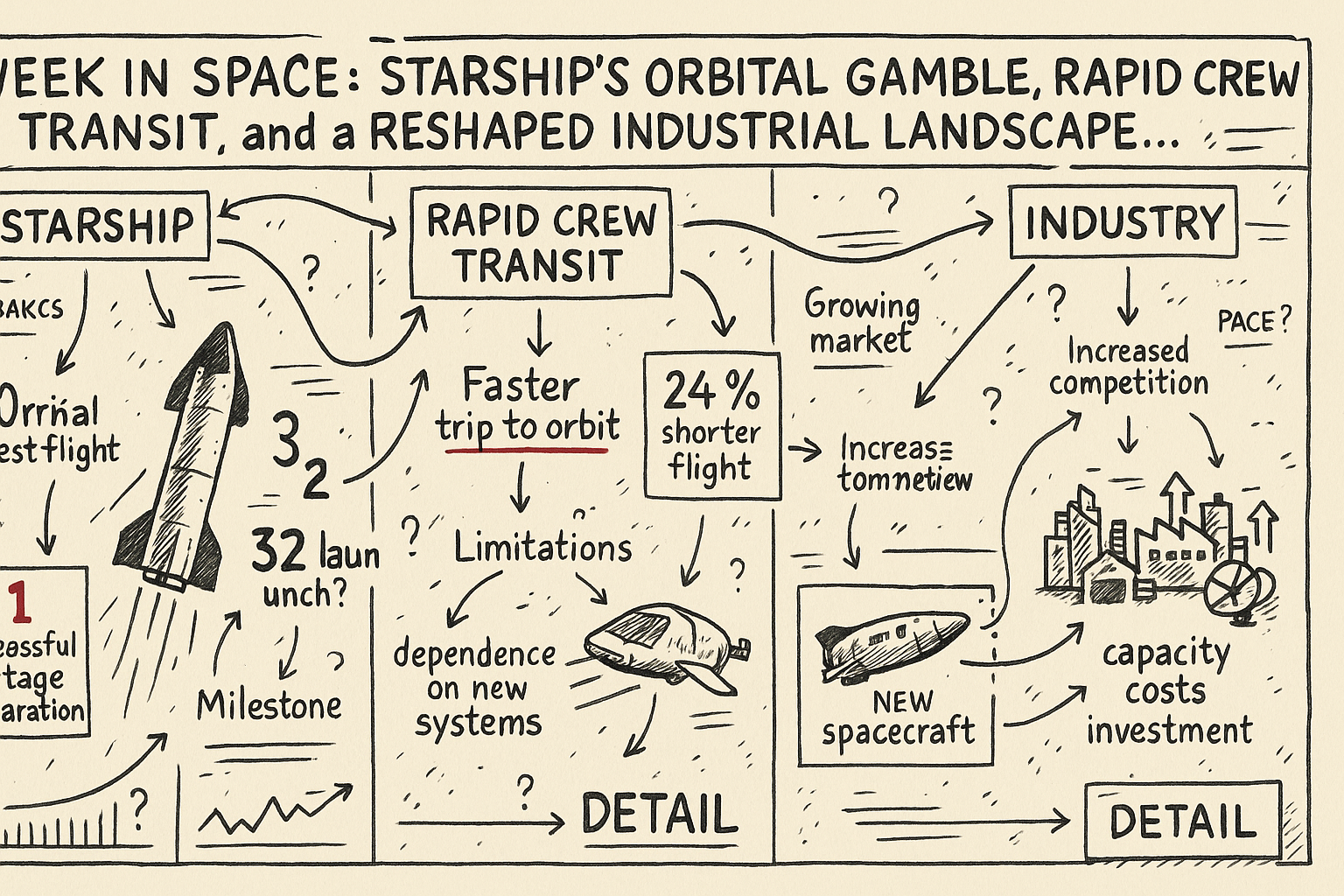
When Starship finally crossed the threshold from test article to orbital system on 28 September 2026, it did so not with a textbook success but with the messy, revealing triumph that technological revolutions often produce. The 14th integrated flight test combined the promise of operational heavy lift and mass-deployable broadband with the blunt realities of engine failures, abbreviated mission plans and regulatory second‑looks. Across the same week, routine and incremental advances — from an eight‑hour Crew Dragon transit to new commercial funding and European satellite production milestones — stitched themselves into a larger pattern: the space enterprise is accelerating unevenly, producing strategic dilemmas for regulators, competitors and customers alike.
Launch activity: Starship’s high‑stakes orbital gambit — and what it means
SpaceX’s Integrated Flight Test‑14 (IFT‑14) dominated attention not merely because the vehicle reached orbit, but because of how the mission exposed the stakes of moving fast while still refining an extraordinarily complex system. The flight, which lofted 26 operational Starlink V3 satellites, demonstrated a capability every heavy‑lift program aspires to: placing significant operational mass into orbit. Yet it also underlined that “operational” does not mean “mature.” Two engines suffered shutdowns across the stages, prompting flight controllers to shorten a planned multi‑orbit, 10‑hour test to a condensed demonstration that still achieved the mission’s primary objective — Starlink deployment — while deliberately cutting out marginal flight segments to reduce risk.
Regulators noticed. The Federal Aviation Administration’s fresh review ahead of IFT‑14 and the eventual signing off on a modified orbital profile signalled a pragmatic shift in oversight philosophy: permit ambitious activity, but constrain profiles to known safety envelopes when anomalies occur. That balance—allowing iterative flight testing while preserving public safety—will be tested repeatedly as SpaceX evolves Starship from experiment to workhorse. The IFT‑14 flight therefore functioned as an operational proof point and a regulatory stress test at once, prompting both awe for the hardware’s progress and careful reassessment of how to supervise ever‑bolder private activity in low Earth orbit and beyond.
Analytically, the flight marks an inflection. Reaching orbit with a fully stacked Starship and deploying operational satellites changes the risk calculus for competitors and customers. Companies that had planned around moderate incremental increases in launch cadence now face a near‑term reality where multi‑ton deliveries and large rideshare capability could be available at scale. That potential accelerates market consolidation around services like Starlink and compresses timelines for national space programs that must decide whether to invest in indigenous heavy‑lift capability, partner with new entrants, or adapt on a procurement and policy level.
Falcon and Dragon still in the mix: a week of complementary launches
SpaceX’s rapid cadence was underscored by operational Falcon 9 activity earlier in the week: Crew‑13’s launch and its eight‑hour transit to the International Space Station bore witness to the company’s growing operational maturity on the crewed side. The flight, carrying commander Jessica Watkins and three mission specialists, recorded the fastest U.S. transit to the ISS to date for a Dragon vehicle. The speed of that rendezvous isn’t only a public relations triumph; it recalibrates mission planning for time‑sensitive crew rotations, emergency contingencies and time‑tagged science operations on the station.
These two launch narratives — Starship’s noisy, imperfect leap to orbit and Crew‑13’s smooth, record‑fast delivery — together illustrate the duality of contemporary space operations. Some platforms are still on their developmental climb, producing headline‑grabbing tests that redefine what’s possible. Others are already iterating inside tight operational envelopes that customers and agencies can rely on. The interplay between the two will define procurement strategies, insurance pricing and international planning across the next several years.
Exploration & science: Mars chemistry, black holes, and new worlds
Beyond launch spectacle, the week featured substantive scientific work that affirms why exploration matters even amid commercial tumult. New syntheses on Mars’ geologic and chemical history emphasized water’s episodic presence, local carbonate formation, and tantalizing signatures of complex organic chemistry. Those findings don’t provide the cinematic confirmation of life; rather, they refine the planet’s habitability map and shape instrumentation priorities for upcoming missions. Understanding where water and organics coexisted in time and space is critical to designing targeted sample collection and in‑situ analyses that could one day resolve the question of whether Mars hosted life.
On much larger scales, fresh work on black holes and the radio signals that trace them highlighted the dynamic nature of galactic cores. Observational programs, leveraging improved radio arrays and multiwavelength coordination, are now able to connect accretion physics to outflows and transient electromagnetic counterparts with finer detail. These are not incremental textbook updates; they reshape models for how black holes influence galaxy evolution and how we interpret signals from extreme gravity regimes.
Finally, an intriguing exoplanet candidate — HD 156295 b — emerged from TESS data analysis, orbiting within the habitable zone of a bright A‑type delta Scuti star. If confirmed, the object would be a massive gas giant roughly six times Jupiter’s mass orbiting at several astronomical units with an extended period. While not Earthlike, its placement in the habitable zone has implications for satellite habitability and for how we model the thermal and radiative environments around bright, pulsating stars. The candidate reinforces the theme that the next wave of exoplanet science will interrogate more extreme stellar hosts and wider parameter spaces than the earlier, Kepler‑era focus on quiet sunlike stars.
Industry & policy: investments, national strategies, and commercial servicing lessons
Commercial and policy currents ran wide this week. Hop Aero’s $11 million raise for suborbital point‑to‑point logistics and Rook 2 development reflects enduring investor appetite for niche transport concepts even as heavy lift and broadband architectures dominate headlines. These smaller bets matter: they diversify the industrial base and preserve the kind of high‑risk, high‑reward experimentation that spawns future categories of services. Airbus’ completion of 32 OneWeb “refresh” satellites in Toulouse, destined for a SpaceX launch, offered a concrete example of cross‑company interdependence: a European manufacturer building hardware for a non‑European constellation and then relying on a U.S. launch provider. That supply‑chain choreography behind the scenes will become more visible and strategically consequential as national interests seek to balance industrial policy with operational pragmatism.
Policy tensions surfaced elsewhere. NASA’s recalibrated timetable for Boeing’s CST‑100 Starliner — with an uncrewed test scheduled for late December into January and a crewed return pushed to mid‑2028 or later — underlines the lingering fragility of restoring redundant American crew transport. NASA’s push to secure a second crewed option and to certify Vulcan raised questions about whether redundancy will be achieved by agency fiat, market competition, or transatlantic collaboration. Those choices ripple into policy, contracting, and alliance structures — particularly as large providers like SpaceX continue to expand capability on timelines largely set by private investment and internal engineering cadence.
Another instructive policy lesson came from Katalyst’s LINK mission attempt to service NASA’s Neil Gehrels Swift Observatory. While the servicing attempt failed to recover the aging observatory, the mission provided invaluable operational lessons about commercial on‑orbit servicing: rendezvous procedures, tug performance in unexpected conditions, and end‑of‑life strategies for valuable scientific assets. The program’s hard lessons will inform NASA’s and commercial operators’ approach to insurance, mission assurance and the architectures chosen for future servicing contracts. In short, when attempts fail, the operational knowledge harvested can still accelerate sectoral learning more cheaply than a decade of incremental tests.
Rideshare, regulatory frameworks and the EU’s cooperative push
Rideshare missions and secondary payload strategies continued to reshape policy discussions. The rise of dense rideshare manifests — exemplified by the Starlink deployment and the planned OneWeb refresh sats — forces regulators to rethink debris mitigation, frequency coordination and cross‑national licensing. Each multi‑sat deployment is less a single industrial act than a negotiation among sovereign regulatory frameworks, frequency allocation regimes and commercial risk appetites.
Europe’s activity this week — spanning Airbus’ production milestone and broader messaging about enhanced collaboration and capability — signalled a concerted effort to deepen continental sovereignty in space services while remaining pragmatically engaged with U.S. commercial providers. Europe’s approach is not a frontal challenge to incumbents but an attempt to assemble layered resilience: national launch capacity where possible, industrial manufacturing at scale, and alliances for services where domestic solutions are less efficient. For partners in industry and government, the practical question is whether this hybrid path yields timely capability, or whether fragmented procurement will miss narrow windows of strategic need.
Technology and the future: AI, autonomy and the new orbital economy
Two related technological threads this week — advances in AI for proximity operations and the economic reshaping caused by AI-enabled satellites — deserve particular attention. Stanford’s presentation of the Out‑of‑this‑World‑Model (OWM) reframes autonomy for spacecraft. By teaching vehicles to generate internal “dreamed” simulations of docking and proximity maneuvers, OWM aims to reduce reliance on ground-in-the-loop decision making and to create safer, more adaptable proximity operations. If matured and validated at scale, such systems could make in‑space servicing, satellite relocation and complex autonomous assembly operations far more routine and less costly.
That technical progress dovetails with broader economic shifts: AI on board satellites — from autonomous image triage to distributed decision‑making on bandwidth allocation — is reshaping the orbital value chain. AI reduces latency in decision cycles, changes data architectures, and creates new business models for in‑space processing. Together with platforms like Starship that increase payload mass and fleet capacity, onboard AI multiplies the types of services that are commercially viable. This combination will invite new entrants and accelerate commoditization in some sectors while creating premium niches for highly curated, low‑latency services.
Cross‑story synthesis: a new tempo and new tensions
Reading the week’s disparate stories as a whole, a pattern emerges: capability is accelerating, but control systems — institutional, regulatory, and organizational — are still catching up. Starship’s leap to orbit demonstrated hardware capability that changes strategic expectations. Crew‑13’s fast transit showed operational refinement in a sibling system. Airbus’ production and Hop Aero’s seed investments showed that industry diversification continues apace. Stanford’s AI work and the LINK servicing lessons indicated that the subtler, software‑driven domains of space operations are a wild card that could redefine cost and risk across the entire sector.
The tensions are clear. Faster capability compresses time available for policy harmonization, safety assessment, and international coordination. More autonomous in‑space systems will outpace traditional satellite licensing and frequency frameworks. And competitive pressures may push both governments and firms toward accepting higher operational risk for the sake of strategic advantage. This week’s regulatory posture — the FAA’s selective constraint paired with permission to fly modified profiles — may become the template: targeted constraints that preserve essential public safety margins while allowing technical organizations to iterate in situ.
What to watch next week
The near term will be dominated by follow‑on questions and verification steps. SpaceX and Starlink will publish more flight telemetry and post‑flight analysis; engineers and independent reviewers will parse the causes and system‑level implications of the engine shutoffs. NASA and Boeing’s planned uncrewed Starliner mission slipping into December–January will draw renewed scrutiny, particularly on how agency reliance on commercial partners is being hedged by alternate certification efforts such as Vulcan. On the science front, Mars chemistry papers and exoplanet candidate confirmations will prompt instrument teams and mission planners to adjust sampling and observational priorities.
Operationally, watch for updates on Crew‑12’s undocking window and how ISS traffic shapes the timing and posture of upcoming cargo and crew missions. Policy watchers should follow Europe’s evolving public statements and procurement releases in response to the Starship milestone; procurement timelines and public‑private frameworks set now will define competitive dynamics for the next half decade. On the technology front, Stanford’s OWM will likely move from preprint to demonstration; one or more commercial or governmental proximity‑operations trials could accelerate validation, particularly as servicing and active debris removal demonstrations become more urgent.
In short, the week closed with a paradox: hardware has leapt forward, delivering capability that changes markets and strategy, while the softer architecture of policy, operations and institutional coordination still needs time to catch up. That gap creates both opportunity and hazard. If industry and governments can translate lessons from partial successes and visible failures into disciplined oversight, faster iteration and more flexible procurement, the next year could deliver widely distributed benefits: cheaper access, more resilient services, and a richer scientific harvest. If not, the same velocity that powers innovation will test societal tolerance for missteps in orbit and on the ground. Either way, the cadence of change is no longer measured in decades but in months; the question is whether our governance, industrial planning and scientific priorities can keep pace.