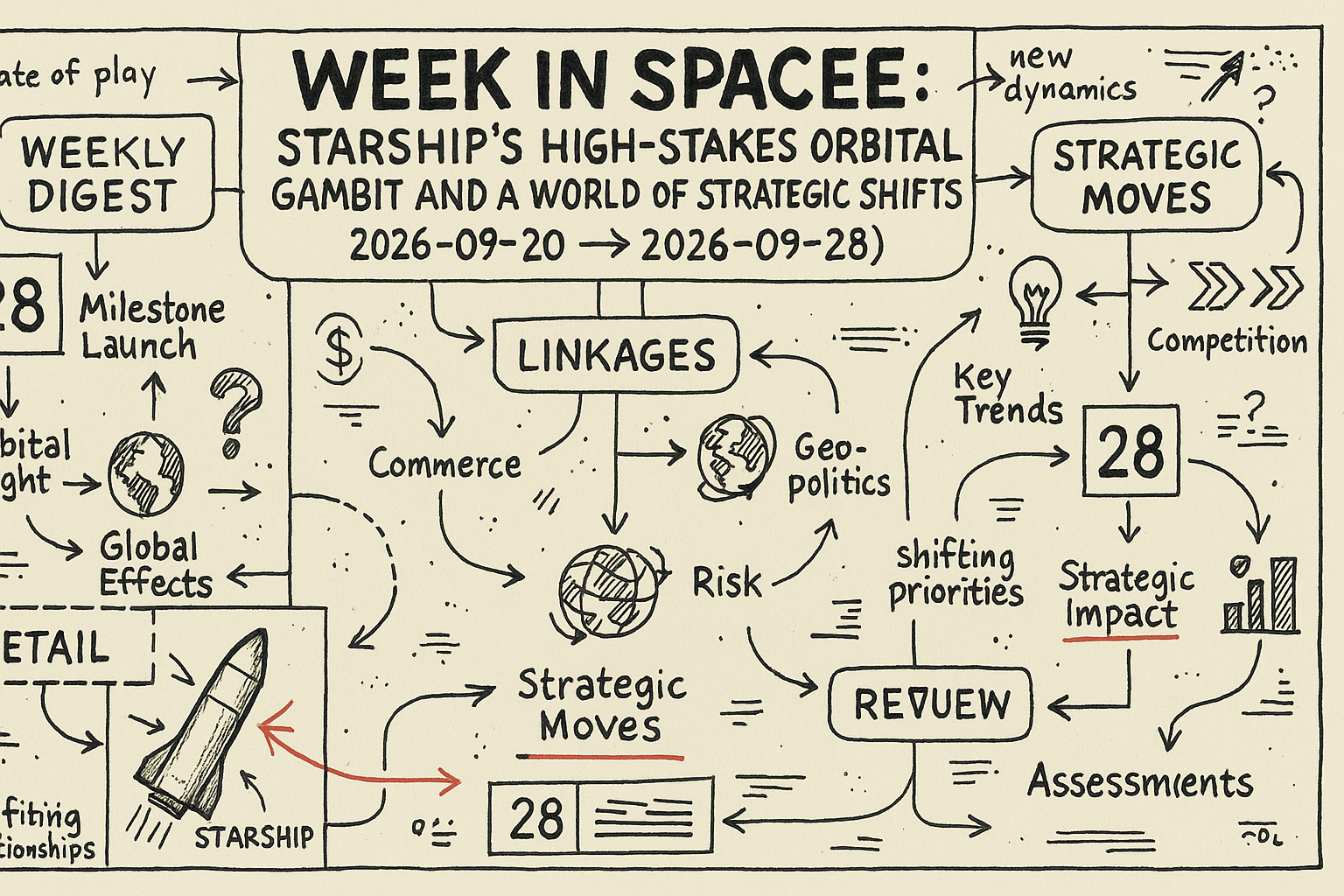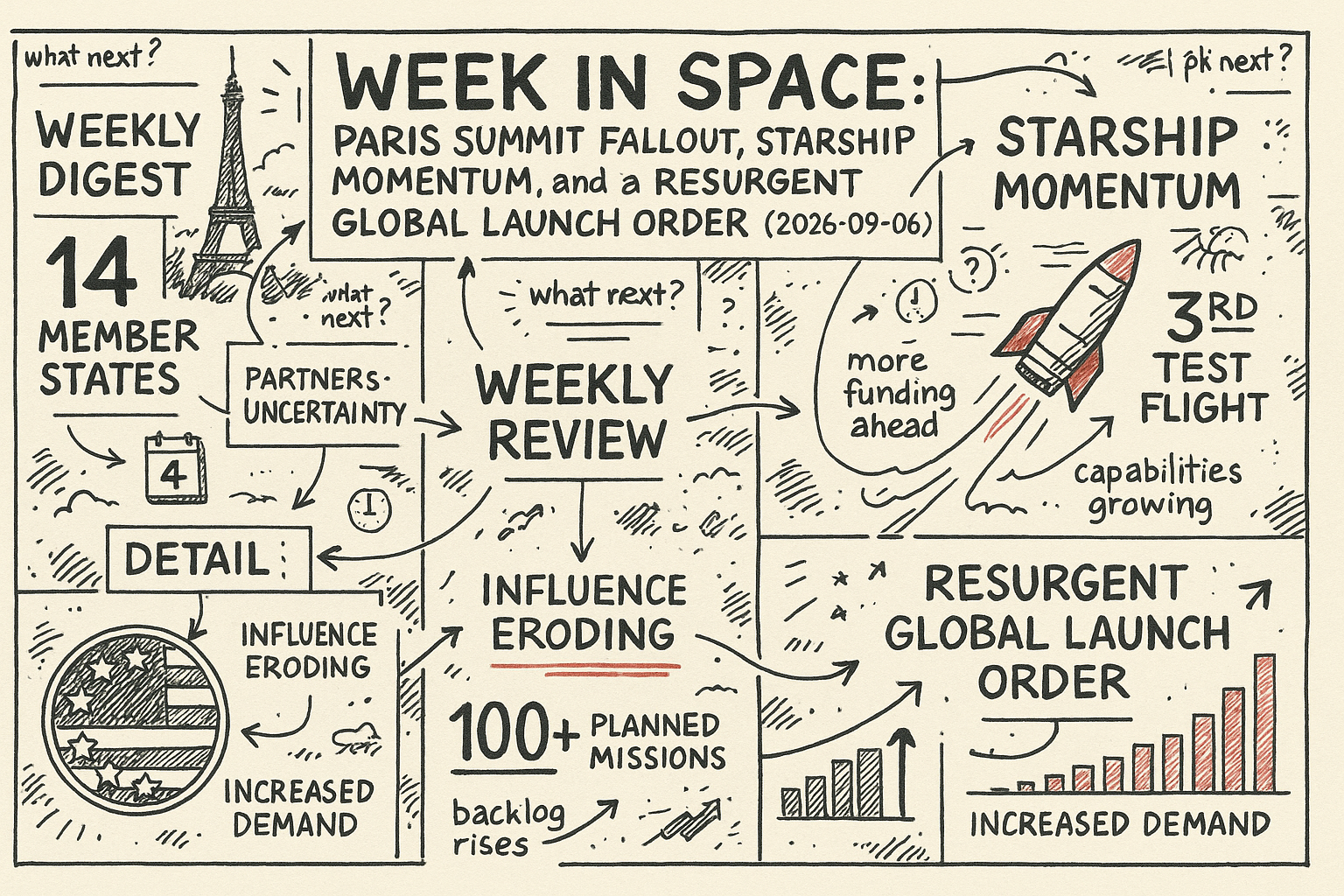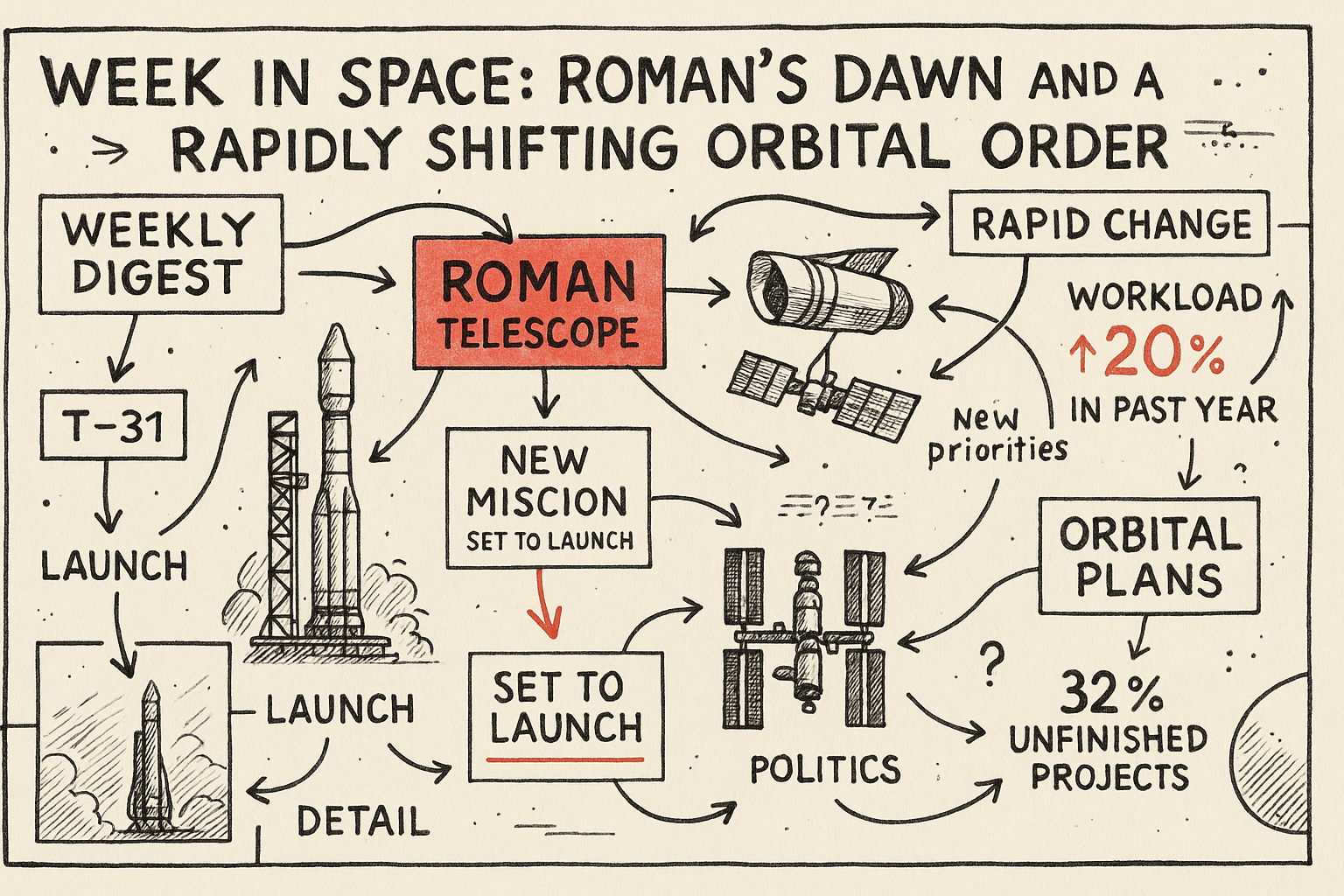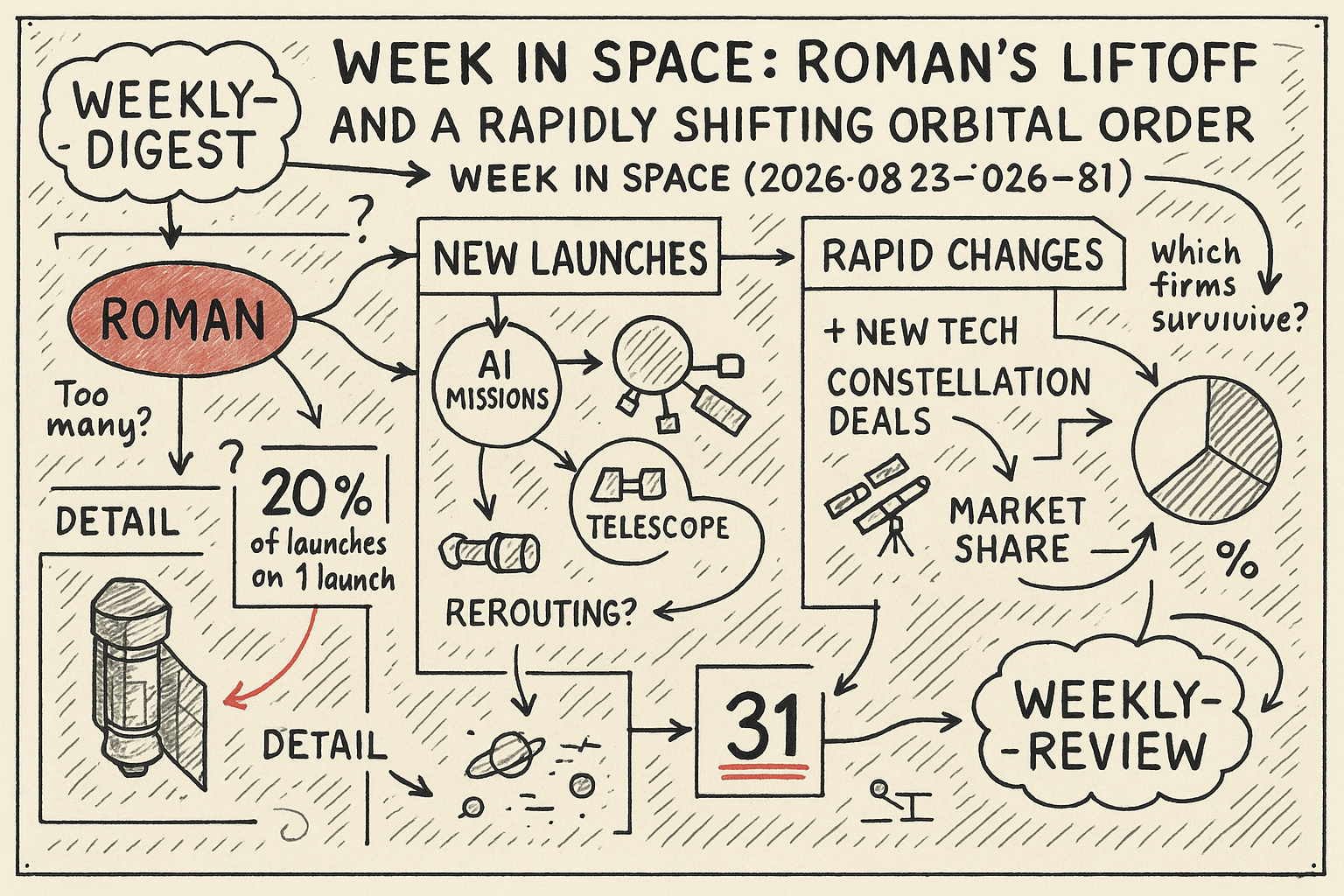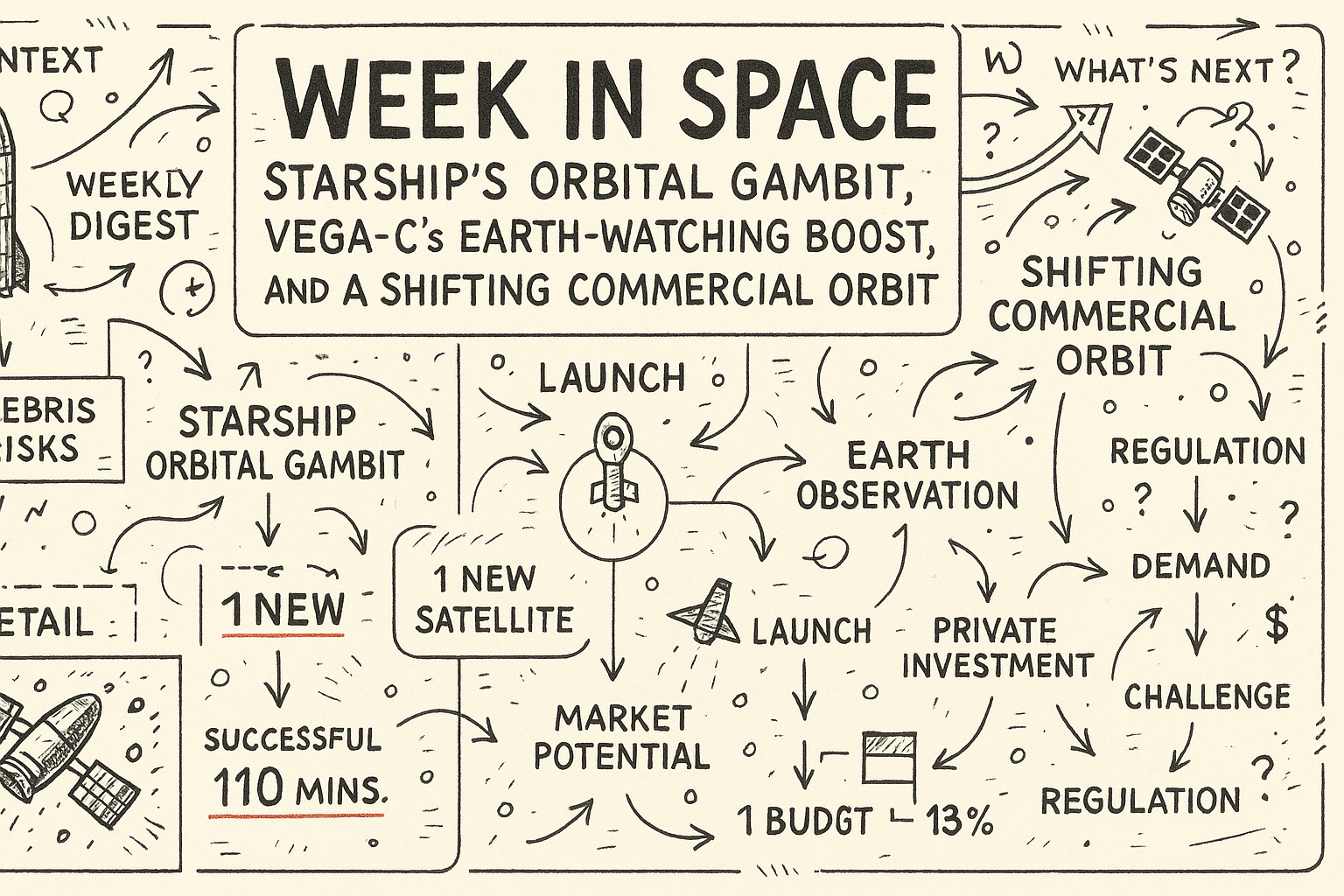
The space industry entered a decisive week between Sept. 13 and Sept. 21, 2026, where technical ambition, national strategy and market dynamics collided. At the center of the narrative was the looming first orbital attempt of SpaceX’s Starship, the single-most consequential development for launch economics and human access to space this decade. Around that headline, Europe pressed forward with operational Earth-observation capability via Vega‑C and FLEX, deep-space science advanced with BepiColombo’s arrival maneuvers at Mercury and JWST discoveries continued to redraw astrophysical boundaries. Meanwhile, commercial balances shifted as satellite leasing, orbital compute and launch-market pricing underwent a rapid reappraisal. Taken together, the week’s developments sketched a space sector in the throes of transition — technically bolder, economically unsettled and geopolitically more strategic.
Launch Activity: Starship’s Orbital Gambit and Vega‑C’s Delivery to Orbit
All eyes this week remained fixed on Starship Flight 14, the integrated flight test that would mark the vehicle’s first orbital attempt and a decisive inflection point for large‑scale reusable launch. Reporting across Sept. 16–20 fleshed out a mission profile that, if approved and executed, would attempt to place the Starship upper stage into orbit, deploy 26 Starlink V3 satellites as a revenue payload and perform multiple orbits with planned recovery splashdowns in the Pacific. The timeline blurred in reporting — initial targeting for Sept. 22 shifted to later in the week with new reports indicating Sept. 28 as an alternate — but the technical story was consistent: SpaceX had worked to resolve a pernicious ice‑clog problem that destroyed Booster 20 on Flight 13, implemented fixes and completed infrastructure moves at Starbase in preparation for another high‑risk, high‑reward test.
The stakes cannot be overstated. A successful orbital attempt would demonstrate end‑to‑end Starship capability at scale: high-payload lift, rapid reusability potential and the ability to loft commercial constellations and deep‑space hardware at dramatically lower nominal cost per kilogram. Failure would be costly not only in hardware but in regulatory goodwill and investor patience. That dynamic explains why coverage this week emphasized both the technical minutiae — ice management, engine health and payload integration — and the broader consequences: new pathways to lunar logistics, massed Starlink deployments and potential decoupling of certain launch markets from traditional pricing pressure.
Counterbalancing the Starship narrative, Europe achieved a clear operational win. Avio’s Vega‑C rocket successfully launched ESA’s Fluorescence Explorer (FLEX) and Copernicus Sentinel‑3C into an 820 km sun‑synchronous orbit on Sept. 15. FLEX, with its fluorescence instrument designed to map vegetation photosynthetic activity, and Sentinel‑3C, which continues ocean, land and atmosphere monitoring, represent tangible, near-term returns for Earth‑observation services. The flight was also symbolically important; it underscored the resilience of European launch supply chains even as global launch dynamics shift, and it provided a useful counterpoint to the big‑bang approach of Starship by delivering assured, mission‑specific capability.
Beyond the marquee launches, SpaceX hit another milestone as three Boeing‑built O3b mPOWER satellites launched atop Falcon 9—closing out Boeing’s mPOWER constellation and marking Falcon 9’s 700th flight. That completion highlights how legacy launch vehicles continue to underpin commercial and institutional constellations, even as larger disruptive systems seek to supplant them.
Exploration & Science: From Mercury Arrival Preparations to JWST Finds
In science and exploration, the week offered both near‑term operational steps and discoveries that stretched our cosmic understanding. BepiColombo’s Mercury Transfer Module (MTM) separation on Sept. 3 — reported in detail this week — formally set the twin orbiter mission into its Mercury arrival phase. ESA and JAXA teams have shifted into meticulous instrument checks and a sequence of braking maneuvers that will shepherd the two spacecraft into separate Mercury orbits over coming months. BepiColombo’s odyssey has been long and technically complex; this separation is the payoff, launching a months‑long orbital choreography that promises unparalleled measurements of Mercury’s magnetosphere, interior and exosphere.
Further out, the Nancy Grace Roman Space Telescope continued its one‑million‑mile transfer to L2, with teams entering orbit‑transfer and commissioning activities. Roman’s wide field and coronagraph technology will soon expand both cosmology and exoplanet science, and the mission’s steady progress is an anchor for astrophysics through the late 2020s.
On the discovery front, JWST remained prolific. Reports this week highlighted JWST/NIRSpec detections of extreme neutral‑gas outflows from massive quiescent galaxies formed 11–13 billion years ago, and separate observations identified brown dwarfs in IC 348 with masses near twice Jupiter’s. Both results underline a theme that runs throughout modern astrophysics: the universe is more varied and more dynamic than earlier models predicted. The gas‑outflow work complicates simplistic narratives about feedback and quenching, showing that even powerful winds may not permanently halt star formation, while the brown‑dwarf results help bridge planet and star formation physics at the low‑mass end.
Closer to home, a University of Maryland and Southwest Research Institute simulation study suggested that giant impacts on icy moons rarely eliminate subsurface oceans, altering our assessment of habitability and thermal evolution on mid‑to‑large satellites. Meanwhile, The Planetary Society and astronomers announced Elias 2‑24 b as the youngest exoplanet candidate yet identified, a reminder that planet formation can proceed astonishingly quickly under the right conditions.
Industry & Economy: Leasing, Pricing Stress and New Commercial Models
Perhaps the most consequential undercurrent this week was the rapid evolution of the space economy. Multiple articles traced a market re‑pricing in response to both technical progress and geopolitical maneuvering. Space industry leaders at World Space Business Week argued that the low price‑per‑kilogram paradigm, driven for years by Falcon 9 economies of scale, is unsustainable as that vehicle’s dominance softens and new capacities come online. The argument is not merely rhetorical; Avio’s CEO reported a tangible influx of customers after SpaceX suspended new Falcon 9 commercial orders, illustrating how a single vendor’s policy ripple can redistribute global demand and revive regional launch vendors.
At the capital and product level, Sophia Space and leasing firm SLI agreed terms for a $300 million framework to lease ten TILE orbital compute satellites, signaling investor appetite for in‑orbit compute as a commercial product. The deal structure — long‑term operating leases with SLI owning the hardware — reflects more sophisticated financing approaches aimed at de‑risking operators while enabling startups to scale. Similarly, Space Cargo Unlimited’s booking of a ~1 tonne Starfall slot for microgravity manufacturing in 2028 points to a maturing service market for space-based industrial activities beyond small experimentation flights.
New rideshare arrangements and manifest bookings also peppered the week. Maverick’s securing of payload capacity on Portal’s Motus Via Sol Falcon 9 mission, Terran Orbital’s senior hire to lead European operations, and NASA’s award of a Falcon 9 ride for StarBurst — a small gamma‑ray observatory — are small data points that collectively indicate a more modular, contract‑driven marketplace. Notably, they show companies hedging bet‑to‑bet by diversifying launch partners and locking long lead items in an increasingly uncertain schedule landscape.
Policy, Strategy and Geopolitics: The Soft Power of Satellite Connectivity
Policy moved in tandem with commerce this week. The U.S. State Department’s launch of the Space Catalyst Partnership and the announcement of a $6.5 million satellite connectivity project for southern Peru exemplify how communications infrastructure is now a line of diplomatic engagement. Linking Artemis Accords signatories with U.S. civil and commercial firms is an explicit attempt to merge technological outreach and geopolitical influence, while the modest budget underscores that early wins can be relatively low cost but high leverage.
On a grander scale, Europe’s public statements about a €20 billion space ambition and broader conversations at the Paris summit revealed a continent determined to remain strategically autonomous in space. Those ambitions, paired with concrete launches like Vega‑C and commercial intake at Avio, make clear that Europe intends to protect and expand its space industrial base even as the market’s center of gravity is challenged by U.S. commercial disruptors.
Defense and security discussions continued as well. Space defense investments and contract flow were themes explored at the week’s policy briefings, suggesting that militaries will remain a steady customer for certain classes of spacecraft and services even as commercial markets bicker over pricing models.
Cross‑Currents: Technical Advances Meet Economic Realities
Reading across the week’s stories, a few cross‑cutting dynamics emerge. First, the rapid technical maturation of large launch vehicles (Starship) exists alongside incremental but essential workhorse launches (Vega‑C, Falcon 9). The two are not mutually exclusive; rather, they redefine market segmentation. Large, low‑cost heavy lift could enable entirely new industries — lunar logistics, space manufacturing and orbital infrastructure — while proven medium‑lift vehicles will continue to serve steady demand for constellation deployments and institutional science payloads.
Second, financing innovations — long leases, mission‑specific rideshares and firmed manifest bookings — are responding to a new risk calculus. As the market recalibrates away from a single‑price benchmark, firms are offering tailored financial products to lock customers in and smooth cash flows. The SLI–Sophia Space framework and Space Cargo Unlimited’s Starfall booking exemplify this trend.
Third, science continues to justify public and private investment. BepiColombo’s progress, JWST’s prolific discoveries and Roman’s commissioning all remind policy makers and investors that headline‑grabbing launch vehicles must be paired with sustained investments in instruments, data processing and mission operations to harvest the long‑term value of space exploration.
Historical Context and the Market Inflection
It is instructive to recall that launch markets have pivoted before. The advent of modern commercial rockets in the early 21st century compressed prices and expanded access, much as reusability promises now. But each technological leap has produced unintended consequences: vertical integration, single‑vendor dominance, supply chain concentration. The present moment is similar in that a new technological frontier (Starship) threatens to reset expectations even as incumbent systems and national actors push back through policy, procurement and strategic investment. What distinguishes 2026 is the breadth of capability across actors: commercial heavy lift, resilient regional launch systems, on‑orbit servicing and nascent in‑space manufacturing are all close enough to reality to make the coming 18–36 months decisive.
What to Watch Next Week
The immediate runway is dominated by the Starship schedule: regulatory approvals, last‑minute technical reads and the decided timeline for any orbital attempt will dictate near‑term market sentiment. If Flight 14 proceeds, watch not only payload deployment outcomes but also secondary effects: how quickly does SpaceX secure commercial customers for follow‑on Starship flights, and how do competitors and governments react to pricing and cadence? Equally important will be Vega‑C’s post‑launch commissioning updates and BepiColombo’s next Mercury‑braking maneuvers, both of which will deliver substantive science and service data that reinforce policy and funding decisions.
On the industry front, expect more financial structuring as leasing firms and operators announce deals to lock hardware ownership and revenue streams. Contracts like the Sophia Space/SLI framework will likely be replicated if market uncertainty persists, creating a market niche for asset managers and long‑term lessors. Watch also for additional procurement moves by national space agencies and defense departments that will signal whether governments will double down on independence or continue to rely on commercial providers.
Finally, in science, JWST and Roman will continue to produce high‑value datasets that shape research agendas; early Roman commissioning milestones will be particularly influential for exoplanet and cosmology teams planning follow‑on observations. And BepiColombo’s Mercury orbital insertion sequence will be a gripping operational narrative to follow as European and Japanese mission teams attempt a complicated, multi‑manoeuvre arrival.
Where the industry lands after this week will depend on a handful of pivotal outcomes. A successful Starship orbital flight would accelerate the transition to mass, low‑cost space operations and force both market and policy actors to adapt quickly. A failure, or a delay, would slow that pivot and leave space for regional launch systems and refined commercial contracts to preserve market share. Either way, the week of Sept. 13–21, 2026 marks another chapter in a decade where technical audacity, financial innovation and geopolitical strategy converge above the atmosphere. The weeks ahead promise to be just as consequential — and worth watching with both excitement and scrutiny.