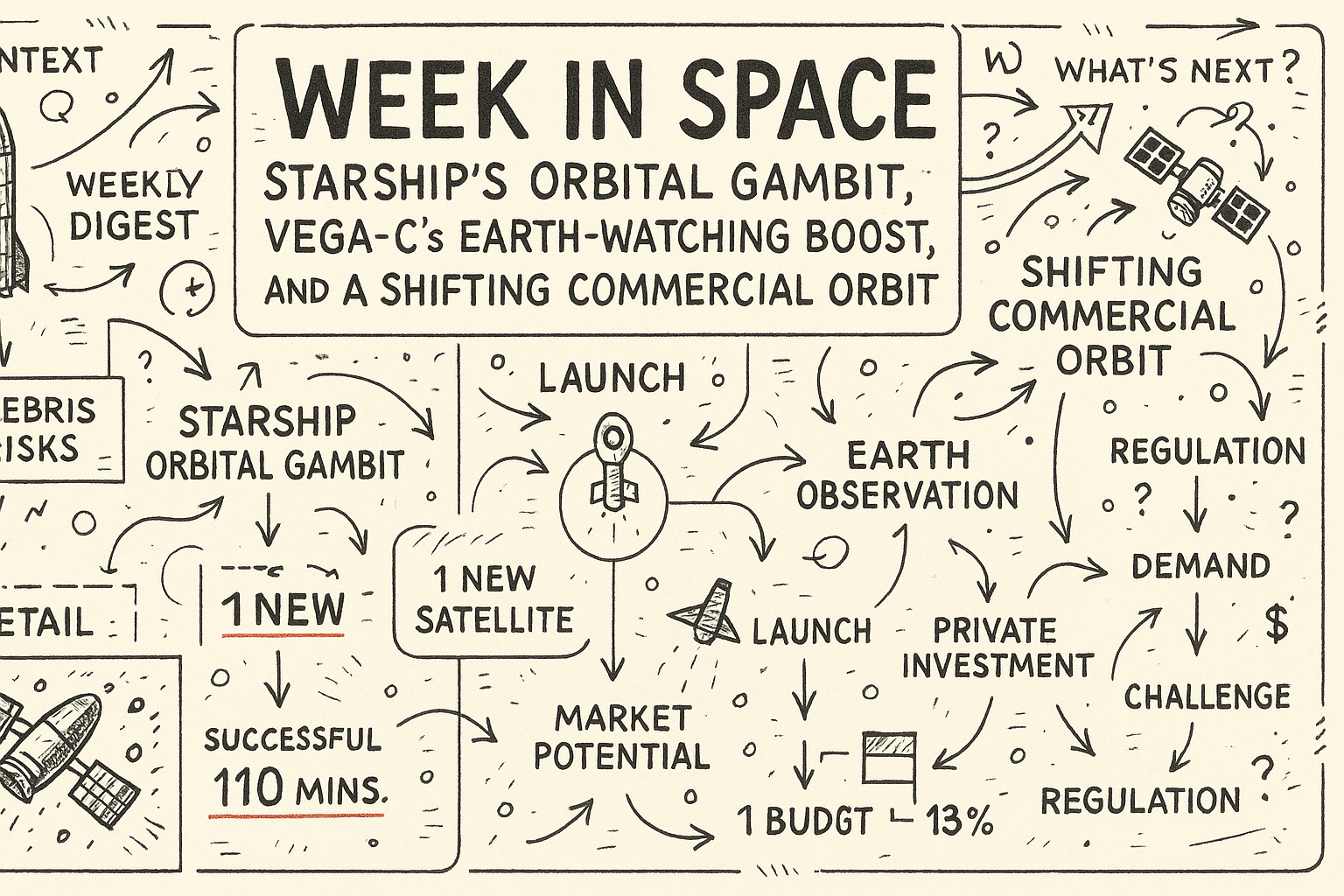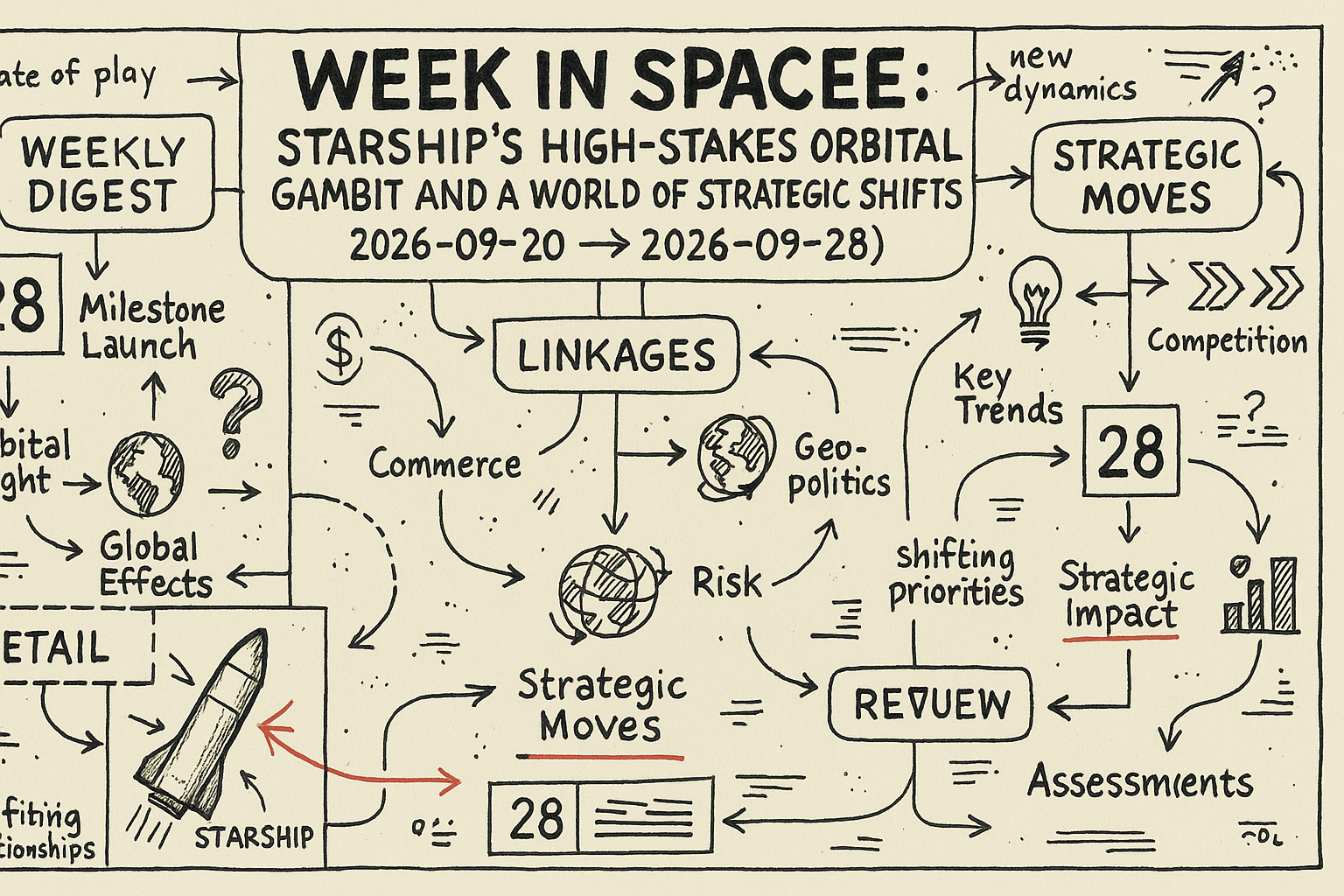
Last week’s space news read like a compressed dossier of late‑stage industrial strategy, national posture and a technology race that is simultaneously cooperative and combustive. At the center of the week’s narrative was SpaceX’s decision to press Starship toward what the company calls its first true orbital trial, a multi‑orbit, multi‑payload flight planned for Sept. 28 that would deploy 26 Starlink V3 satellites and attempt a full orbital insertion. The attempt is less a simple test than a crossroads: success would move Starship from experimental system toward operational reality, fracturing long‑standing assumptions about mass access to orbit; failure would extend another season of high‑risk development and regulatory scrutiny. Around that single, headline‑grabbing objective, governments and companies recalibrated programs, announced major contracts and revealed technical anomalies with ripple effects for schedules and markets.
Launch Activity: Starship’s Gambit and the European Countdown
SpaceX closed the week in the familiar posture of high ambition and tight timelines. Public and proprietary reporting converged on Sept. 28 as the date for Flight 14, an attempt that would test Ship 41 and Booster 21 through a full orbital profile, deploying 26 V3 Starlink satellites across multiple orbits and ending with offshore splashdowns. The operation is being framed internally and externally as Starship’s first true orbital mission — not merely a demonstration of staging or ascent but a proof that the system can complete orbital insertion, payload deployment and controlled returns at scale.
That framing matters because Starship is one of the few single systems in modern spaceflight capable of radically changing the economics of launch. If Flight 14 succeeds, it will not only put Starlink payloads on orbit but also validate practices and hardware iterations that underpin SpaceX’s broader ambitions: moon and Mars cargo, commercial heavy rides, and even in‑orbit servicing. If it fails, the program will still advance learning but will face renewed calls from regulators and customers for more conservative flight pacing and enhanced transparency on safety and debris risk.
Allied to the Starship story were two complementary launch narratives in Europe. Arianespace disclosed a troubling turbopump anomaly discovered during August ground inspections that will limit Ariane 6 flights for the rest of 2026 to perhaps five or six missions. The affect is immediate: the cadence intended to clear the backlog from Ariane 5’s retirement and to restore Europe’s assured access to orbit has been slowed. At the same time, Vega‑C continues to carve out a role in Earth observation and science missions, and new reports highlighted a European pivot toward connectivity and strategic resilience — an axis that will grow more prominent as national governments seek assured communications and sovereign capability.
What ties these stories together is timing and capacity. Starship’s potential to deliver massive mass to orbit is a market disruptor at a moment when Europe is simultaneously coping with supply anomalies, modernizing launcher fleets, and betting on building predictable institutional capacity. A constrained Ariane 6 schedule makes Europe more sensitive to alternatives — both domestic (Vega‑C) and non‑European — and intensifies interest in responsive launch, in‑orbit servicing, and satellite architectures that tolerate delay or augment on‑orbit resiliency.
Exploration & Science: Moon ambitions, Apophis, JWST and New Horizons in Planetary Science
Beyond the launch pads, the week presented important forward steps in exploration and discovery. NASA’s Artemis program continued to occupy the policy spotlight as Administrator Jared Isaacman promised an “Artemis Acceleration” update in early October, a signal that timing for missions remains under active refinement. Linked to that was Italy’s commitment of over $5 billion toward a Multi‑Purpose Habitation module for the Moon Base programme, securing two moonwalk opportunities for Italian astronauts. This is more than a bilateral funding note; it is a geopolitical anchor for European participation in Artemis and a tangible reminder that international partnerships are continuing to define the architecture of lunar exploration.
On the robotic front, ESA and JAXA powered the Ramses spacecraft for the first integrated test at OHB Italia. Ramses, slated for launch in spring 2028 toward asteroid Apophis, is a planetary‑defense mission that arrives at a particular moment of public and technical awareness about near‑Earth objects. The power‑on milestone is a classical programmatic checkpoint — the spacecraft is moving from component readiness toward integrated system tests and the long, exacting path to deep space operations.
Science itself offered vivid results. The Lunar Reconnaissance Orbiter found and characterized McGetchin Crater, a newly formed 222‑meter‑wide impact on the Moon dated to between April and May 2024; LRO’s thermal signatures around the crater add a layer of detail that helps researchers understand regolith behavior after fresh impacts. Closer to home, the James Webb and Hubble observatories continued to serve up discoveries: JWST and Hubble combined to refine our view of interstellar structures, Hubble logged its 200,000th orbit while monitoring the reappearance of a lensed supernova named Athena, and JWST data contributed to new findings about Chariklo’s rings changing opacity — a small object, but one that reminds us how active the solar system remains even at its periphery.
Industry & Commercial: Data centers, constellations, financing and corporate pivots
Commercial strategy and capital markets shaped much of the week’s noise. SpaceX submitted a 12‑page technical response to the FCC assessing atmospheric demise and collision probabilities for “Starmind,” a proposed orbital data‑center constellation of four‑ton satellites. The application is a bellwether for a potential new class of heavy, in‑orbit platforms that push regulatory regimes into unfamiliar territory — especially on reentry risk, fragment survival, and long‑term debris management. Regulators around the world will be watching because Starmind is a test case of how the commercial appetite for large, high‑value satellites collides with public safety and orbital sustainability concerns.
In the GEO and LEO markets, Viasat declared its ViaSat‑3 constellation fully operational with F2, F3 and F1 in service, each satellite delivering terabit‑scale capacity with adaptive beamforming. The completion of ViaSat‑3’s deployment is significant for governments and enterprises that rely on high‑throughput GEO capacity, and it underscores that even as LEO systems proliferate, GEO still offers differentiated capacity and coverage advantages. Complementing that, Hubble Network raised $200 million in a Series C to expand a Bluetooth Low Energy satellite constellation for connectivity redundancy — a reminder that niche architectures and terrestrial–space hybrids remain attractive to investors seeking differentiated revenue models.
Financially small but strategically interesting was Katalyst’s Link mission, an attempt to rescue NASA’s aging Swift Observatory. After an 85‑day stint in orbit and a close approach to Swift, Link reentered without completing its objective; the failure underscores how difficult proximity operations and on‑orbit servicing remain, even as the market for active debris removal, servicing and life‑extension grows. By contrast, True Anomaly and Northrop Grumman being awarded work on GHOST‑R prototypes for GEO reconnaissance highlights the U.S. Department of Defense’s increasing willingness to use commercial buses and sensors to field lower‑cost, fast‑turn capabilities in high orbits.
Policy, National Strategy and Partnerships
Policy moves and national strategy threaded through the week. ISRO’s chairman laid out a roadmap to 2047 that emphasizes indigenous rockets and cryogenic engines, reaffirming India’s long‑term trajectory toward self‑reliance and regional leadership. Italy’s large financial commitment to lunar habitation modules and the Artemis Accords’ continuing expansion both illustrate how coalition building is now as important as technical progress; nations are leveraging funding and partnership to secure mission roles and scientific returns. The U.S. DoD’s procurement of commercial GEO prototypes and NASA’s Probe Explorers initiative — which advanced PRIMA into Phase B with a $1.2 billion cap — show a bifurcated approach: governments will fund flagship science while also experimenting with lower‑cost, commercially infused capabilities for operational needs.
These policy threads intersect with commercial tensions. A constrained Ariane 6 schedule raises European sensitivity to launcher availability, and Italy’s domestic investments in lunar habitat capabilities show how national industrial policy can be used to cement influence in international programs. Meanwhile, the FCC’s assessment of heavy orbital platforms — and SpaceX’s technical filing for Starmind — frames an emerging regulatory question: what limits should states and regulators place on very large satellites, both in terms of orbital lifetime and potential surviving debris? The answer will shape procurement choices and risk models for years to come.
Science & Health: Human factors, physiology, and biology in orbit
Human health in space continued to draw careful attention. NASA published a synthesis on decompression sickness and venous thromboembolism risk for spaceflight crews, emphasizing the operational drivers of risk and the need for further study before long‑duration missions. This work is practical and foundational: as missions extend in duration, surface access becomes more distant, and extravehicular activities increase in complexity, the medical frameworks for risk mitigation must be robust. Complementing that, Expedition 75’s upcoming crew swap and biomedical payloads on the ISS underscore how low Earth orbit remains the crucible for human physiology research that will underpin Artemis, Mars aspirations, and commercial station concepts.
Technology & Materials: Phononics, adaptive optics and imaging
Alongside systems and policy, incremental technological leaps were reported that could have outsized effects. Empa and Beyond Gravity’s phononic payload adapter prototype redirects vertical launch shocks into rotational motion, a novel approach that, if matured, may simplify mechanical isolation for sensitive instruments. Advances in adaptive optics and spectrography — highlighted in a separate roundup — continue to raise the observational bar for ground‑based astronomy, converging with space telescope capabilities. In planetary imaging, TRL11 won a NASA contract to supply imaging systems and edge computing for SR‑1 Freedom’s SkyFall helicopter deployments, pointing to a future in which on‑board processing reduces data volumes and enables more autonomous science in deep space.
Cross‑story Analysis: What the week tells us about the sector’s trajectory
This week’s stories form a coherent picture: we are in a transition phase where a handful of high‑risk, high‑reward technical gambles intersect with more conservative, distributed investments. SpaceX’s Starship is the archetypal gamble: success could reshape launch economics, but it also forces national and commercial programs to think in new ways about redundancy, debris risk, and procurement. Europe’s problems with Ariane 6 remind us that traditional providers still face classic engineering and supply‑chain risks that can slow their ability to pivot. Meanwhile, national investments in lunar infrastructure, combined with commercial finance for new connectivity architectures and defense agencies’ embrace of commercial prototypes, reflect a pragmatic hedging strategy: diversify access, preserve sovereign capability, and invest in new industrial bases.
The week also showed fragmentation and convergence at once. Fragmentation appears in the multiplicity of architectures — GEO terabit satellites, LEO Bluetooth meshes, heavy data‑center platforms, lunar habitats and planetary defence probes — each competing for capital and orbital real estate. Convergence appears in how these architectures must cohabit an increasingly crowded orbital environment and a policy framework that is still catching up. The FCC’s review of Starmind and NASA’s medical reviews are procedural, even bureaucratic, but they are essential scaffolding for an industry in which technical audacity must be balanced with public safety and long‑term sustainability.
What to Watch Next Week
The immediate calendar leaves three items that will shape headlines. First, Starship Flight 14’s regulatory sign‑off and launch attempt will dominate technical and policy conversation; success or failure will reverberate through launch markets, insurance costs and national plans. Second, expect further clarifications from Arianespace and ArianeGroup about turbopump remediation schedules and whether suppliers can accelerate fixes to recover cadence early in 2027. Third, NASA’s promised “Artemis Acceleration” briefing in early October, and continued delineation of Italy’s role in lunar habitation, will crystallize the political and programmatic contours of moonbase development.
Beyond those immediate watchpoints lies a longer arc: regulators worldwide will be parsing SpaceX’s Starmind filing as a precedent for how giant, heavy satellites are assessed for reentry and collision risk. Industry will continue to test business models in GEO, LEO and cislunar space while governments balance national security needs with commercial opportunity. The advance of small technological improvements — phononic isolators, improved adaptive optics, on‑board edge processing and low‑cost GEO reconnaissance prototypes — will continue to compound, quietly reshaping capabilities even as the industry’s marquee launches capture public attention.
Last week was, in sum, a microcosm of the era: dramatic, technically ambitious and strategically complicated. The sector is accelerating into new scale and density, but it must also develop the institutional and regulatory frameworks that keep that growth sustainable and safe. In the coming days, a single flight and a handful of policy briefings will move the chess pieces. Expect the conversation to grow louder and more consequential.