Overview
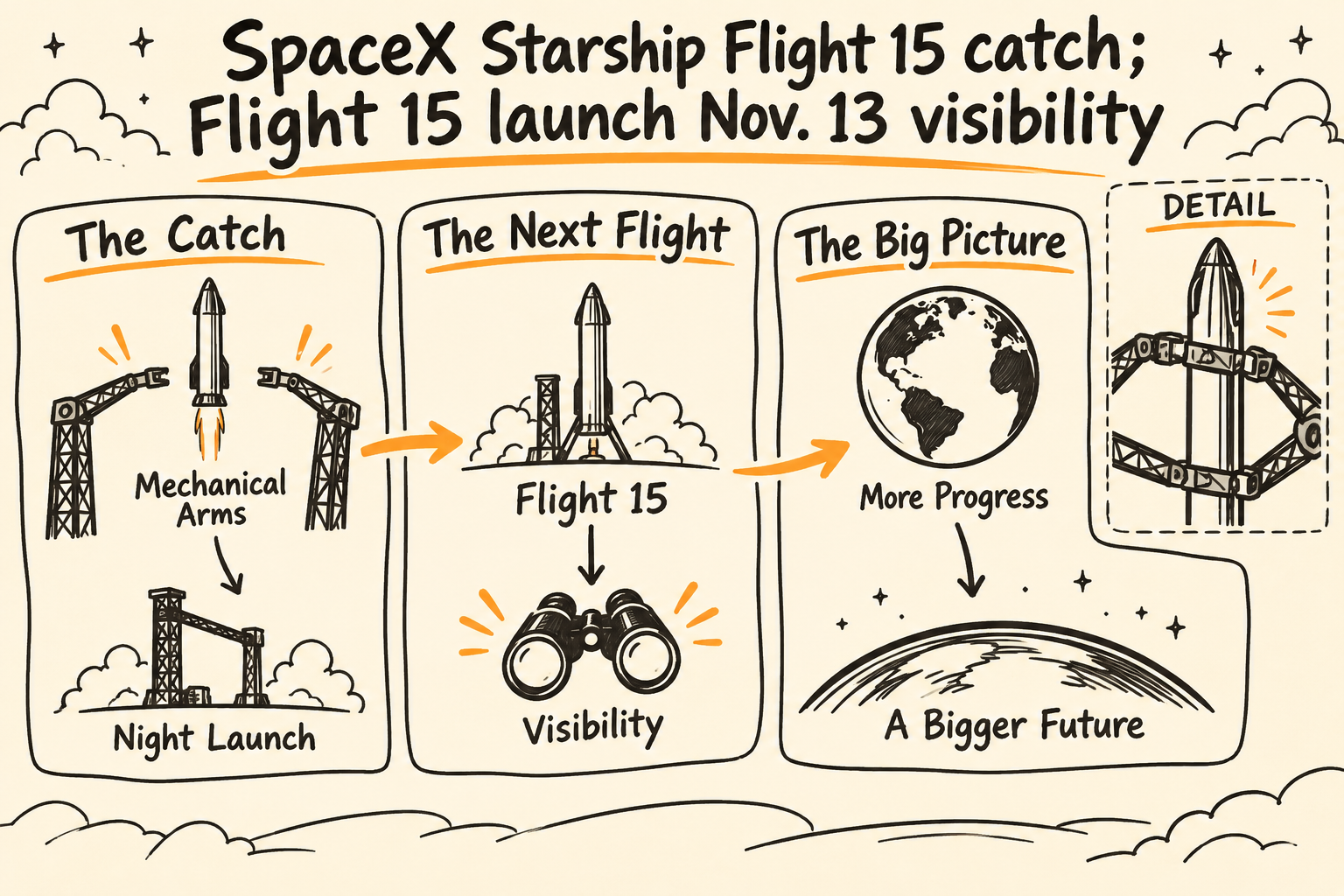
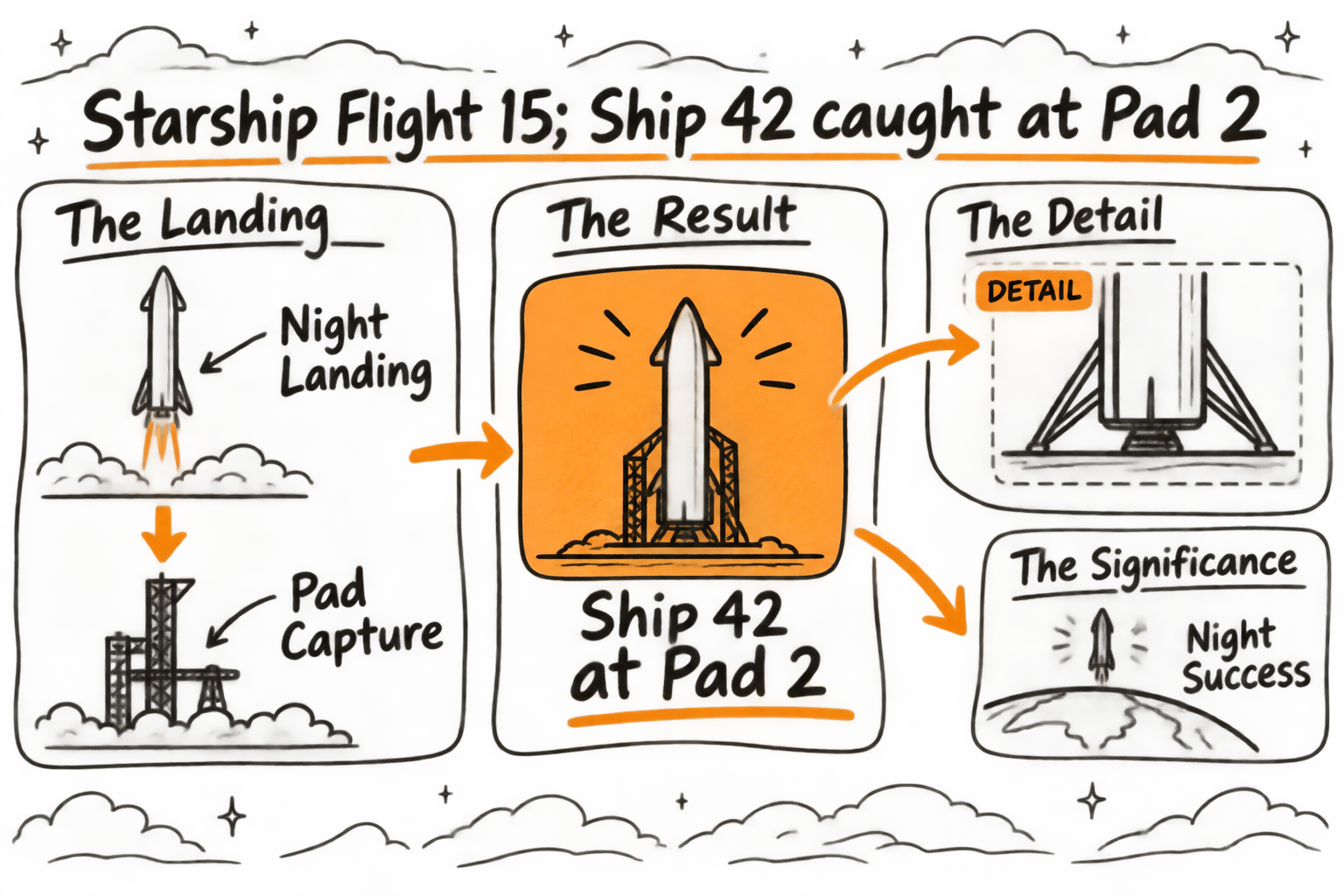
SpaceX's Starship Flight 15 represented a study in contrasts: a historic success on the second-stage recovery side and a blunt reminder that first-stage recovery remains a hazardous, unresolved engineering problem. On 13–14 November 2026 the flight returned Ship 42 to the pad where its catcher arms secured the vehicle, marking the first time a second stage of an orbital-class launcher was snagged back at its launch tower. Simultaneously, Booster 22 executed an autonomous abort and splashed down in the Gulf — its flight terminated by self-destruct safeguards as it diverted from a planned tower landing.
What happened — technical sequence
According to public accounts and SpaceX updates, Ship 42 performed nominally to orbit and carried out a precision deorbit and landing maneuver that culminated with the tower’s catcher mechanism grabbing the vehicle at Pad 2. The capture represents a clear maturation of guidance, navigation and control (GNC) for the upper stage as well as incremental reliability in the mechanical catcher and tower sensors.
By contrast, Booster 22 did not complete its return-to-launch-site profile. During descent the booster’s onboard sensors reported an unexpectedly low propellant level; the flight-control logic autonomously diverted the booster to a water landing to avoid risking damage to the launch complex. Prior to splashdown the vehicle’s self-destruct system was activated, preempting any recovery attempt. Early accounts also suggested a missing outer-ring engine at staging, though observers reported that Ship’s engines functioned correctly.
Why this pairing of outcomes matters
Spaceflight development rarely advances in uniform steps; progress is frequently asymmetric. The simultaneity of Ship 42’s capture and Booster 22’s intentional sea abort crystallizes a design and operational fact: the engineering demands for reliably returning and catching two very different hardware elements are not the same. The upper stage needs precise propulsive control in a thin-atmosphere, lower-mass envelope; the booster must survive high dynamic pressure, heavy loads, and extremely tight margins on propellant across an extended flip-and-burn sequence.
Operationally, the incident underscores an implicit tradeoff SpaceX has accepted as it pushes for cadence: aggressive flight testing with imperfect redundancy. The system-level decision to allow an autonomous diversion in the name of asset and range safety — even when it terminates the booster — reflects a prioritization of infrastructure preservation and risk management over preserving that particular recovery attempt.
Historical context
The pattern echoes earlier eras of rapid iteration in rocketry: in the 1960s, Apollo and Gemini tests frequently yielded spectacular partial successes that taught more than routine flights. Reusability programs in recent years have likewise advanced in fits and starts: Falcon 9 recovered boosters became routine only after dozens of failures and refinements. Starship’s scale magnifies that learning curve; catching a 120+ ton orbiter ascending back to the pad is a qualitatively harder problem than snagging a two-stage Falcon first stage.
Counterintuitive insights
First, success on the second stage does not imply near-term booster reusability: the dynamics and failure modes are fundamentally different, and engineering one does not automatically validate the other. Ship 42’s capture is a milestone, but it shouldn't be read as proof that full, symmetrical reuse is solved.
Second, an autonomous abort and deliberate destruction can be a sign of a mature safety culture, not merely program fragility. The self-initiated diversion of Booster 22 to the ocean — triggered by onboard sensor reporting — shows how flight-control autonomy prioritizes ground and public safety even at the cost of hardware loss. That choice preserves high-value infrastructure and personnel while still allowing lessons to be gathered from telemetry.
Implications for operations and business
Practically, the ability to return Ship 42 to the pad could lower turnaround costs for the upper stage and accelerate cadence if it proves repeatable. Pad-capture of the second stage also enables rapid refurbishment and inspection, shortening the feedback loop between tests. However, booster losses or waterings will continue to impose cost penalties until the first stage reaches consistent recoverability.
From a market perspective, the partial progress keeps SpaceX’s long-term promise of extremely low-cost, high-payload launches plausible but conditional. Customers that need immediate, predictable access may remain cautious until the booster demonstrates repeated safe returns; governments and large commercial operators typically price reliability into their contracts.
What to watch next
Track the next several flights for three signals: (1) whether Ship pad catches repeat reliably, (2) if booster V22’s telemetry leads to a software or fuel-management fix, and (3) whether the outer-ring engine failure reported at staging is isolated or systemic. Each outcome will materially affect risk models, launch cadence projections, and the economics of Starship services.
Conclusion: Flight 15 was both a milestone and a reminder. Celebrating the captured Ship is warranted — it expands what we thought recoverable — but the sea abort of Booster 22 keeps the larger goal of symmetric, low-cost reusability firmly in the testing phase. In high-stakes aerospace, asymmetric successes plus disciplined failures are the engine of progress.