Overview
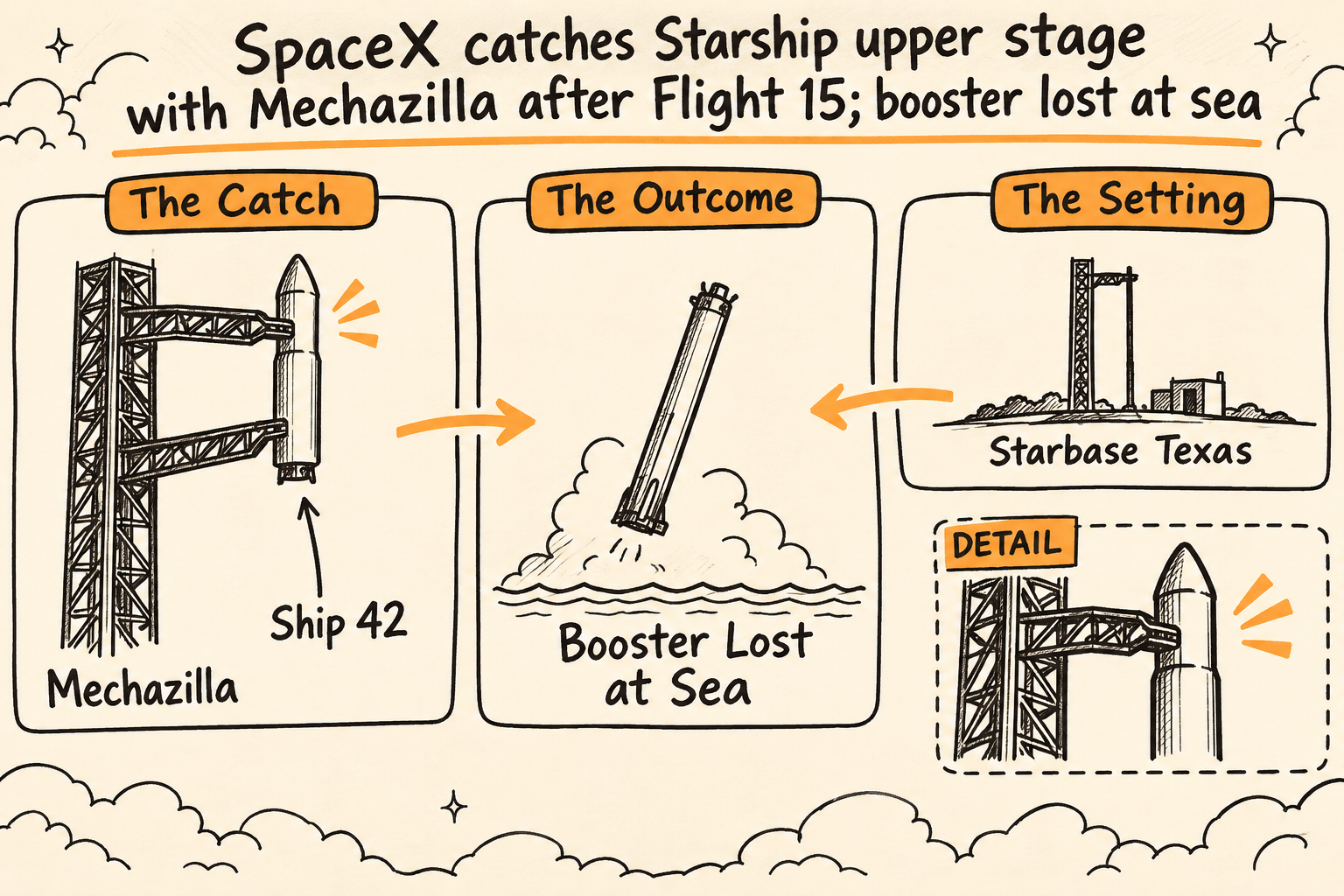
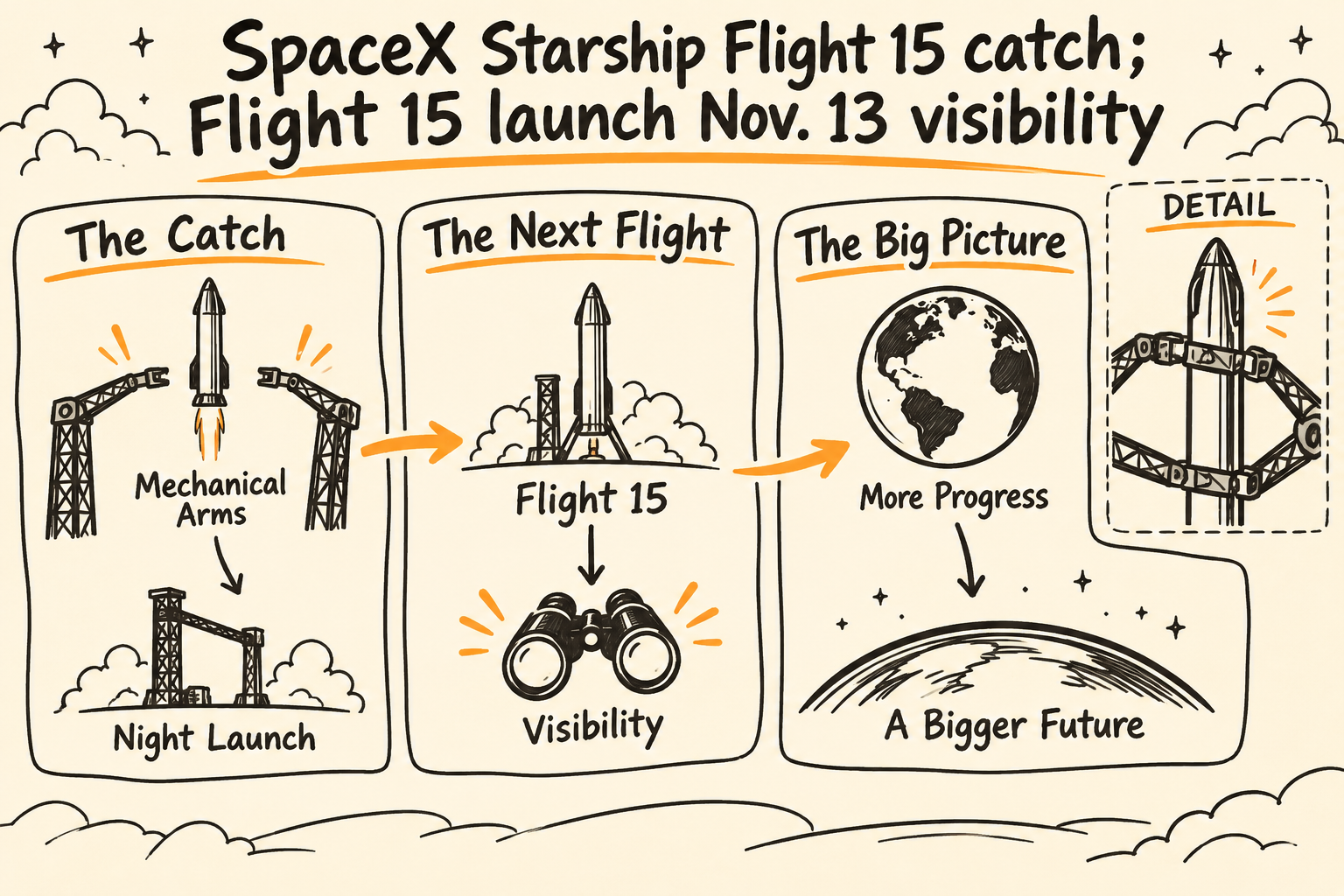
On 13–14 November 2026, SpaceX achieved what years of ambitious engineering had been driving toward: its Starship upper stage returned from orbit and was caught by the launch tower’s giant mechanical arms — the sensational "chopsticks" maneuver — even as the booster failed to be captured and splashed down. This sequence of events crystallizes a new phase in orbital launch operations where rapid reusability, complex ground infrastructure and public spectacle intersect.
Technical context and what happened
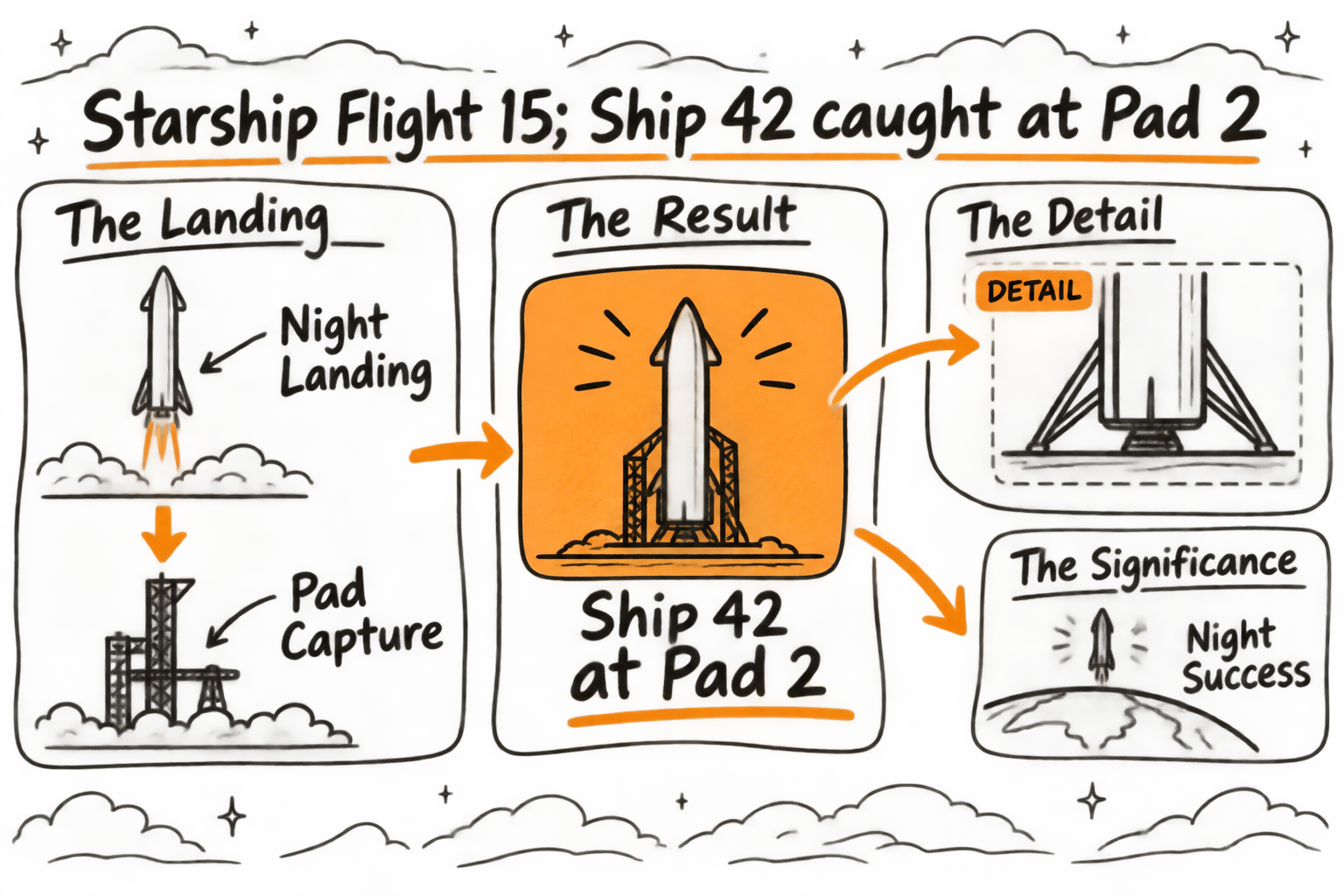
SpaceX’s Starship system is a two-stage super-heavy launch vehicle designed from the outset for full reusability. The Flight 15 mission combined a night launch visible across wide areas, a planned orbital insertion for the Starship upper stage, and a daring recovery scheme: the upper stage would re-enter, carry out a precision flip and engine burn, and be arrested mid-descent by the tower-mounted arms nicknamed "Mechazilla." After an earlier period of iterative test failures and recoveries, SpaceX aborted the booster catch — which fell into the ocean — but achieved the historic midair capture of the Starship vehicle itself. Footage and livestreams showed the vehicle settling into the arms, a moment heralded across media as a technical milestone.
Mechanically, the catch is the culmination of decades of progress: from expendable launchers to Falcon 9 boosters that land propulsively, to the new choreography of rendezvous on a pad. It requires precise guidance, autonomous control software capable of managing hypersonic re-entry aerothermodynamics, and ground systems that can tolerate and rapidly process a full orbital stage arrival.
Why this matters beyond a dramatic video
First, the economics: fully reusable large stages have long been the missing ingredient for low-cost access to orbit at scale. Catching an orbital vehicle on the pad reduces refurbishment cycles, lowers turnaround time and shifts the cost equation for high-cadence missions — from satellite constellations to crewed deep-space missions and commercial payload stacking.
Second, operational tempo and risk. The booster’s splashdown underscores a key point: reusability is probabilistic. A successful upper-stage catch does not guarantee a fully reusable system; each element (booster, stage, ground equipment) must be hardened into an integrated reliability envelope. The complexity of Mechazilla creates new single points of failure that mission planners and insurers will watch closely.
Public optics and regulatory pressure
Launching a very bright Starship at night — widely visible and often brighter than Starlink satellites — turned the mission into a public spectacle. That visibility increases public engagement but also raises questions: night launches over populated areas, sonic booms, and a visible debris or splashdown track can spur local and national scrutiny. Regulators globally are still adapting licensing frameworks to the cadence and risk profile of repeatedly reentering large objects into busy coastal airspace.
Historical parallels and scaling challenges
There’s a historical echo of aviation’s early reliability battles. Just as early jetliners required new maintenance bases, tooling and inspection regimes, the Starship era demands an ecosystem: recovery ports, specialized cranes, pad-side technicians trained for rapid turnarounds, and a supply chain for large-scale heat-shield and propulsion refurbishment. SpaceX’s success accelerates that ecosystem’s emergence, but it does not obviate the work — or the cost — of scaling it.
Future implications
Near term, expect more flights with incremental changes: repeated attempts at double-catch maneuvers, refinement of pad arrestor motions, and improvements to the booster’s deorbit guidance to avoid ocean loss. Medium term, if SpaceX reliably recovers and reflies Starship stages with low refurbishment overhead, the company will reshape launch pricing, satellite constellation economics, lunar cargo logistics and mission architectures for Mars. That shift will also concentrate more launch capability into operators who can afford Mechazilla-like infrastructure, reshaping competitive dynamics.
Internationally, other launch providers will face new benchmarks for cadence and cost. Some will pursue alternative architectures (air-launch, in-space refueling, modular smaller reusable stages) rather than replicate Mechazilla’s pad-centric approach.
Conclusion
Flight 15’s mixed result — a dramatic upper-stage capture paired with a lost booster — is precisely the kind of hybrid outcome that marks technological inflection points. It is both advance and reminder: major leaps require not just a single brilliant maneuver but the repetitive, reliable sequencing of many complex operations. For the space industry, investors, regulators and the public, the question is less whether such feats are possible (they are) and more how quickly and cheaply they can be made routine.
Space policy, safety oversight, and launch economics will now pivot from theoretical discussions of reusable orbital stages to concrete decisions about ports, recovery infrastructure, and acceptable operational risk — and Flight 15 has made those choices immediate.