Overview
In recent months a cluster of developments — the OBRIA NANO test satellite for a Ukrainian sovereign network and Greece’s ERMIS‑3 demonstration of a 1 Gbps optical downlink — have exposed an emerging policy nexus: national security, industrial sovereignty and the rapid normalisation of laser communications. These technically separate stories are connected by a shared political logic. Small, cheap experiments in low Earth orbit (LEO) are now being used as diplomatic and industrial instruments to reduce dependence on foreign providers, accelerate domestic capability, and influence regional launch and export policy.
Technical advances as policy instruments
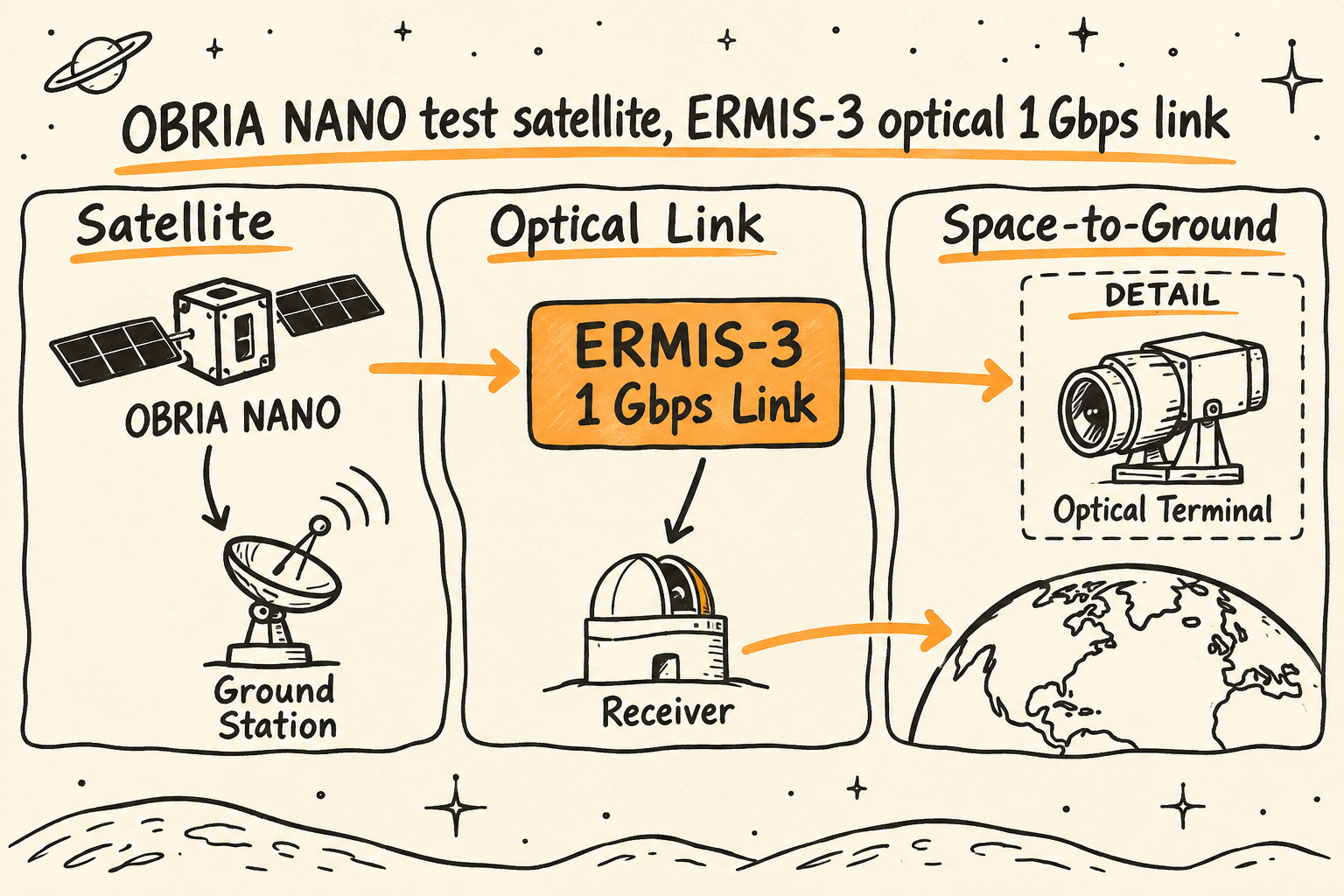
OBRIA NANO, flown on SpaceX’s Transporter‑18 and developed by Ukraine’s HIMERA with Denmark’s GomSpace, is explicitly a first step toward a Kyiv‑controlled tactical communications network. That program is paralleled by ERMIS‑3, a Greek CubeSat that has established a laser‑based 1 Gbps link to ground stations. At first glance these are engineering demonstrations; read politically, they are instrumented sovereignty. Each leverages low-cost, rapid testbeds in LEO to change the bargaining power of states and companies vis‑à‑vis dominant commercial providers.
Context and history
Historically, satellite communications and launch access have been concentrated in a small set of players — big geostationary operators, a few launch providers and the defence contractors that service governments. The past decade’s proliferation of CubeSats, hosted payloads and rideshares democratized space access. What’s new is the policy reflex: governments now subsidize or directly develop small orbital experiments to assert control over critical infrastructure. Ukraine’s drive for an independent satcom network follows a long pattern — states adopt proprietary systems in reaction to perceived strategic vulnerability. But the tools are different: instead of building huge national GEO constellations, states can validate tactical, resilient LEO architectures with cubesat testbeds at far lower cost and faster timelines.
Industry alignment and European manoeuvres
Simultaneously, pieces of the European industrial ecosystem are positioning to capture the emerging demand. ENPULSION’s integration of Orbion’s Hall‑effect propulsion, and technology demonstrations in optical downlinks from companies such as Mynaric, show a converging capability set: compact electric propulsion for satellite agility and high‑bandwidth laser links for secure, spectrum‑light communications. Those capabilities dovetail with national policy goals because they let smaller states field resilient networks without relying on legacy RF spectrum or large GEO platforms.
Launch politics and the Azores case
Launch policy is also in flux. INNOSPACE and the Atlantic Spaceport Consortium’s licensing bid to fly an orbital HANBIT‑Nano from Portugal’s Azores signals a strategic move: regional launch sites lower political and logistical barriers for European and allied projects. Local launch capability reduces reliance on U.S. or Russian/NATO ranges and can accelerate responsive launches for tactical systems — a compelling asset for states pursuing sovereign satcom.
Geopolitical pressure points — Ukraine and SpaceX
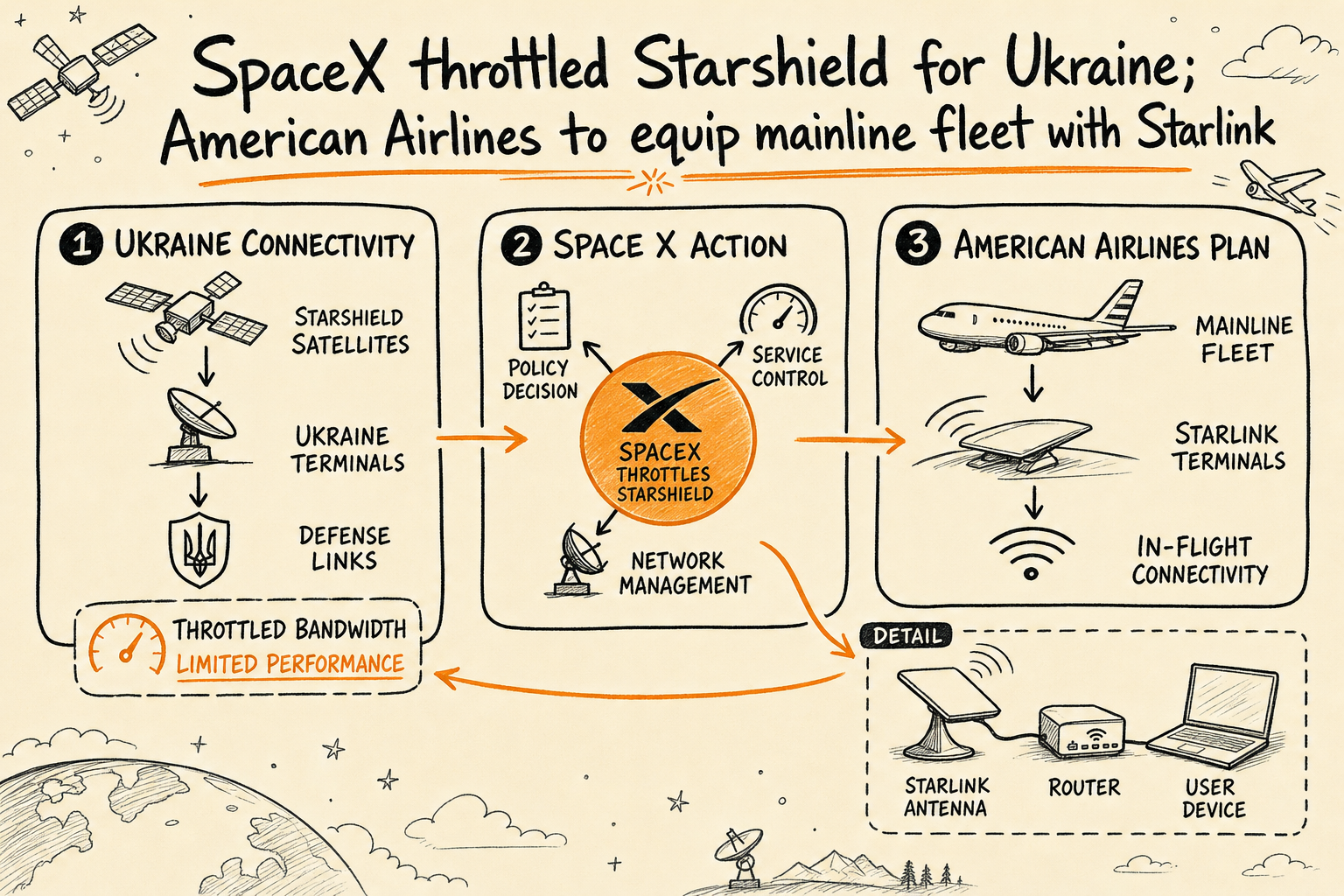
Ukraine’s negotiations for further Starshield support from SpaceX, and its simultaneous investment in a domestic LEO capability, illustrate a hedging strategy. Kyiv seeks near‑term operational bandwidth from established commercial actors while investing in sovereign infrastructure to reduce future dependence. That duality creates policy tensions: sustained reliance on commercial vendors keeps operational tempo high but leaves governments exposed to commercial constraints and outages; conversely, sovereign systems require time, capital and industrial partnerships — hence Ukraine’s blend of quick buys and indigenous tests.
Two counterintuitive insights
1) Small satellites can be more sovereign than big ones. Politically, a distributed LEO tactical network composed of many low‑cost nodes can be harder to entirely deny or coerce than a single national GEO bird. Smaller units complicate an adversary’s targeting calculus and permit incremental capability growth. In other words, miniaturisation amplifies strategic resilience.
2) Laser links increase political, not just technical, independence. Optical downlinks like ERMIS‑3’s 1 Gbps demonstration reduce dependence on crowded RF spectrum and on ground infrastructure tied to particular vendors. Laser communications can thus be a lever to bypass geopolitical chokepoints in frequency allocation and provider relationships — they shift bargaining power back toward national operators and their industrial partners.
Implications and what to watch
Policymakers and defence planners should expect three dynamics to accelerate: more national and regional testbeds launched as political signals; an industrial scramble in Europe to bundle propulsion, optical communications and smallsat platforms into turnkey sovereign solutions; and a growing market for regional launch sites such as the Azores to provide fast, politically independent access. These trends will complicate export control regimes, spectrum allocation and alliance politics, because allied nations will increasingly prefer near‑term, sovereign workarounds to long alliance procurement cycles.
For Ukraine, the near‑term priority will remain operational capacity — contracts such as Starshield, or commercial buys, will fill gaps. But the strategic payoff of projects like OBRIA NANO is long‑term: they create domestic engineering experience, anchor international partnerships on Ukrainian terms, and gradually reconfigure the policy landscape around who controls space‑enabled communications.
In short: what looks like incremental technical experimentation is, increasingly, a policy toolkit. Smallsat demos and laser links are not just proving ground hardware; they are low‑cost instruments of sovereignty reshaping how states think about communications, alliances and access to space.