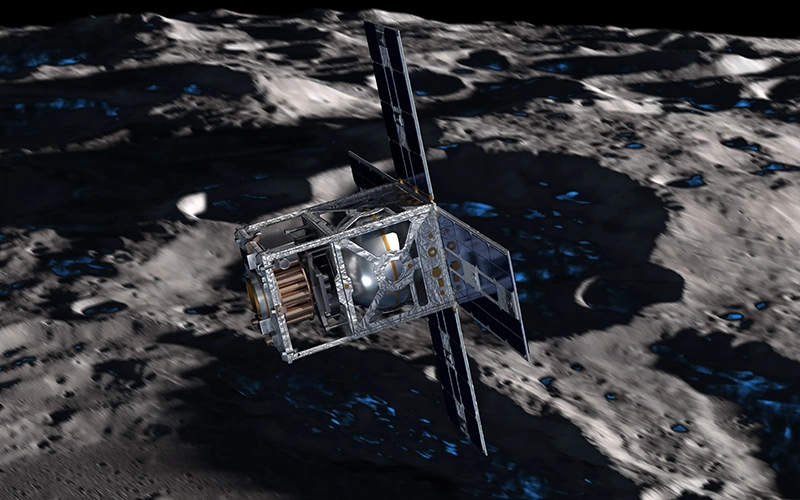
GomSpace announced on Thursday, 19 November, that it has secured an €8 million (about 89.1 million Swedish krona) Phase 2 contract to continue developing two spacecraft that will operate in lunar orbit and conduct resource prospecting. The company's announcement called the customer only a “leading North American space company”. It said the mission would “deploy two satellites into orbit around the Moon to conduct resource prospecting in support of future lunar exploration.”
The customer GomSpace has not named in its release
GomSpace's own announcement did not name Blue Origin. The link comes from the company's investor communications, as reported by European Spaceflight. On the Q1 earnings call in May, CEO Carsten Drachmann said GomSpace was working on a mission for Blue Origin involving “two satellites orbiting around the moon.” In the Q3 2026 investor presentation earlier this month, he said the mission was “about mapping out the moon” and “looking for minerals” to mine.
According to European Spaceflight, the two spacecraft are being built for Oasis-1, the first mission under Blue Origin's Project Oasis initiative. Project Oasis was unveiled in September 2025 and aims to identify, assess and eventually use resources found on the Moon. It is being developed with Luxembourg. In June 2025, Blue Origin signed a cooperation agreement with Luxembourg's Ministry of the Economy and announced plans for a European office in the country.
Oasis-1 will map lunar resources, including water ice, helium-3, rare earth elements and precious metals. The mission is meant to identify potential extraction sites and assess the availability of materials that could eventually support a sustained human presence on the Moon.
Phase 2 runs from detailed design to US payload integration
Phase 2 follows a €2.9 million Phase 1 contract announced on 9 January 2026, which covered the preliminary design of the two spacecraft. Together the phases bring the project's value to €10.9 million.
Under the new phase, GomSpace will complete detailed spacecraft engineering and a Critical Design Review. It will then move to flight-hardware manufacturing and the integration of scientific payloads in the United States. Delivery is expected in late 2027. GomSpace says that schedule positions the dual-satellite system for U.S. launch operations and subsequent lunar orbit insertion.
Edgar Milic, GomSpace's vice president of advanced missions, said in the release: “This contract marks an important milestone for GomSpace and highlights our capability to deliver reliable, high-performance systems for complex exploration missions. By leveraging our deep-space heritage, we are proud to contribute to advancing lunar exploration and enabling future resource utilization beyond Earth.”
Hera heritage and the move beyond subsystems
To meet the radiation, navigation and reliability demands of cislunar flight, GomSpace says it is drawing on engineering heritage from the European Space Agency's Hera planetary defence mission, including its work on the Juventas CubeSat. The work is carried out by the company's advanced missions engineering teams, including its Luxembourg operations. It adapts modular deep-space small-satellite architectures for sustained operations beyond Earth orbit. GomSpace says this foundation lets it progress from supplying individual subsystems to delivering complete mission solutions.
Blue Origin was also one of eight companies NASA selected on 7 November for its new CLPS 2 lunar delivery contract, a 10-year framework with a combined maximum value of $10 billion. NovΔ mAInd reported the selection alongside Firefly Aerospace, Intuitive Machines, ispace-U.S., Lockheed Martin, Northrop Grumman, SpaceX and Voyager Technologies.
According to NovΔ mAInd's launch database, Blue Origin has 13 launches tracked, a 92.3% success rate, a most recent launch on 2026-04-19, and a listed capacity of 45000 kg to LEO. The sources do not say which vehicle will launch the Oasis-1 satellites.