Executive summary
In three weeks in November 2026 the space economy offered a compact lesson in how capital, sovereignty and sensor capability are reshaping industry structure. ICEYE’s €2.0–2.05 billion all-cash takeover bid for Italian launcher and missile-builder Avio; the company’s simultaneous announcement of a next-generation synthetic aperture radar (SAR) with 11 cm resolution; LeoLabs’ acquisition of missile-defense engineering firm FishEye; and India’s SatSure raising $21 million with backing from a sovereign space-technology fund are not isolated items. Taken together, they reveal an accelerating trend: commercial players are pursuing vertical integration and defense-aligned capabilities while national actors use targeted capital to secure domestic capability and dual-use technologies.
Historical context
The post-Cold War era saw a decades-long separation between commercial satellite services and sovereign launch and defense capabilities. Launch providers and missile contractors traditionally sat in the government domain; commercial satellite operators focused on imagery, communications and data analytics. The last ten years have blurred that boundary. U.S. policy shifts, large private capital inflows, and the maturation of high-resolution sensors have incentivized companies to assemble end-to-end stacks—from sensors to satellites to the rockets that loft them—under single corporate roofs.
What ICEYE’s bid for Avio signals
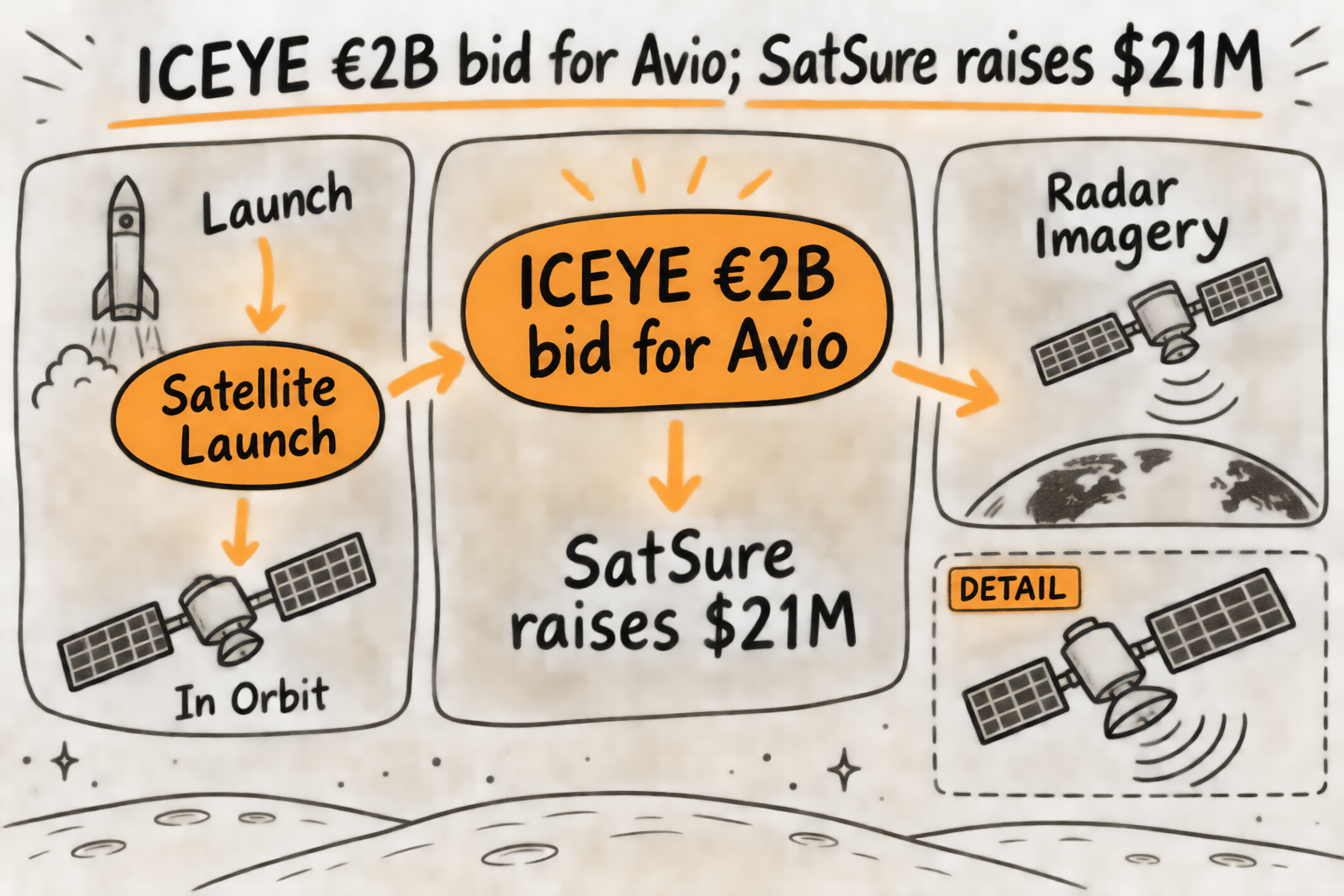
ICEYE’s all-cash €2–2.05 billion bid for Avio is a bid for more than manufacturing capacity. It is a bet on European strategic sovereignty in launch and resilient imaging. By folding Avio’s small- to medium-class launchers and missile heritage into its SAR-dominant portfolio, ICEYE would immediately close a capability gap: control of payload and delivery. That vertical integration short-circuits third-party dependencies at a time when European policymakers worry about reliance on U.S. systems and supply chains.
ICEYE’s pledge to invest another €1 billion in Italy if the deal succeeds is politically savvy: it frames the takeover not as an extraction of a strategic asset but as industrial renewal. Yet the move raises friction points. Avio’s suppliers, Italian regulators and European defense stakeholders will scrutinize how intellectual property, export controls and governance are handled. The bid also illustrates a counterintuitive fact: consolidation can be framed as a sovereignty-enhancing move even when it concentrates capabilities in fewer corporate hands.
Sensor upgrades change the game
ICEYE’s announcement of a fifth-generation SAR capable of 11 cm resolution for sovereign customers (16 cm commercially) is more than a product launch; it alters the value proposition of imagery. At sub-decimeter scale, SAR can reveal small vehicle movements, temporary structures and finer tactical details in all weather and night. When combined with assured launch capacity from Avio, such sensors become strategic assets rather than mere commercial data sources. That’s one reason defense-minded buyers and sovereign funds are now comfortable investing in firms that historically were purely commercial imagery providers.
Parallel moves: India and sensing-as-sovereignty
SatSure’s $21 million Series B, with investment from India’s sovereign space-technology fund, reflects the same logic from the demand side. New Delhi is directing capital toward domestic analytics and imagery firms that can provide decision-quality data to agriculture, infrastructure, and defense users while staying under Indian control. This is pragmatic hedging: India expands commercial capability without ceding critical data streams to foreign entities. It also highlights a regional divergence—Europe is seeing private consolidation into vertically integrated firms, whereas emerging powers like India combine private growth with explicit public financial backing.
Other consolidation signals
LeoLabs’ purchase of FishEye, an engineering firm focused on missile defense and space awareness, complements the picture: companies that once specialized in space situational awareness (SSA) and debris tracking are moving into defense-relevant engineering and mission assurance. The industry is not only integrating up (sensors to launch) but sideways—adding missile-defense, SSA and analytics capabilities to make end-to-end service offerings for governments and large enterprises.
Two surprising, counterintuitive insights
1) Bigger players can increase national sovereignty. Conventional wisdom treats consolidation as a risk to competition and resilience. Yet in the current geopolitical environment, a well-structured acquisition (ICEYE+Avio) can reduce reliance on foreign launchers and create a European-controlled stack that governments may prefer.
2) Highest-resolution commercial imaging accelerates defense-style procurement, not just commercial demand. Sub-decimeter SAR, once purely a commercial differentiator, now functions as a strategic capability that attracts sovereign funding and merger interest—closing the loop between sensors, launch, and state security needs.
Implications and what to watch
If regulators approve ICEYE’s bid, expect a wave of M&A around vertically integrated models: satellite operators eyeing launch capacity, analytics firms acquiring SSA or missile-defense expertise, and sovereign funds making targeted minority investments to keep control over data flows. Policymakers will need new export-control frameworks and industrial strategies that balance competition with strategic autonomy.
For investors, the thesis is clear: capabilities that sit at the intersection of commercial value and sovereign utility—high-resolution sensors, assured launch, SSA—will command premiums and political support. For smaller firms, the pathway will often be acquisition or partnership rather than independent scaling.
Conclusion
The recent cluster of transactions and fundraises shows a market re-prioritizing sovereignty, resilience and full-stack control. Whether Europe’s and India’s approaches converge or maintain distinct flavors will shape who builds, owns and governs the next decade of orbital infrastructure.