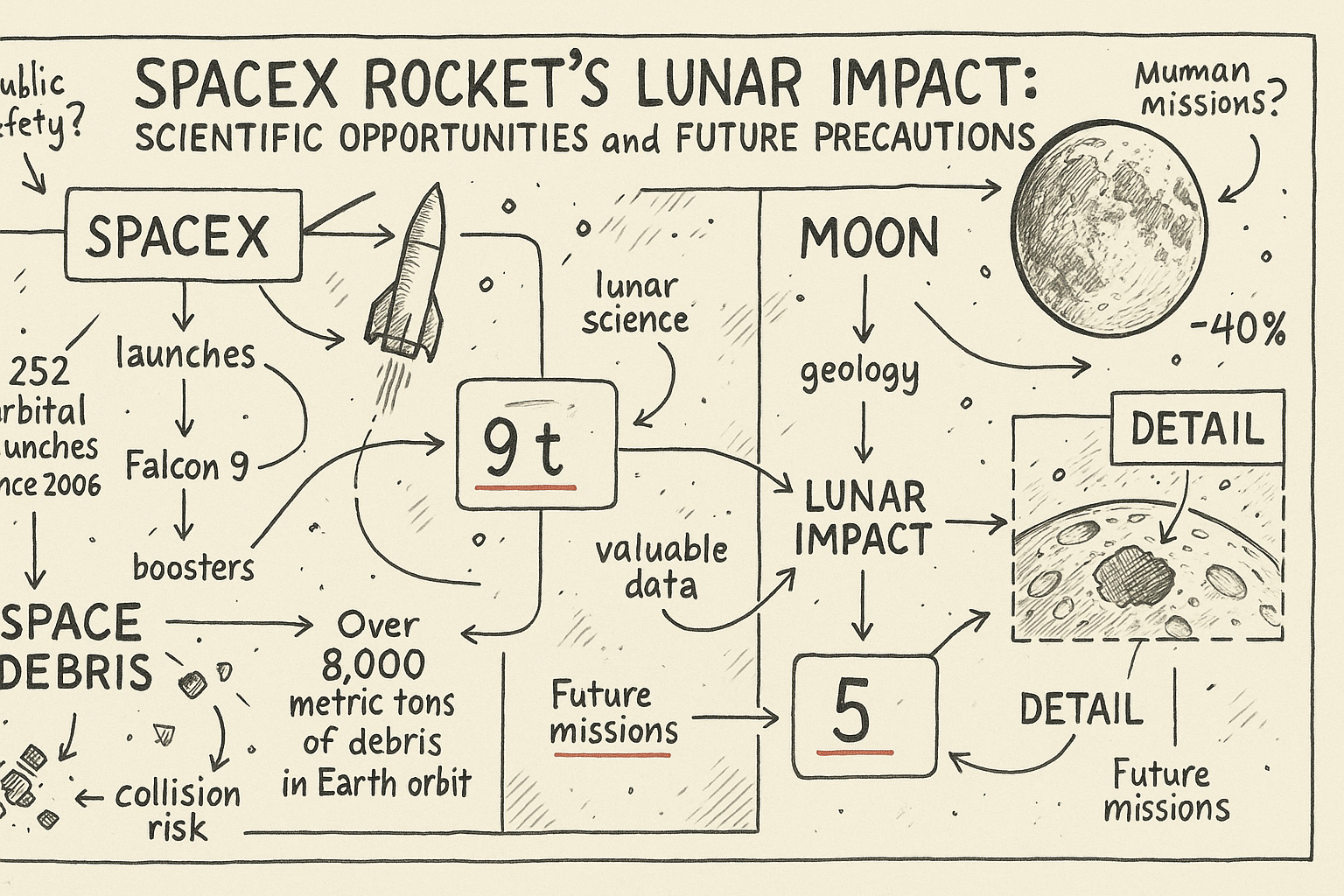
On August 5, a SpaceX Falcon 9 rocket stage, weighing approximately 3,900 kilograms, is expected to crash into the Moon at a speed of 2.43 km/s. This event presents a rare opportunity for astronomers to study the impact and its effects on the lunar surface. The collision is anticipated to create a flash that might be visible from Earth, although it will be brief due to the impact occurring on the Moon's illuminated side.
The Falcon 9 upper stage involved in this collision was part of a mission launched in January 2025, which successfully delivered lunar landers for Firefly Aerospace and ispace. However, the upper stage was left adrift in space as it lacked sufficient fuel to return to Earth or enter a stable orbit. As a result, it has been on a collision course with the Moon for the past year and a half.
The impact is expected to generate an explosion equivalent to 3 metric tons of TNT, creating a crater up to 27 meters in diameter and 5 meters deep. This event raises significant questions about the implications of space debris on future lunar exploration, especially concerning the safety of potential lunar bases.
Scientific Opportunities
Astronomers are keenly observing this event to gather data on the impact's effects on the lunar surface. Such data can provide insights into the Moon's geological characteristics and the behavior of materials upon high-velocity impacts. The observation of this collision can also help refine models used to predict the outcomes of similar impacts, which is crucial for planning future lunar missions.
Preventing Future Collisions
In response to this incident, SpaceX is collaborating with NASA to explore methods to prevent future upper stage collisions with the Moon. This collaboration aims to develop strategies to ensure that rocket stages either return safely to Earth or are placed in stable orbits, minimizing the risk of unintended impacts. The growing concern over space debris highlights the need for improved mission planning and debris mitigation strategies as space exploration activities increase.
The upcoming impact serves as a reminder of the challenges posed by space debris in the context of expanding lunar exploration efforts. As the space race intensifies, ensuring the safety of lunar infrastructure and minimizing the environmental impact of space activities will be critical priorities for space agencies worldwide.