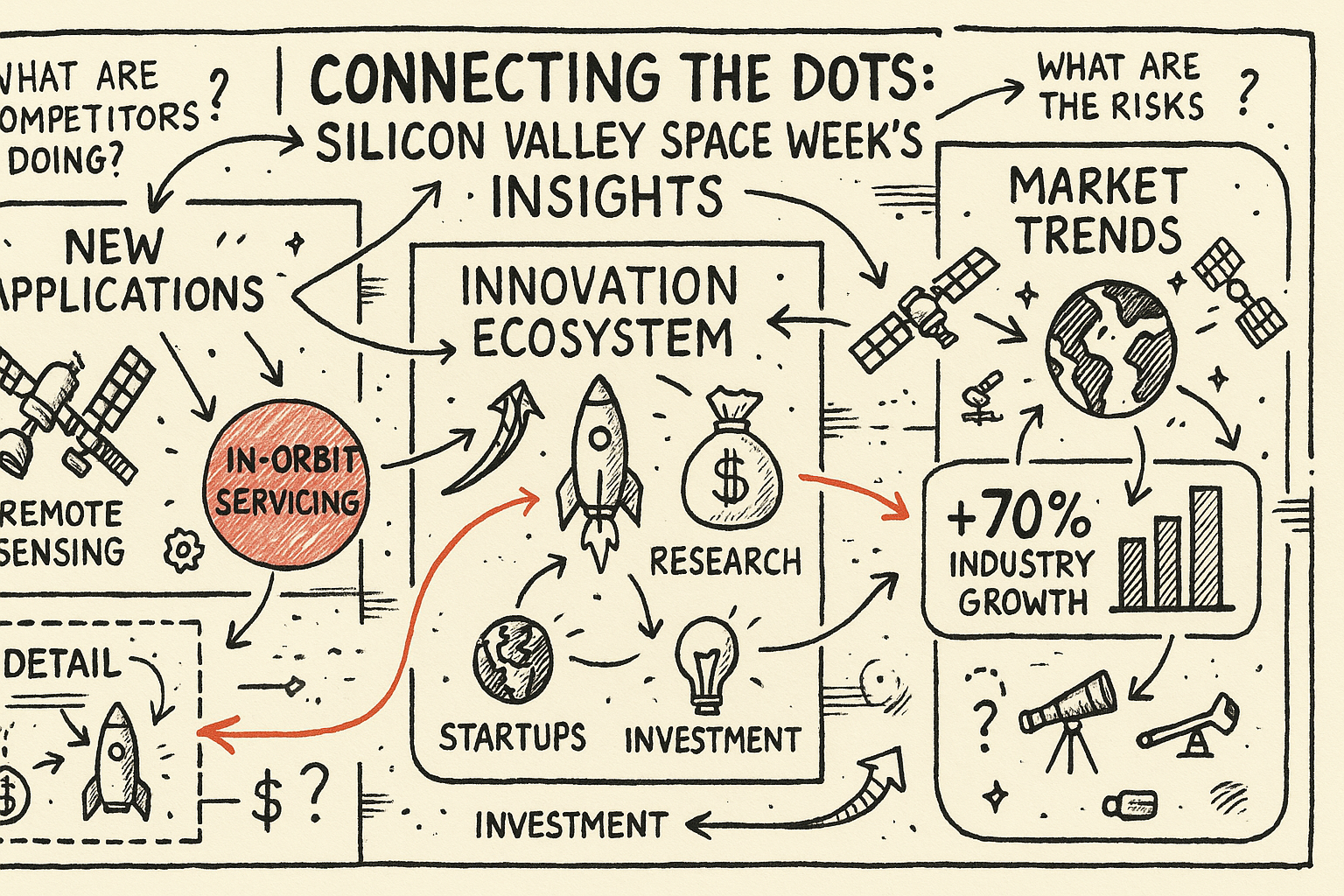
Silicon Valley Space Week has become a critical junction for discussions on the future of the space industry. This year's event brought together key stakeholders who are redefining the landscape of space exploration and commercial activity. From new technological paradigms to policy shifts, the conference highlighted several trends and innovations that promise to shape the future of space.
A New Horizon for Satellite Operations
The conference underscored the growing importance of satellite servicing and refueling as a cornerstone of sustainable space operations. Astroscale U.S., represented by Janna Lewis, is leading efforts with a $25.5 million refueling spacecraft awaiting deployment to geostationary orbit. This move is part of a broader trend towards enhancing the longevity and functionality of satellites (Source 1).
Complementing this development, Dr. Robert Antypas from the Air Force Research Laboratory discussed the Space Force's upcoming on-orbit refueling demonstration, now scheduled for early 2027. The initiative aims to test the viability of extending the operational life of existing satellite assets, a crucial capability as orbital congestion increases (Source 3).
Network Expansions and Open Standards
Another pivotal theme was the expansion of satellite constellations. Eutelsat's commitment of €3.39 billion to Europe's IRIS² low Earth orbit constellation marks a significant investment in global connectivity. As Ian Canning highlighted, this project positions Eutelsat as a leader in the LEO segment and underscores the competitive dynamics in satellite internet services (Source 2, 5).
Astrolight's advancement of an open-standard laser communication architecture aims to dismantle the vendor lock-in prevalent in mega-constellations like SpaceX's Starlink. This shift towards interoperability could democratize access to satellite networks, fostering innovation across a broader range of vendors and users (Source 4).
Strategic Implications for Spectrum and Defense
Spectrum management emerged as a critical issue, with the NTIA tasked with identifying 500 megahertz of new spectrum by 2027. This endeavor, spearheaded by Scott Patrick, is essential for accommodating the growing demand for satellite communications and ensuring robust network capabilities (Source 7).
On the defense front, Phil Carrai from Kratos presented insights into the development of the Golden Dome interceptor layer. With twelve companies competing against a 2028 deadline, the initiative reflects the ongoing militarization of space and the strategic imperative for advanced missile warning systems (Source 8).
Commercialization and the Next Frontier
The ambitions of Cowboy Space Corporation to deploy up to 20,000 orbital data center satellites further illustrate the rapid commercialization of space. Joseph Yaffe emphasized the transformative potential of such infrastructure in supporting data-intensive applications and expanding the economic reach of space activities (Source 6).
Taken together, these discussions provide a comprehensive view of where the space industry is headed. The interplay between technological innovation, policy frameworks, and commercial ambitions will determine how effectively the industry can navigate the challenges of an increasingly crowded orbital environment.
Surprising Insights and Future Directions
A surprising insight from the event is the emphasis on open standards in an industry historically dominated by proprietary systems. This shift could catalyze new partnerships and lower barriers to entry, driving further innovation. Moreover, the strategic focus on satellite refueling and servicing suggests a paradigm shift towards sustainability and long-term asset management in space operations.
As the industry continues to evolve, stakeholders must address the complexities of spectrum allocation, orbital debris, and international collaboration. Silicon Valley Space Week has reinforced the need for a coordinated approach that balances competitive interests with the collective goal of sustainable space exploration and utilization.