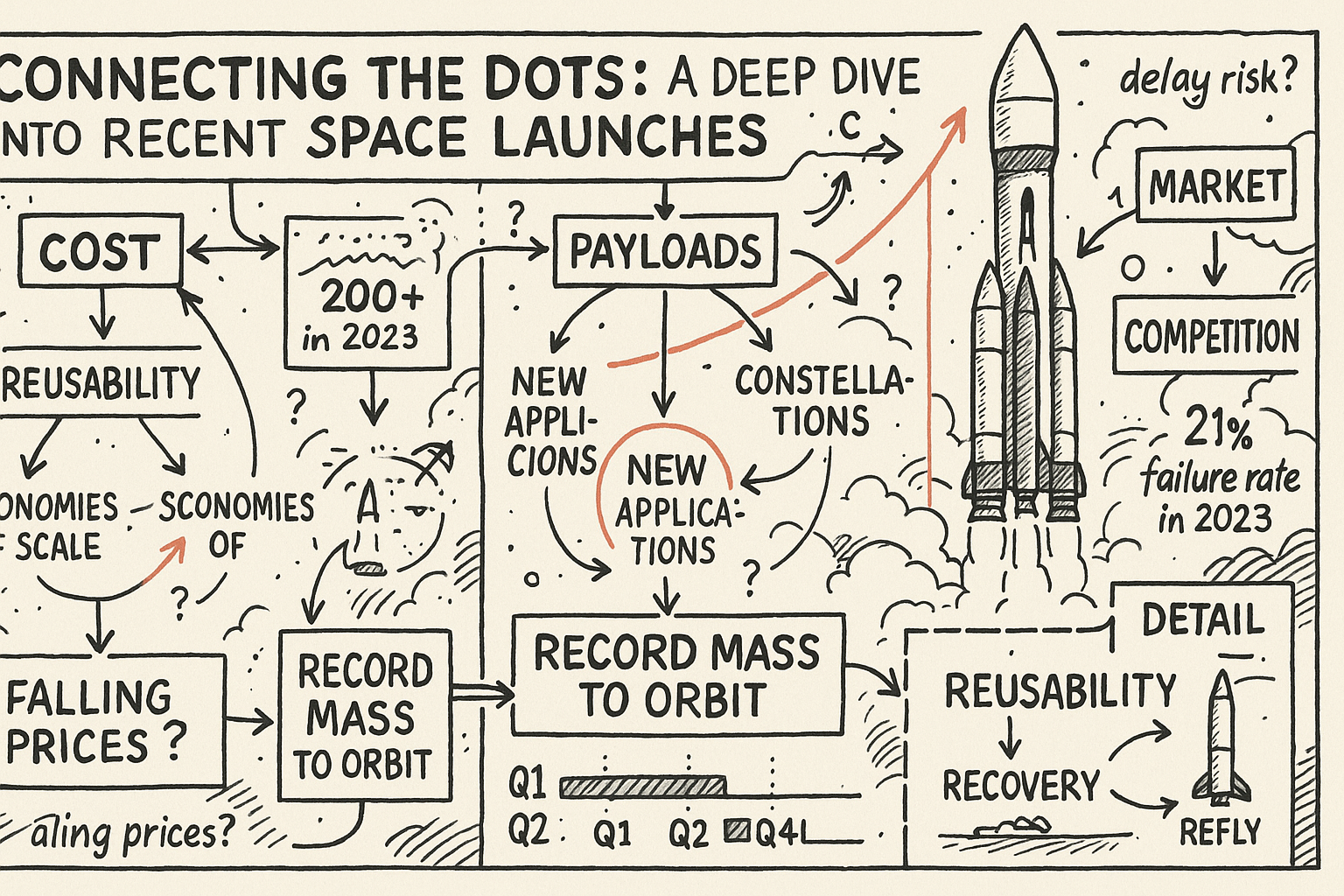
In the ever-evolving landscape of space exploration, recent launches by Rocket Lab, SpaceX, and JAXA have highlighted significant trends that are reshaping our understanding of space access and utilization. These launches not only demonstrate technical prowess but also signal the maturation of the commercial space sector and the growing importance of international collaboration.
The Rise of Commercial Launch Providers
One of the most striking aspects of recent launch activities is the dominant role played by commercial entities like SpaceX and Rocket Lab. SpaceX's achievement of 100 missions this year is a testament to its operational efficiency and engineering capabilities. This milestone is not just a numerical achievement; it reflects a broader shift in the space industry where private companies are increasingly taking the lead in launching payloads to orbit.
Rocket Lab's recent launch of a Japanese Earth-observing satellite is another example of the growing international collaboration facilitated by commercial launch providers. By providing reliable and cost-effective access to space, companies like Rocket Lab are enabling nations and private entities to pursue ambitious satellite missions that were previously the domain of government agencies.
Technological Advancements and Operational Efficiency
SpaceX's preparation for the first orbital flight of its Starship megarocket marks a significant technological milestone. The Starship is designed to carry large payloads and crew to destinations beyond Earth's orbit, including Mars. This capability, once realized, has the potential to revolutionize human space exploration and open up new possibilities for interplanetary travel.
Similarly, JAXA's launch of MICHIBIKI No. 7 aboard an H3 launch vehicle underscores the advancements in satellite navigation systems. The Quasi-Zenith Satellite System (QZS) enhances GPS capabilities for Japan, providing more accurate and reliable positioning services, particularly in urban environments where signal obstruction is common.
Strategic Implications and Future Prospects
The strategic implications of these launches are profound. As commercial and national actors continue to launch more satellites, the potential for enhanced global connectivity and data collection becomes increasingly feasible. This is crucial for applications ranging from climate monitoring to global internet coverage, which are vital for sustainable development.
Moreover, the success of these recent launches illustrates a growing trend towards international collaboration. As nations recognize the benefits of pooling resources and expertise, we can expect to see more joint missions and partnerships in the future. This collaborative approach not only spreads the financial risk but also accelerates technological advancements.
A Counterintuitive Insight
One surprising insight from these developments is the potential for commercial launches to drive regulatory changes. As companies like SpaceX and Rocket Lab push the boundaries of what is possible, they also challenge existing regulatory frameworks. This could lead to a reevaluation of space law and policy, encouraging more adaptive and forward-thinking regulations that balance innovation with safety and sustainability.
In conclusion, the recent spate of launches is more than just a series of technical achievements. They are indicative of broader trends and shifts within the space industry, encompassing commercial dominance, technological innovation, and strategic international cooperation. As we look to the future, these launches set the stage for a new era of exploration where space is increasingly accessible, collaborative, and integral to global progress.