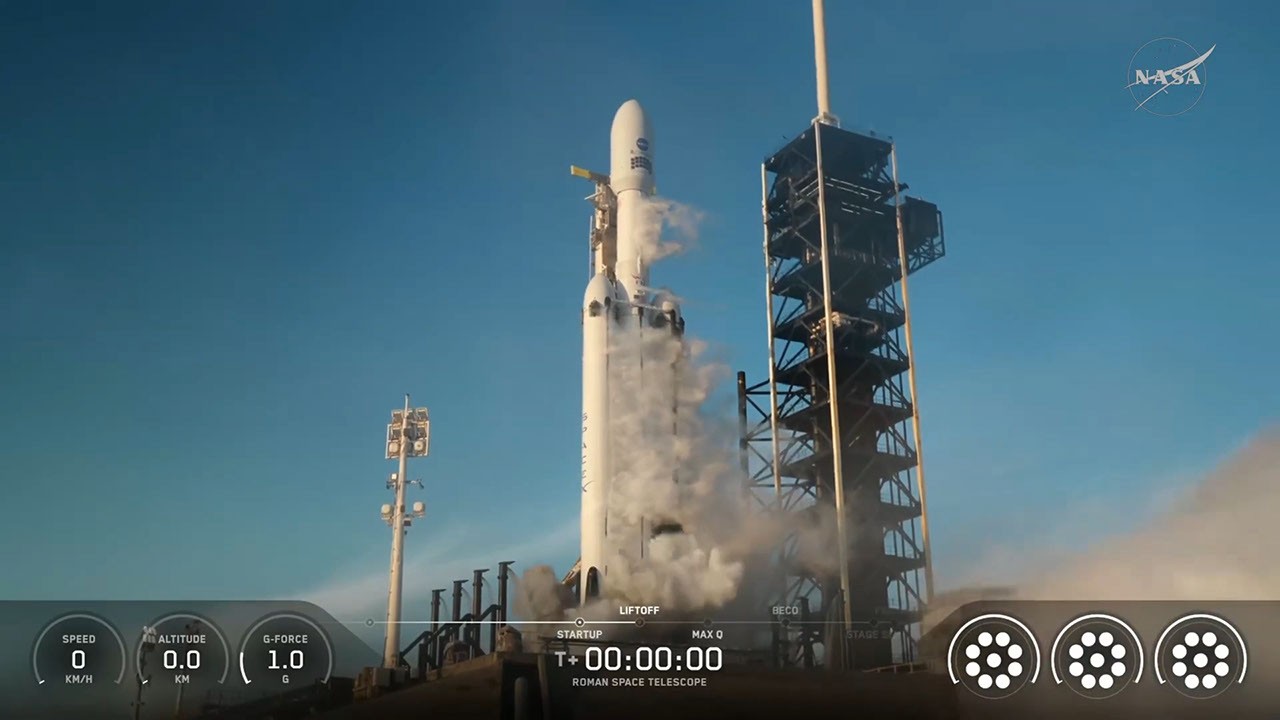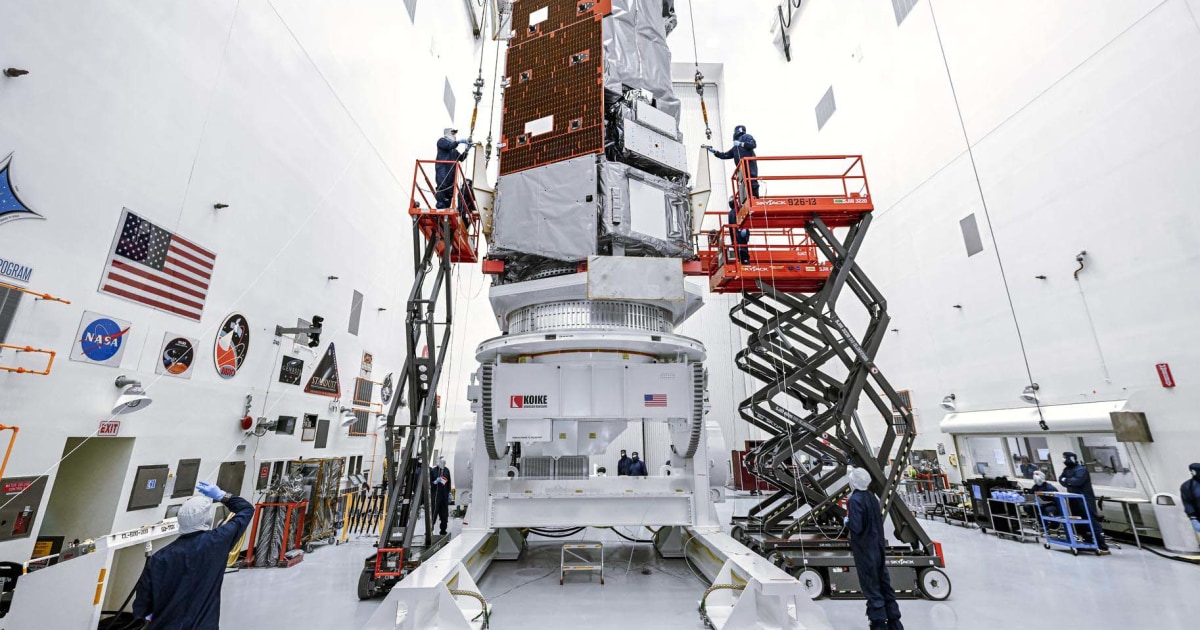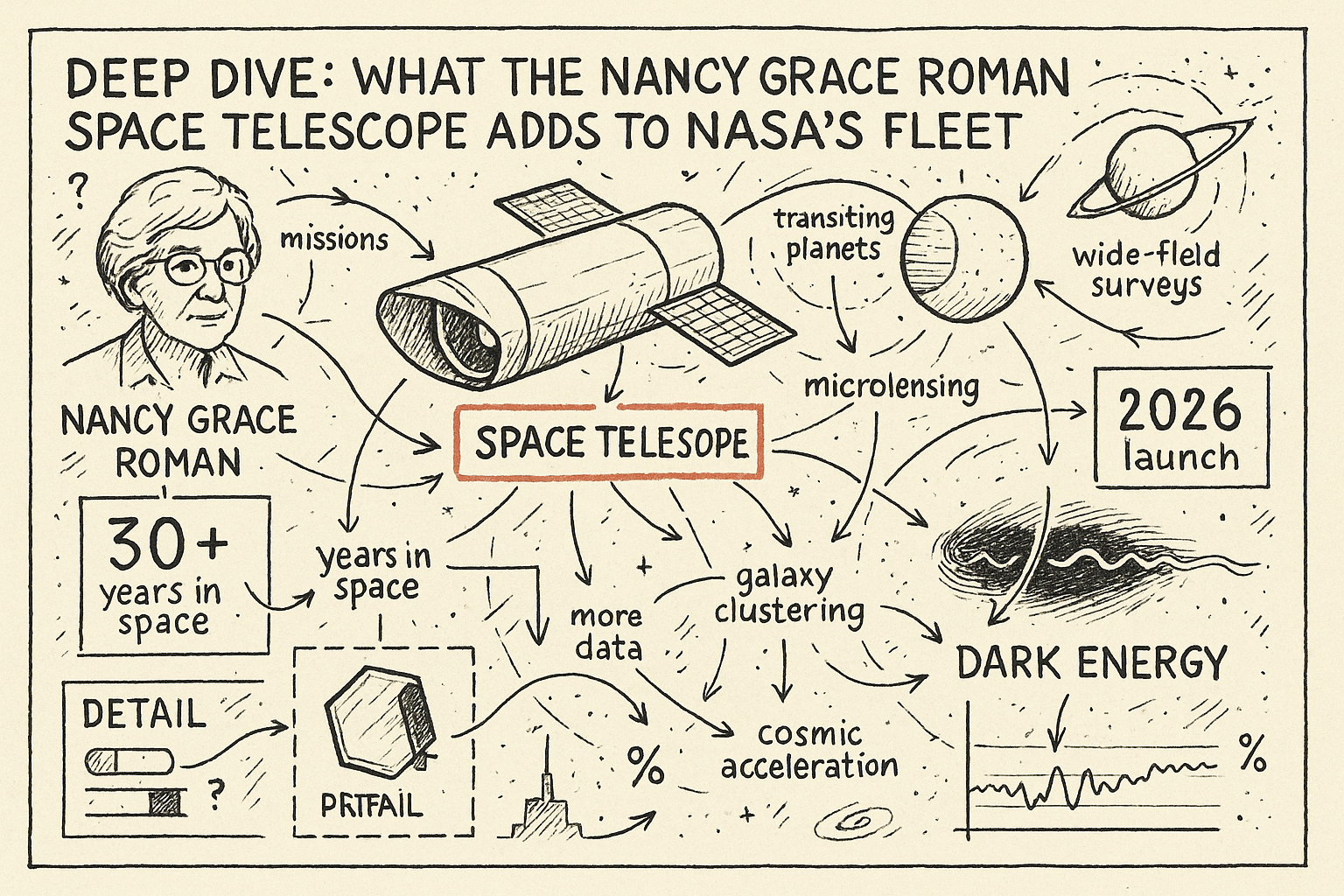
NASA’s Nancy Grace Roman Space Telescope lifted off on Aug. 30, 2026, aboard a SpaceX Falcon Heavy from Kennedy Space Center and is headed to an observation point roughly 1 million miles (1.6 million kilometers) from Earth. The launch marks the start of a multiyear mission designed to produce very large-area surveys of the sky and probe outstanding problems in cosmology and exoplanet demographics.
Unlike Webb and Hubble, the Roman telescope was explicitly designed for panoramic surveys. Multiple outlets noted Roman’s unusually wide field of view: the BBC highlighted that it will capture views at least 100 times larger than Hubble’s field, enabling sky maps at scales those observatories cannot routinely achieve. That survey capability underpins the mission’s twin emphases on dark energy and exoplanets.
Exoplanets at scale
Reports emphasize Roman’s role in finding planets beyond our solar system. NPR described the observatory as “tour-bus-sized” and said it aims to identify more than 100,000 exoplanets, a scale of discovery that would substantially expand known populations. Phys.org and other outlets characterized the telescope as a planet hunter whose survey power will allow astronomers to study exoplanet demographics across a broad swath of the sky rather than focusing on individual targets.
That statistical approach to exoplanet science is one of Roman’s defining features: by surveying large sky areas with high sensitivity, it will fill parameter-space that targeted missions and ground-based surveys sample more sparsely. The Planetary Society noted the telescope’s importance for reshaping knowledge about planets across the galaxy.
Dark energy, dark matter and cosmic mapping
Roman’s other principal science drivers are cosmological. Coverage from Phys.org and the BBC stressed that the spacecraft will contribute to investigations of dark energy and dark matter by creating new, unprecedented maps of the cosmos. Those maps are expected to inform studies of how the universe’s expansion and structure evolve over time, a key objective cited repeatedly in the coverage.
The mission sits alongside NASA���s other flagship observatories in a complementary role: while Webb conducts deep, targeted studies and Hubble provides versatile imaging and spectroscopy at high resolution, Roman will trade fine detail for breadth, surveying enormous areas to reveal statistical trends in galaxies, dark matter distribution, and the influence of dark energy.
Orbit and operational context
Roman will operate from a distant observation point approximately 1 million miles from Earth, the same general region that already hosts the Webb Space Telescope. Phys.org reported that Roman was launched toward that observation point, and multiple sources placed the distance at about 1 million miles (1.6 million kilometers). Being positioned there supports stable, long-duration observations across wide fields.
Financial and program context also appeared in reporting: Phys.org stated the mission cost at $4.3 billion, and coverage noted that the telescope represents a major NASA flagship observatory addition to U.S. space astronomy capabilities.
What this new reporting adds
Previous pieces have described Roman’s general goals and engineering, but the new wave of reporting arriving around launch emphasizes three concrete distinctions: the mission’s exceptionally wide field of view (at least 100 times Hubble’s field, per BBC), a targeted quantitative exoplanet yield (more than 100,000 planets, per NPR), and its placement roughly 1 million miles from Earth alongside Webb, which positions Roman to deliver large-area surveys complementary to those telescopes’ strengths. Together these elements frame Roman not as a replacement for Webb or Hubble, but as a survey-driven complement that will provide the statistical backbone for many future, more detailed investigations.
As Roman begins its transit to the distant observation point, astronomers and mission planners will turn those survey capabilities toward the twin puzzles of dark energy and exoplanet populations, and the massive sky maps it produces will be a resource for astronomy for years to come.