Tokyo Metropolitan University tests magnet-powered aerobraking with MX-6.0
Tokyo Metropolitan University has built an 8-metre expansion tube facility named MX-6.0 and companion test hardware to experimentally study magnetohydrodynamic (MHD) braking for atmospheric reentry, reproducing shock conditions representative of high-speed reentry up to 7.7 km/s. The test setup combines a high-energy Pulse Forming Network (PFN) and strong electromagnets to generate transient magnetic fields and observe how those fields interact with ionized shock layers that form in front of a reentering vehicle.
The MX-6.0 facility fires shockwaves similar to those a spacecraft would experience during reentry and strikes miniature test modules with shock speeds reaching 7.7 km/s. To evaluate different magnetic designs, the team built two 20 mm test modules with distinct magnetic characteristics and exposed them to high-speed shock conditions inside MX-6.0. The objective is to quantify how magnetic fields can alter the plasma layer, reducing heat transfer to the vehicle surface and increasing aerodynamic drag through Lorentz forces acting on the weakly ionized gas.
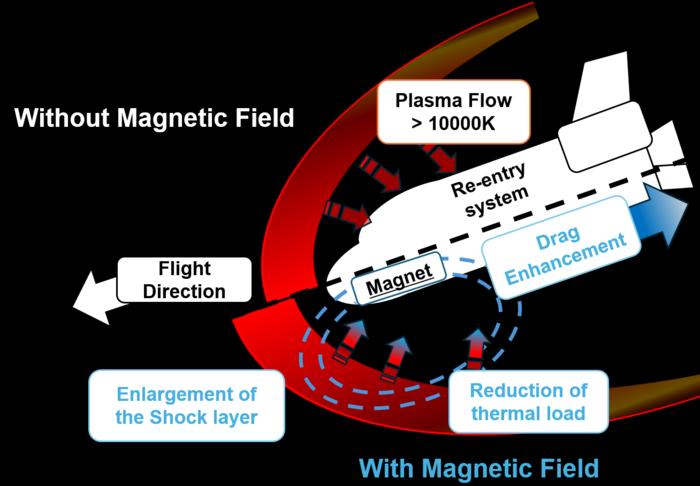
Magnetohydrodynamic braking uses an imposed magnetic field from the spacecraft to push against the ionized gas that forms ahead of a vehicle at hypersonic speeds. The Lorentz force — the fundamental electromagnetic force on charged particles — can in principle create a “magnetic cushion” that both lowers thermal loads on the heat shield and increases drag to slow the vehicle. MHD braking has been proposed as an alternative or complement to conventional ablative heat shields, which intentionally sacrifice material during reentry but impose long turnaround times and mass penalties for reusable vehicles.
A practical challenge has been producing magnetic fields strong enough and timed appropriately with a vehicle’s reentry profile. Permanent neodymium magnets have been considered in some designs but are limited to about 0.8 tesla in practical strength and are constrained geometrically by their rigid shapes. The Tokyo Metropolitan University team addressed this limitation by using a Pulse Forming Network, an electrical circuit of alternating capacitors and inductors that can store energy and discharge it in a very short burst. PFNs deliver high power for fractions of a second without requiring continuous cooling, making them suitable for the brief but intense magnetic pulses needed during peak reentry heating and deceleration.
In the MX-6.0 experiments, PFNs power electromagnets that reach considerably higher fields than typical permanent magnets, enabling the study of MHD interactions under conditions closer to those in actual reentries. The experimental scale — 20 mm test modules and an 8-metre expansion tube — is intended to provide measurable, repeatable data on plasma behavior, surface heating, and drag changes when subject to strong, transient magnetic fields and shock speeds up to 7.7 km/s.
The new test capability aims to overcome a critical bottleneck in MHD development: validating electromagnetic braking concepts under realistic, high-enthalpy shock conditions. Accurate ground tests are essential because the properties of the weakly ionized plasma, the electrical conductivity of the shock layer, and the geometry of magnetic field application all determine whether MHD braking can deliver meaningful heat reduction or drag augmentation for full-scale reentry vehicles.
Researchers and engineers pursuing reusable launch systems have long sought methods that reduce reliance on ablative shields, which add mass and require refurbishment. MHD braking, if validated and scaled successfully, could reduce heat-shield mass and turnaround time for reusable spacecraft. The MX-6.0 experiments provide a controlled environment to probe how magnetic fields generated by PFNs and electromagnets interact with shock-heated air and to compare different magnet geometries.
These experiments are not a demonstration of an operational system but a step in the experimental validation pathway. Ground-based facilities such as MX-6.0 supply empirical data necessary to refine numerical models, test component geometries, and evaluate the transient behaviour of PFN-driven electromagnets under representative shock loading. The Tokyo Metropolitan University team’s work therefore contributes to the foundational laboratory research needed before MHD braking concepts can be scaled to flight hardware and integrated into reentry vehicle designs.
As the aerospace community continues to emphasize reusability and payload efficiency, experimental platforms like MX-6.0 that recreate high-speed shock environments will be decisive in deciding whether electromagnetic braking can transition from theory to practice. The Tokyo Metropolitan University tests, combining PFNs, strong electromagnets and high-velocity expansion-tube shocks up to 7.7 km/s, mark a focused effort to close that experimental gap.
Sources: Tokyo Metropolitan University experiments described in Universe Today article "Scientists Develop Test Setup For New Way To Survive Reentry" and related reporting summarized by Phys.org.