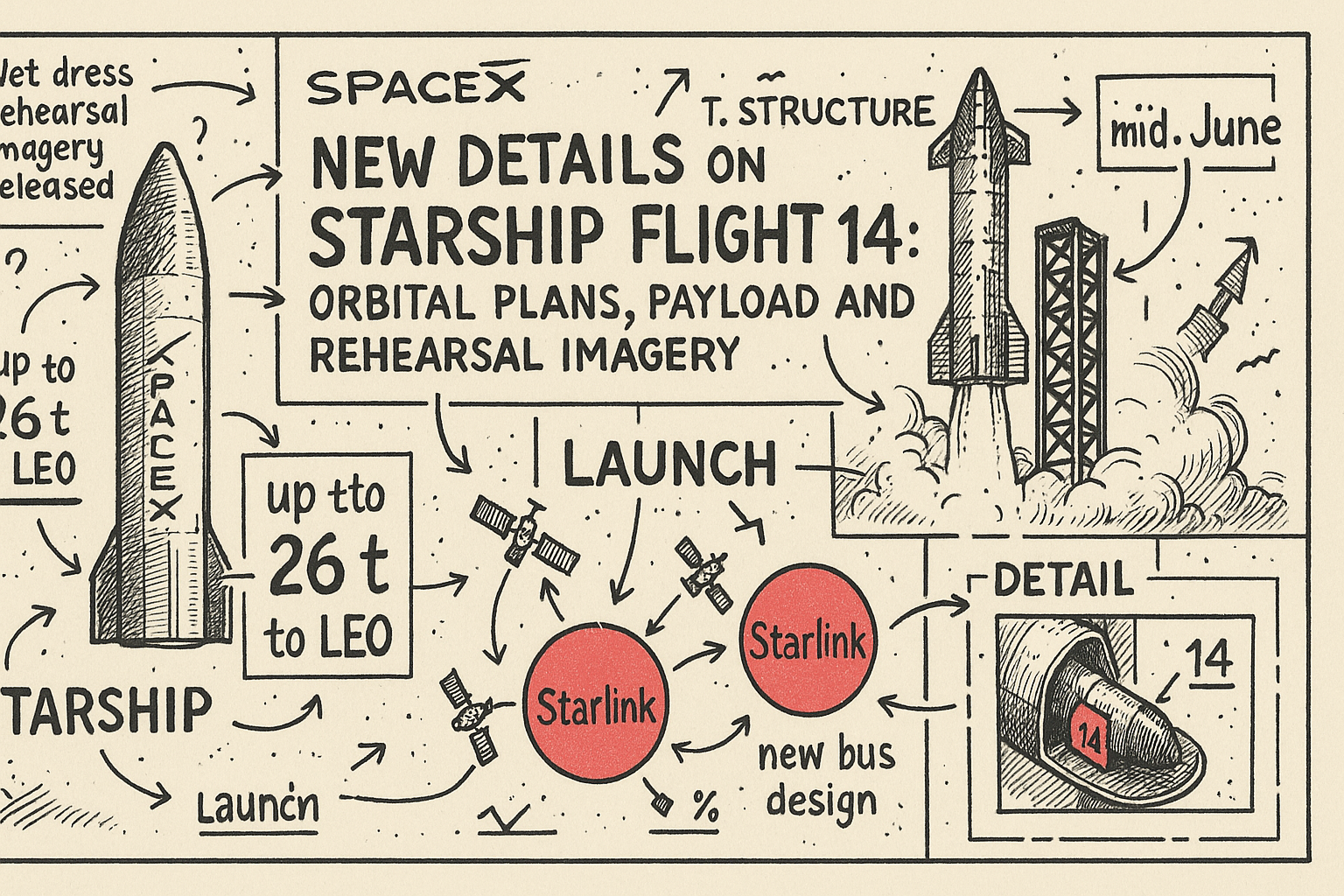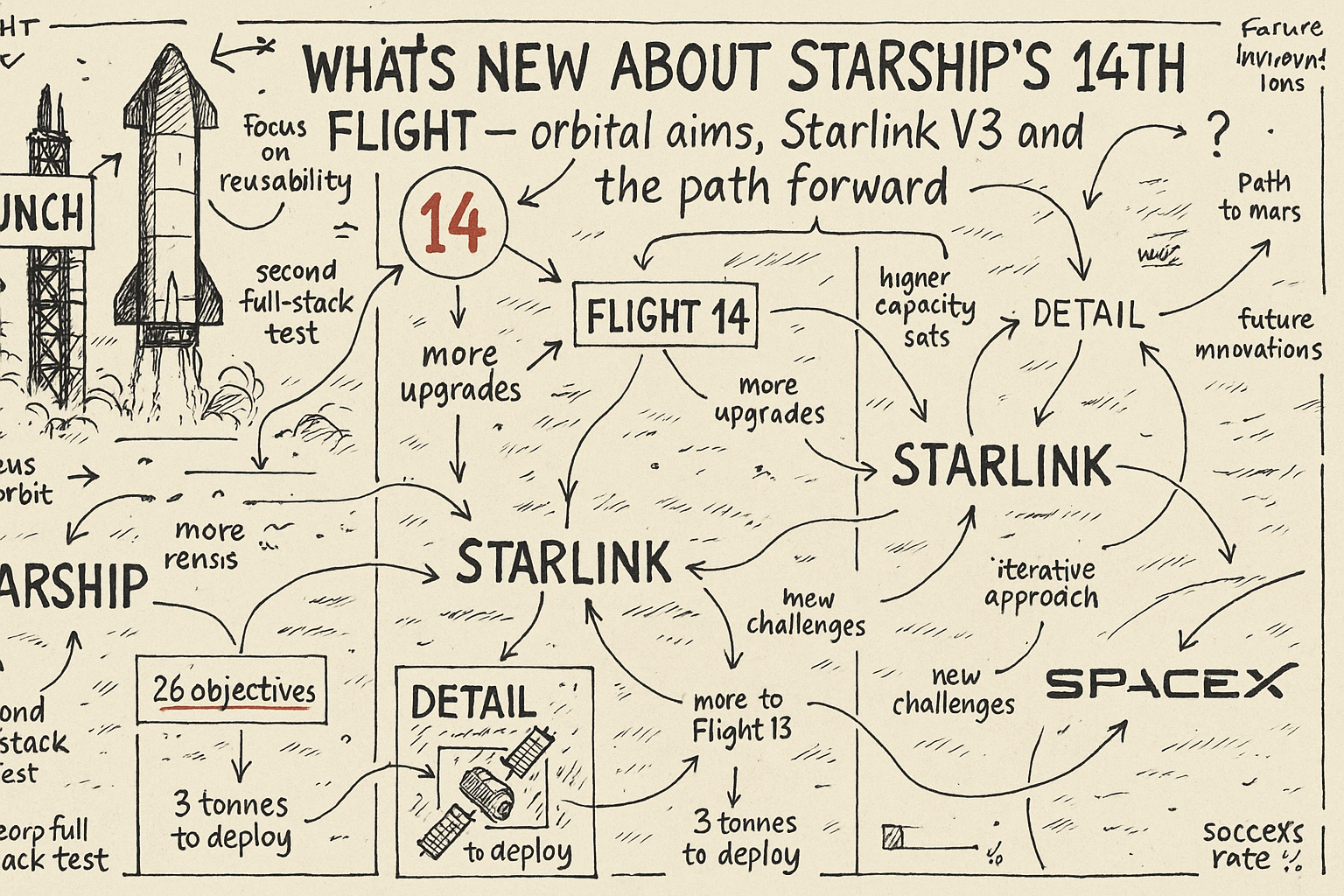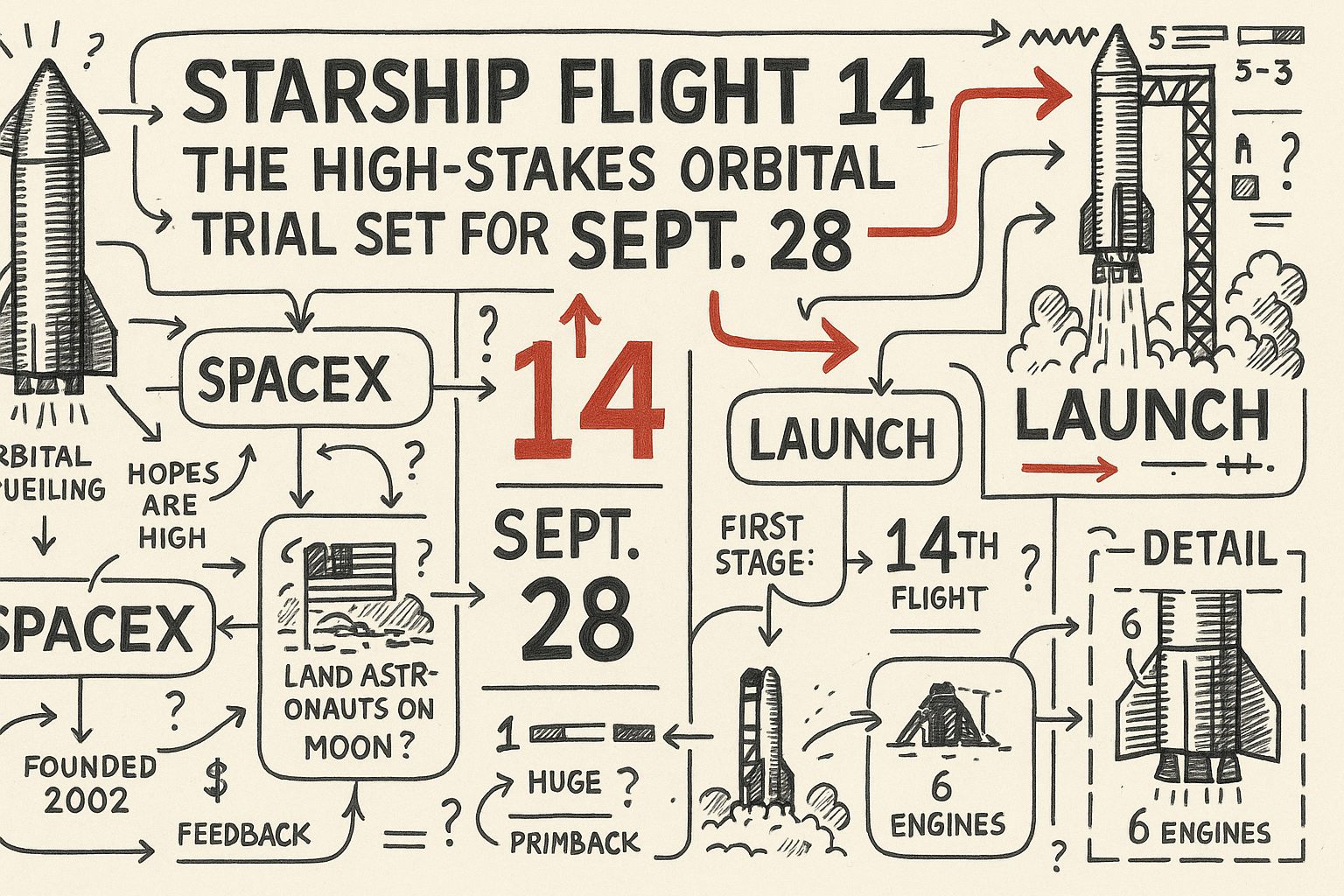
SpaceX is preparing what it calls Integrated Flight Test‑14 (IFT‑14) as a major step for the Starship program: the company is targeting Monday, September 28, 2026, pending regulatory approval, for what is being described across multiple outlets as Starship’s first orbital mission.
Unlike prior test flights that ranged from short hops to dramatic in‑flight breakups and sea‑borne landings, Flight 14 is planned as a full sequence intended to demonstrate Starship as an actual orbital vehicle. Several independent reports state the flight would place the Starship upper stage into an approximately 275 km orbit and carry out roughly six revolutions of Earth before reentry and splashdown about 10 hours after liftoff.
Payloads and orbital profile
Sources agree that the upper stage will carry 26 Starlink V3 satellites intended to be released during the multi‑orbit mission. After completing its planned orbits — reports specify about six revolutions — the second stage is expected to splash down in the Pacific Ocean off the coast of Chile.
The mission therefore serves two purposes at once: it is both a payload delivery demonstration for SpaceX’s Starlink constellation and a test of Starship’s end‑to‑end orbital capabilities over multiple orbits and hours of flight.
Booster recovery plan
Flight 14’s first stage, the Super Heavy booster, will not return to the launch mount for a tower catch on this mission. Reporting indicates the booster is expected to splash down in the Gulf of Mexico rather than attempt to return to the pad.
That recovery choice highlights the incremental approach SpaceX has used across the test campaign: progressively adding mission complexity while mixing and matching recovery techniques as engineers validate different elements of the system.
Regulatory and program context
All outlets note that the launch date is contingent on regulatory approval. SpaceX continues to operate under close oversight as the Federal Aviation Administration and other agencies review mission plans and safety measures for these more ambitious orbital tests.
Flight 14 follows a long, iterative test series: coverage of the program recounts the early April 2023 maiden flight that ended in a rapid destructive failure and later flights that produced headline‑grabbing Super Heavy tower catches and other dramatic events. Industry and media observers characterize SpaceX’s approach as "fail fast, learn faster," a philosophy reflected in the company’s steady cadence of increasingly complex test flights.
What comes next
Industry reporting indicates that, if Flight 14 meets its objectives, subsequent flights could pursue additional milestones such as pad catches and launches from other pads. One report identifies a potential timeline where Flight 15 could open the window for a ship catch, and Flight 16 is cited internally as a candidate for the first launch from Kennedy Space Center’s Launch Complex 39A, though those missions would follow Flight 14 and depend on its outcome.
For now, Flight 14 represents a clear inflection point: a planned orbital payload deployment, multiple orbits, and separated splashdowns will put many elements of the Starship architecture through their most comprehensive real‑world test to date.