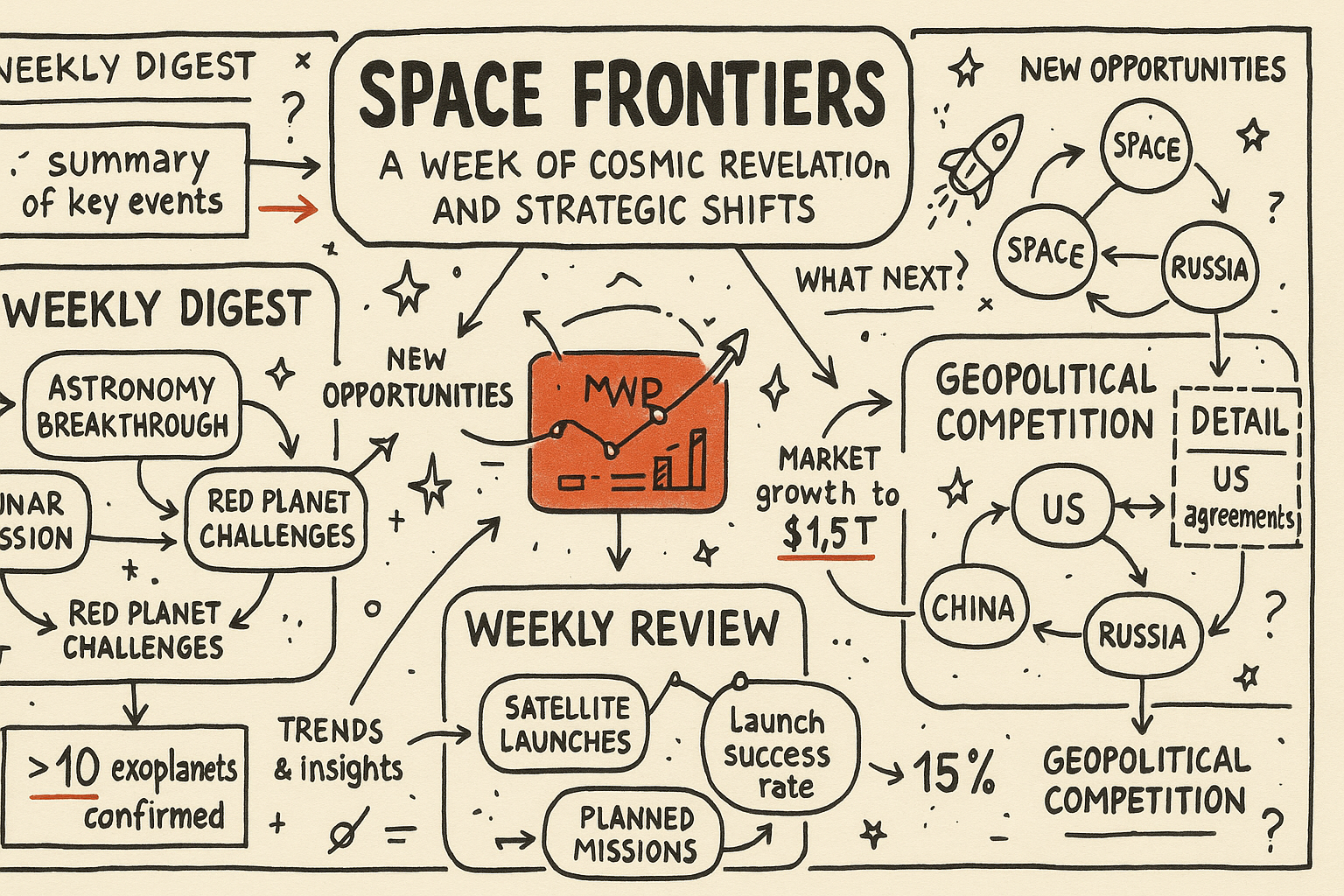
The universe never ceases to amaze with its boundless potential and this past week was no exception. From groundbreaking technological advancements to strategic shifts in space policy, the cosmos was abuzz with activity that promises to reshape our understanding and utilization of space. Among the most significant developments was the revelation of a mature galaxy cluster by the James Webb Space Telescope, captured an astonishing 10 billion light-years away, challenging established theories of the early universe's evolution.
Exploration & Science: Decoding Cosmic Mysteries
The James Webb Space Telescope (JWST) continues to redefine our understanding of the universe. This week, it unveiled a mature galaxy cluster, XLSSC 122, located a staggering 10 billion light-years away. This discovery is particularly significant because it suggests that such massive structures formed much earlier in the universe's timeline than previously thought. This revelation not only challenges current astrophysical models but also opens up new avenues of inquiry into how galaxies and cosmic structures evolved in the nascent universe.
In parallel, the Hubble Space Telescope contributed to our understanding of galaxy formation by providing new insights into the transformation of an early galaxy neighborhood. These findings highlight the complex interplay of processes that have shaped the universe over billions of years, offering a window into the past that could help decode the future of cosmic evolution.
On Mars, NASA's HiRISE instrument captured another key milestone for the Perseverance rover, continuing its groundbreaking exploration of the Martian surface. These ongoing missions are crucial for piecing together the planet's geological history and assessing its potential for past life.
Launch Activity: A Dynamic Week for Space Deployment
This week witnessed a flurry of launch activities that underscore the dynamic nature of current space operations. Rocket Lab's successful deployment of its 10th Synspective satellite from New Zealand highlights the company's growing capabilities and its critical role in the global launch market. This particular mission, delayed to accommodate a U.S. Space Force launch, underscores the increasing complexity and demand within the launch sector.
Meanwhile, SpaceX continued its relentless pace with the launch of its 'Starfall' reentry capsule, a mysterious mission that could herald a new era in space transport. The company also prepared for its final Starlink launch of June, further expanding its already extensive satellite constellation. These activities not only demonstrate SpaceX's operational prowess but also its strategic focus on expanding global internet coverage through its Starlink network.
Additionally, the Pegasus XL made a notable return, providing a nostalgic nod to its pioneering role in launching small payloads and contributing to the rich tapestry of this week's launch dynamics.
Industry & Policy: Strategic Shifts and Economic Frontiers
The commercial space industry continues to evolve at a rapid pace, marked by strategic alliances and technological advancements. Astroscale's ambitious plans for satellite servicing and space debris management are setting a new standard in the industry, reflecting a growing recognition of the need to address orbital debris as space activities intensify.
In Europe, OHB's significant €510 million investment aims to bolster its manufacturing capabilities and launch vehicle programs, positioning the company as a key player in the continent's space ambitions. Meanwhile, the ESA's decision to reassess its contributions to NASA's Lunar Gateway project following NASA's program pause indicates a pivot towards more autonomous European lunar initiatives.
The Moon itself has emerged as a strategic economic frontier, highlighted by NASA's Artemis 2 mission achieving a historic lunar orbit. This mission, coupled with Firefly Aerospace's Blue Ghost lander, underscores the Moon's potential as a hub for future space-based industries, driven by its untapped resources such as water ice and helium-3.
Commercial space also saw significant movements with Calian Group's acquisition of Galaxy Broadband and Boeing's $2 billion contract to enhance the U.S. Space Force's communication capabilities. These developments reflect a broader trend of consolidation and strategic investment aimed at strengthening infrastructure and services in the burgeoning space economy.
Looking Ahead: What Lies Beyond
As we look forward to the coming weeks, the space community will be keeping a close eye on several key developments. The postponed ESA Space Rider test, now rescheduled for October, promises to be a pivotal moment for Europe's reusable spacecraft ambitions. Additionally, the upcoming ISS spacewalk, focusing on the repair of the Canadarm2, will be critical in addressing the aging station's challenges.
Moreover, the ongoing integration of AI into satellite systems, as seen in Loft Orbital's collaboration with NASA's JPL, is set to revolutionize Earth observation capabilities, offering more precise data and insights that could transform our understanding of climate change and environmental dynamics.
In summary, this week has been a testament to the relentless progress and innovation within the space sector. From cosmic discoveries that challenge our fundamental understanding to strategic industry maneuvers that redefine our operational capabilities, the future of space exploration and utilization looks brighter than ever. As we continue to push the boundaries of what is possible, the universe awaits with endless possibilities.