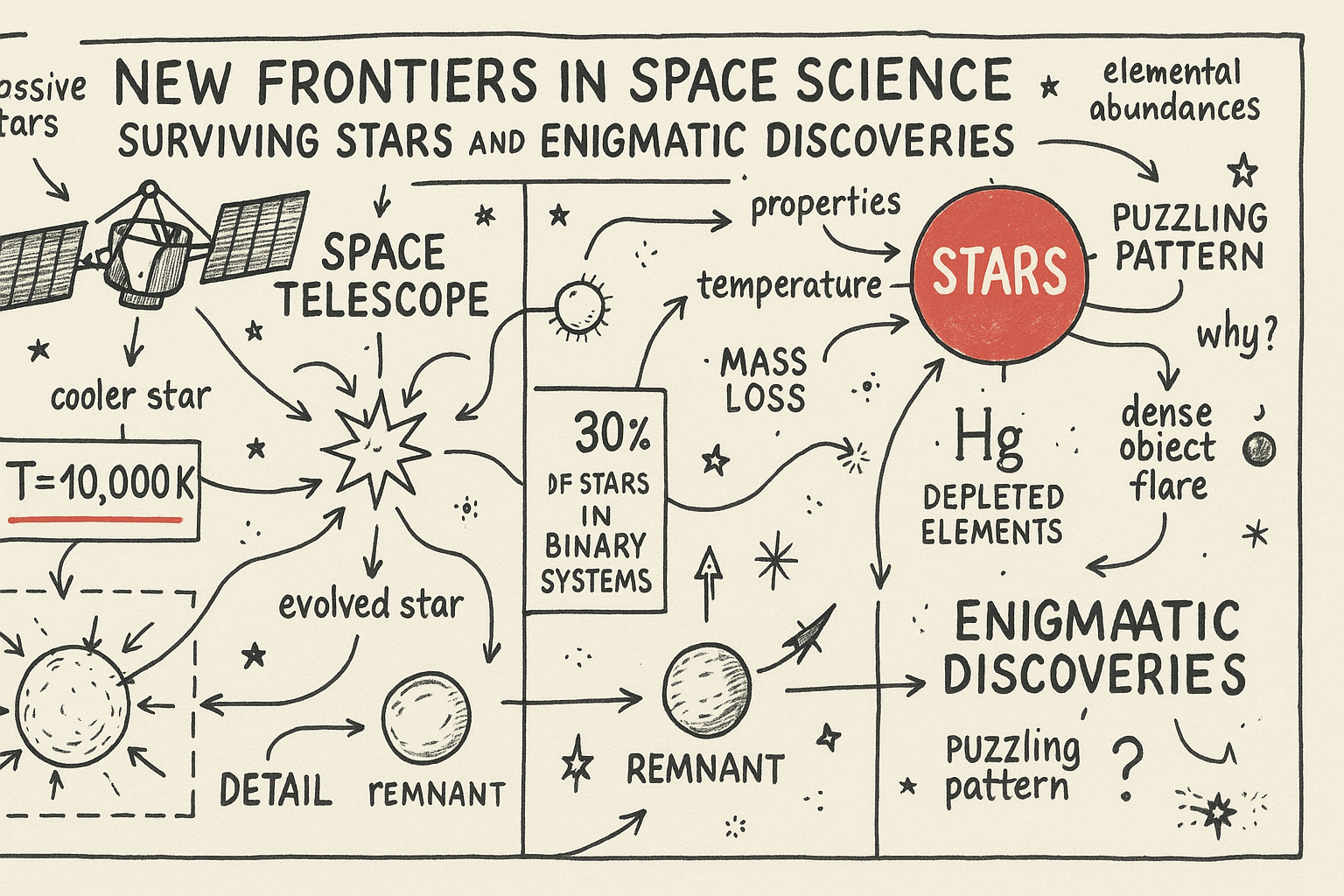
The cosmos has once again proven to be a treasure trove of surprises and revelations, as recent discoveries have highlighted the extraordinary resilience of planets and the intricate chemistry surrounding massive stars. These insights not only challenge our existing understanding but also pave the way for future explorations.
Unveiling the Chemistry of Massive Stars
In a groundbreaking study, researchers have detected sulfur oxides in the circumstellar environment of the supergiant HD 87643. This finding, facilitated by the Atacama Large Millimeter/submillimeter Array (ALMA), suggests a richer molecular chemistry in environments previously thought too hostile for such complexity. The presence of sulfur oxides indicates that even under extreme conditions, where ultraviolet radiation is intense, molecular chemistry can thrive, pushing the boundaries of our current models of stellar evolution and chemical processes.
Planets Defying Stellar Death
The James Webb Space Telescope (JWST) continues to amaze with its capabilities, as it has observed a planet surviving the death of its host star. Orbiting a white dwarf, this planet challenges the traditional view that planetary systems are completely obliterated during a star's red giant phase. The JWST's detailed observations provide a glimpse into what our own solar system might look like when the Sun transitions into a white dwarf. This discovery not only enriches our understanding of planetary system evolution but also prompts a reevaluation of the potential habitability of planets around dying stars.
Satellites and the Quest for Knowledge
On a different front, Isar Aerospace's collaboration with Planet Labs Germany marks a significant step in commercial satellite launches, aiming to deploy the new Pelican satellite constellation. This initiative reflects the growing trend of private sector involvement in space, highlighting the potential for increased data collection and Earth observation capabilities. As these satellites become operational, they promise to enhance our understanding of Earth's climate patterns and contribute to environmental monitoring efforts.
European Ambitions and Technological Marvels
Meanwhile, the European Space Agency's Euclid telescope celebrates three years since its launch, continuing to deliver unprecedented data about the universe's dark matter and dark energy. Its mission underscores Europe's commitment to leading space exploration efforts and advancing our cosmological knowledge. Euclid's findings are pivotal in addressing fundamental questions about the universe's composition and fate, providing a complementary perspective to other space telescopes like the JWST.
The Enigma of 'Little Red Dots'
Adding to the intrigue, astronomers have identified a new class of objects termed 'Little Red Dots,' likely early galaxies at high redshifts. This discovery, once again made possible by the JWST, offers a glimpse into the universe's infancy, challenging existing models of galaxy formation and evolution. Understanding these early galaxies can illuminate the conditions that prevailed in the young universe, offering clues about the processes that led to the formation of the first stars and galaxies.
Future Implications and Unanswered Questions
These diverse discoveries underscore the dynamic nature of space science, where each revelation opens new questions and avenues for exploration. The identification of resilient planets and complex chemical environments suggests that the universe is more adaptable and intricate than previously thought. As technology advances, further studies will likely uncover more about these phenomena, potentially reshaping our understanding of life's possibilities in extreme cosmic environments.
In conclusion, the recent strides in space science highlight humanity's relentless quest to understand the cosmos. As we continue to explore these celestial frontiers, we are reminded of the universe's vastness and the boundless potential for discovery that lies ahead.