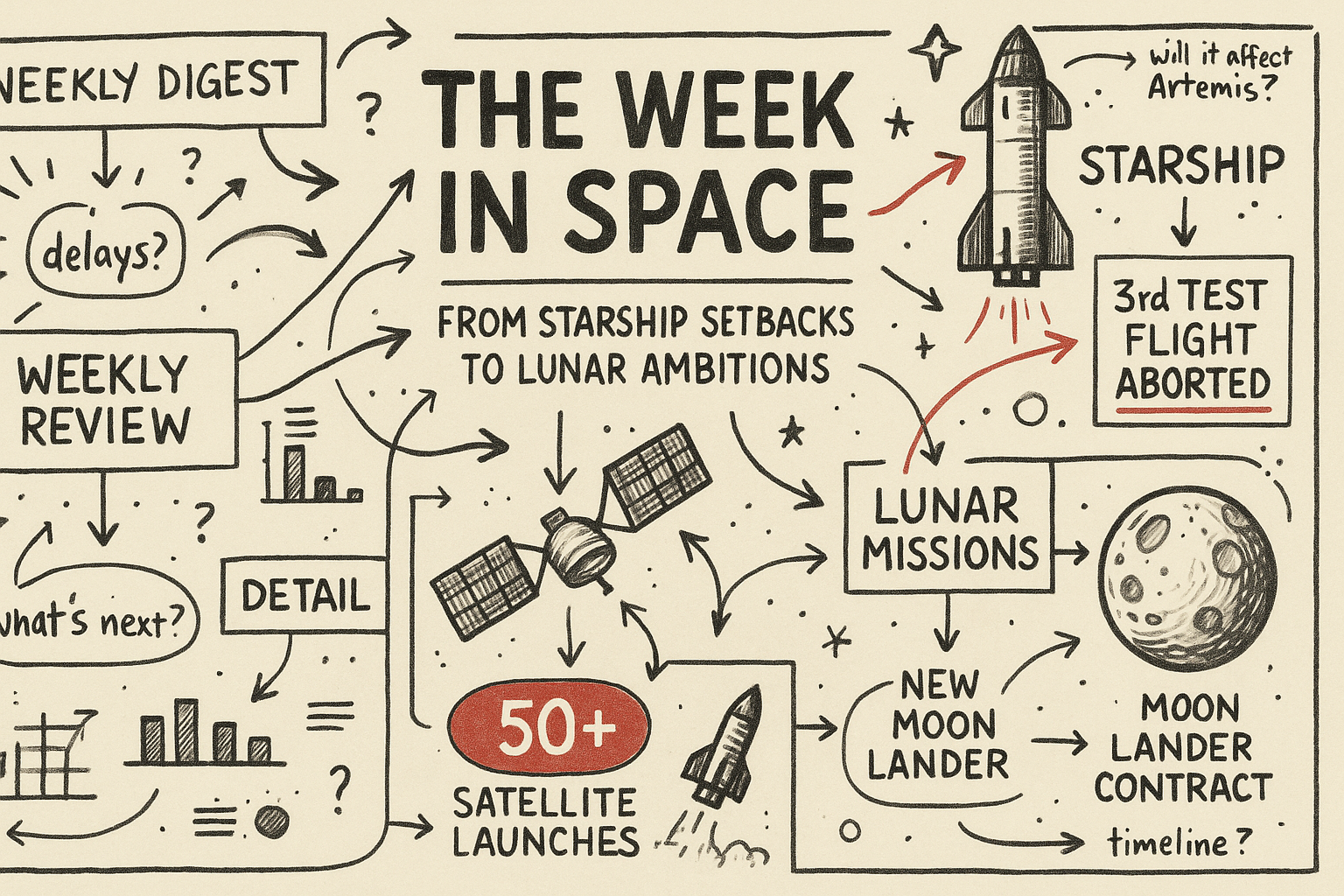
This week, the space industry witnessed a flurry of activity, marked by significant technological advancements, strategic acquisitions, and inspiring visions for the future. Among the most notable events was SpaceX's Starship Flight 13, a mission that was anticipated to be a landmark in the company's ambitious space exploration trajectory but was unexpectedly stalled due to engine ignition issues. Meanwhile, the acquisition of Astrobotic Technology by Voyager Technologies, now rebranded as Voyager Lunar Systems, underscored a strategic push towards expanding lunar infrastructure — a move that aligns closely with NASA's ongoing lunar exploration initiatives.
Launch Activity: Pioneering New Frontiers
This week, the launch sector was abuzz with activity, reflecting both the potential and challenges in current space missions. SpaceX's Starship Flight 13 was poised to test new technologies and deploy advanced Starlink V3 satellites, a mission that could have set new benchmarks in reusable launch vehicle capabilities. However, technical setbacks highlighted the complex nature of spaceflight and the iterative process required to overcome engineering challenges in pioneering missions. Despite the delay, SpaceX remains a pivotal player in the industry, with its Starlink constellation continuing to expand as evidenced by the successful launch of 24 additional satellites earlier in the week. This deployment further bolsters SpaceX's dominance in the satellite internet market and underscores its commitment to enhancing global connectivity.
Concurrently, the European Space Agency (ESA) made strides with its Ariane 6 rocket selection for the Henon CubeSat mission, a project that aims to push the boundaries of autonomous satellite technology in deep space. The promise of CubeSats, with their compact form and cost-effectiveness, represents a growing trend in the space sector towards miniaturization and efficiency. Moreover, the Soyuz MS-29 launch, carrying a Russian-American crew to the International Space Station (ISS), celebrated another successful mission in international cooperation, reinforcing the collaborative spirit that remains at the heart of space exploration.
Exploration & Science: Unveiling the Mysteries of the Universe
Beyond launch activities, the realm of space exploration and scientific discovery saw substantial progress. NASA's Perseverance rover on Mars continued its groundbreaking work, uncovering a 245-foot-thick stack of ancient rock, shedding light on the planet's impact history. Such findings are crucial in piecing together the geological and potentially biological history of Mars, as scientists continue to search for signs of past life.
The James Webb Space Telescope (JWST) also made headlines by revealing unprecedented insights into the atmospheric dynamics of WASP-121b, an ultra-hot Jupiter. These observations not only enhance our understanding of exoplanetary systems but also help refine the techniques used to study atmospheres of distant worlds, which is vital as astronomers seek to identify habitable planets outside our solar system.
Meanwhile, the discovery of an atmosphere on the rocky exoplanet LHS 1140 b marked a milestone in the search for habitable worlds. Situated 48 light-years away, this finding could significantly impact future efforts to detect life beyond Earth, as it provides a tangible target for studying atmospheric conditions conducive to life.
Industry & Policy: Strategic Moves and International Collaborations
In the business realm, Voyager Technologies' acquisition of Astrobotic Technology marked a strategic expansion into the lunar market. This move is indicative of a broader industry trend towards establishing a sustainable presence on the Moon, a key objective for both NASA and commercial entities. Voyager's rebranding to Voyager Lunar Systems signals its commitment to becoming a major player in lunar infrastructure development, an area expected to see significant growth in the coming years.
International collaborations also took center stage, with Serbia joining the Artemis Accords, becoming the 69th nation to sign this U.S.-led framework for space exploration. This move highlights Serbia's strategic pivot towards Western space initiatives, despite its previous commitments to China's lunar projects, illustrating the dynamic nature of international space alliances.
Additionally, the Canadian Space Agency's new grant program for deep-space health research emphasizes the growing recognition of the health challenges posed by long-duration missions. As humanity eyes Mars and beyond, understanding and mitigating health risks for astronauts will be crucial to the success of these ambitious endeavors.
Forward-Looking: What Lies Ahead
Looking forward, the space community will be closely monitoring the developments surrounding SpaceX's Starship, as the company addresses the technical challenges that led to the recent launch abort. The success of Starship is pivotal for future missions to Mars and beyond, making its next steps closely watched by industry observers and enthusiasts alike.
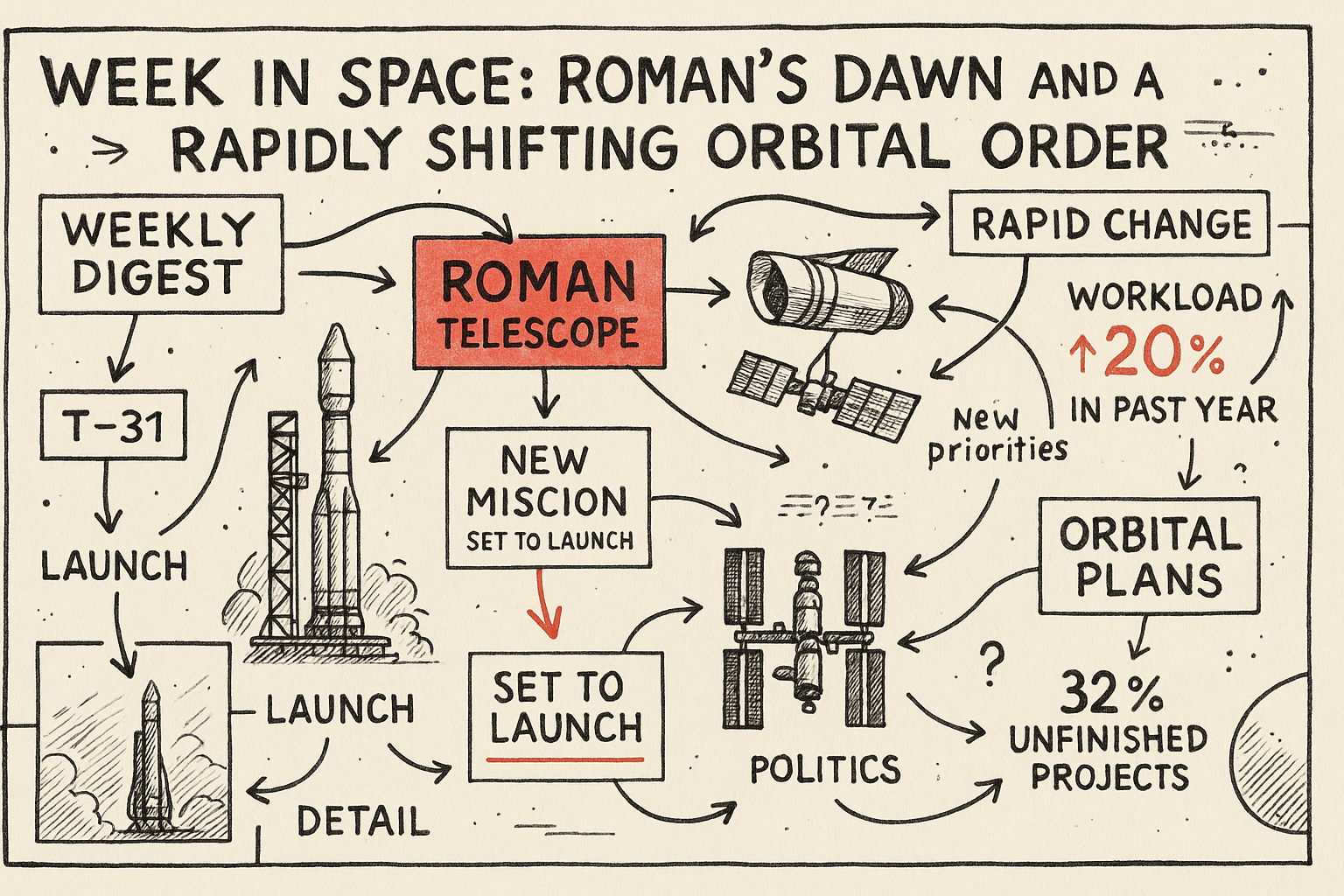
Furthermore, the upcoming launch of NASA's Nancy Grace Roman Space Telescope at the end of August promises to open new frontiers in cosmic exploration, with its mission to explore dark matter, dark energy, and search for new exoplanets. This telescope is set to revolutionize our understanding of the universe, offering new insights into some of the most profound questions in astrophysics.
As the space industry continues to evolve, balancing innovation with market realities will be crucial. The integration of commercial entities like SpaceX into NASA's Artemis program, alongside international partnerships, highlights a future where collaboration and commercial capabilities drive new achievements in space exploration. Stay tuned as these narratives unfold, offering a glimpse into the future of humanity's journey beyond Earth.