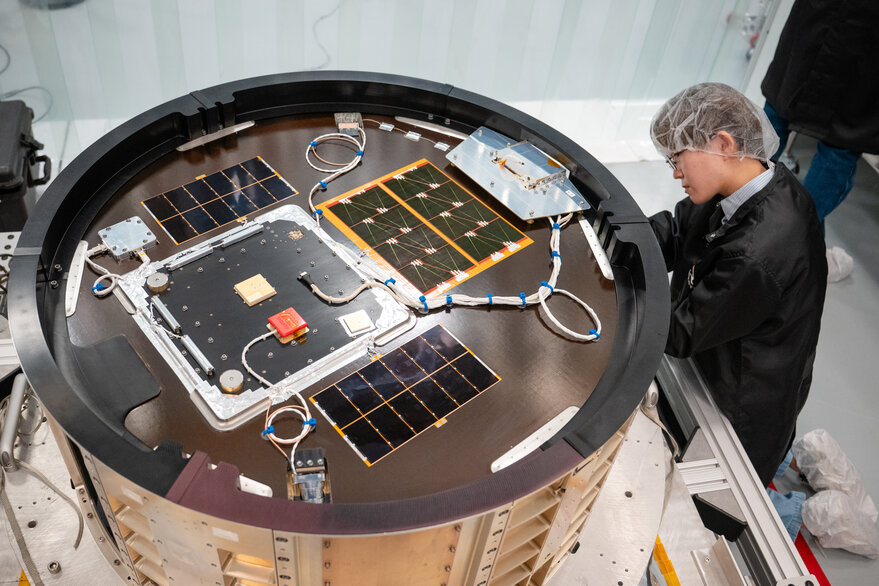
Rocket Lab, a leading private aerospace manufacturer and small satellite launcher, has secured a $397 million contract from the U.S. Space Force to develop, launch, and operate a constellation of innovative 'Flatellites.' This contract, part of the Space-Based Airborne Moving Target Indicator (SB-AMTI) program, aims to enhance the Department of Defense's (DoD) capability to track airborne threats with advanced space-based sensors.
This initiative reflects the U.S. Space Force's strategy to extend its surveillance capabilities beyond terrestrial and airborne sensors, leveraging Rocket Lab's expertise in satellite technology and launch capabilities. Rocket Lab's CEO, Peter Beck, stated that the contract is a testament to the company's vertically integrated approach, which allows it to manage every aspect of the space value chain—from satellite manufacturing to launch services.
The Flatellites, as described by Rocket Lab, are designed to be highly efficient in deployment and operation. These flat-packed satellites can be stacked inside a launch vehicle, similar to SpaceX's Starlink satellites, optimizing the payload and reducing deployment costs. Each Flatellite is equipped with space-based sensors and low-latency, high-bandwidth communication links, enabling real-time tracking and identification of moving airborne targets. These capabilities are crucial for national security and defense operations.
The satellites will be launched using Rocket Lab's Neutron, a medium-lift launch vehicle yet to make its maiden flight. Once operational, the Flatellites will rely on Rocket Lab's MAX constellation flight software and InterMission ground software. These systems are designed to handle the vast amounts of data collected, using artificial intelligence to process information and identify potential threats. Rocket Lab's approach ensures that the data remains secure and meets the stringent cybersecurity requirements necessary for national security applications.
In addition to Rocket Lab, two other companies have secured funding as part of the overall $615 million allocated by the Space Force for the SB-AMTI program. While Systems & Technology Research (STR) is known to be one of the recipients, the identity of the third company remains undisclosed for security reasons.
This contract follows a series of significant achievements for Rocket Lab. Recently, the company announced a record $266 million contract for suborbital launches with the Space Force, marking its largest launch award to date. This contract includes the establishment of a new launch site at the Pacific Spaceport Complex in Kodiak, Alaska, which is expected to become operational by the end of the year.
The introduction of Flatellites marks a pivotal development in Rocket Lab's ongoing efforts to expand its presence in the defense and national security sectors. The company's strategy to offer comprehensive space solutions aligns with the increasing demand for advanced satellite technologies that can provide critical data for military and governmental operations.
As Rocket Lab continues to innovate and expand its capabilities, the company is positioning itself as a key player in the rapidly evolving space industry. The successful deployment and operation of the Flatellite constellation could set a new standard for space-based surveillance and tracking technologies, potentially leading to further contracts and collaborations with governmental and commercial entities.
With the aerospace sector witnessing rapid advancements, Rocket Lab's contract win reinforces the strategic importance of space-based technologies in national defense and security. As these Flatellites prepare to take their place in orbit, they promise to deliver critical insights and enhance the United States' ability to monitor and respond to global threats.