The Aerospace Corporation is making significant strides in satellite technology with the demonstration of its innovative DiskSats in low-Earth orbit (LEO). Launched in December 2025 from NASA's Wallops Flight Facility in Virginia on a Rocket Lab Electron, these uniquely designed satellites aim to revolutionize the satellite industry. As the DiskSats descend approximately two kilometers per month due to atmospheric drag, engineers are commissioning the Enpulsion Nano Field Emission Electric Propulsion systems to guide them to very low Earth orbit (VLEO), less than 300 kilometers above the Earth.
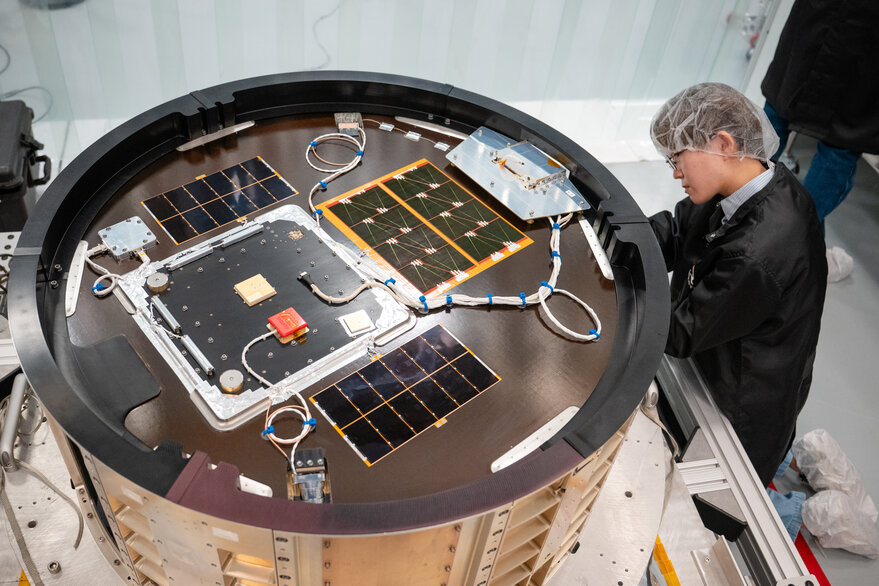
Described by Darren Rowen, the chief engineer of the DiskSat demonstration mission, as “the biggest advancement in containerized satellites since cubesats were introduced in the early 2000s,” these DiskSats represent a new chapter in satellite form factors. The DiskSats, each weighing 17 kilograms, feature a bus with a diameter of one meter and a depth of just 2.5 centimeters. This novel form factor required Aerospace engineers to take a fresh approach to designing satellite power management, communications, attitude control, and thermal subsystems.
One of the key challenges faced by the team was thermal control, given that thrusters, payloads, star trackers, and other components are mounted on the exterior of the DiskSats. This configuration necessitated considerable engineering efforts to maintain optimal temperature conditions. Furthermore, the custom-built dispenser designed to deploy the DiskSats was a critical component of the mission, with Rowen emphasizing the mission-critical nature of its successful operation.
In the early phase of the mission, the DiskSats' team encountered a steep learning curve as they navigated several 'firsts' in space operations. As documented in their paper, 'DiskSat: On-Orbit Performance and Lessons Learned from the Inaugural Flight of Two-Dimensional Satellites,' presented at the 2026 Small Satellite Conference, nearly every subsystem was novel, necessitating extensive adaptations and problem-solving.
A particular issue arose with stray light interfering with the star trackers, a problem that required a conceptual revision of the DiskSat's operational approach. Despite these challenges, the DiskSats are now moving towards propulsive lowering and sustainment at lower altitudes, according to Catherine Venturini, the mission's principal investigator.
The introduction of DiskSats marks a significant departure from the traditional satellite design, promising enhanced capabilities and operational efficiencies, particularly in VLEO. This could have profound implications for satellite technology, offering more compact, cost-effective, and versatile solutions for various applications, including Earth observation and telecommunications.
As the DiskSats continue their descent towards VLEO, the Aerospace Corporation remains focused on overcoming the technical challenges inherent in their innovative design. The ongoing mission not only highlights the potential of this new satellite paradigm but also the resilience and adaptability of the engineering teams pushing the boundaries of what's possible in space technology.