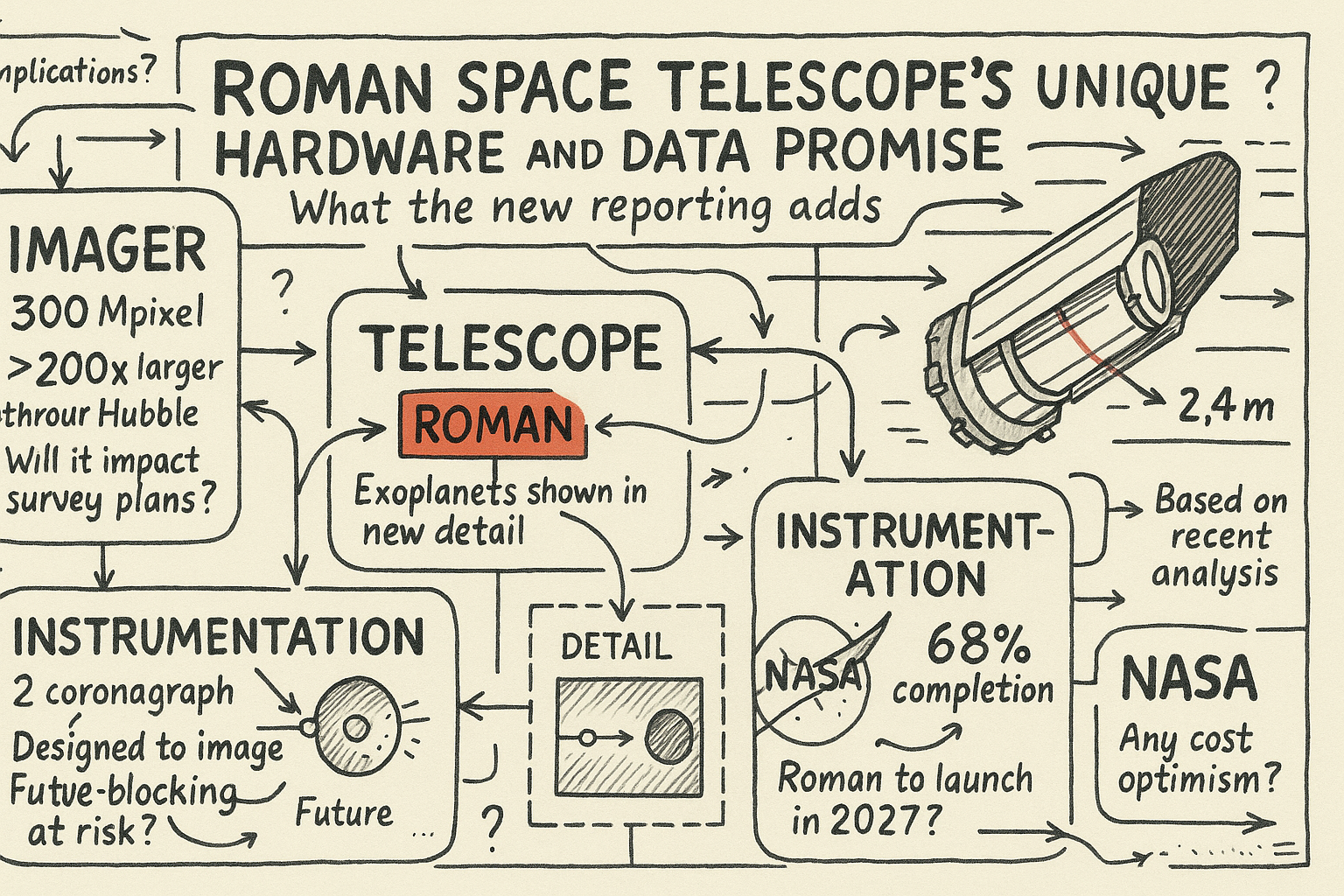
As the Nancy Grace Roman Space Telescope prepared to depart Kennedy Space Center, recently surfaced reporting filled in technical and international details that complement earlier launch coverage. Together these reports illuminate elements of Roman’s hardware pedigree, its data ambitions, and the role of European partners in what NASA calls a next-generation wide-field observatory.
Donated Hubble-class mirror and heritage hardware
Spaceflight Now notes that Roman’s primary mirror is a Hubble-class optic that was donated and originally built for a spy satellite. That provenance ties Roman to a lineage of high-performance space optics and helps explain how the mission achieves Hubble-quality image sharpness across a vastly larger field of view. The report frames the donation as a practical and scientific boost to the project as it readies to begin its million-mile journey after liftoff.
Wide-field camera: scale and data
Reporting by Spaceflight Now contrasts Roman’s wide-field capabilities with Hubble’s long record. Roman’s 300-megapixel wide-field camera produces single full-resolution images that would cover about 45 city blocks or the entirety of El Capitan in Yosemite, according to officials cited in that report. The telescope also promises a dramatic increase in downlinked data: while Hubble has returned roughly 172 terabytes over 30 years, Roman is expected to return about 2,500 terabytes during its five-year primary mission.
Science goals and spectral reach
European Space Agency coverage reiterates Roman’s scientific remit: Roman will scan large swaths of the sky in visible to near-infrared light to study dark energy, dark matter and to find new exoplanets. Those science drivers have been central to Roman’s design as a wide-field, high-throughput observatory that complements existing and planned facilities rather than duplicating them.
ESA contributions and international support
ESA is explicitly named as a contributor to multiple spacecraft systems. According to ESA, Europe provided star trackers, batteries, detectors for Roman’s coronagraph instrument, and communications support through ESA’s deep-space ground station network. ESA also participates via scientific expertise through its Mission of Opportunity programme, aiming to help guide and maximise Roman’s scientific return.
Context for the launch
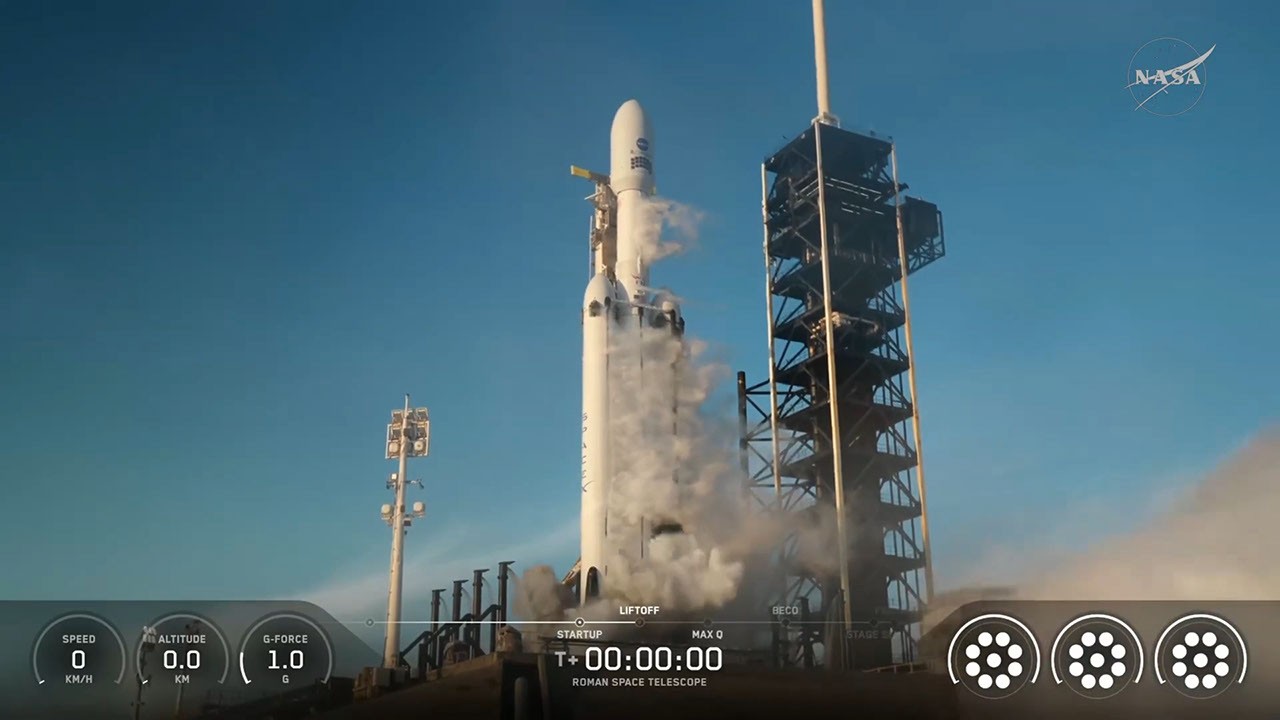
Multiple outlets confirm the launch timeline and vehicle: Roman was slated to launch from NASA’s Kennedy Space Center on 30 August 2026. ESA published the local launch times as 07:26 EDT / 12:26 BST / 13:26 CEST. Coverage describes the telescope encapsulated atop a SpaceX Falcon Heavy vehicle as it awaited liftoff from the Florida pad.
These freshly surfaced facts — the donated Hubble-class mirror, the mission’s projected data volume, and ESA’s concrete hardware and communications contributions — add texture to the launch narrative. Together they emphasise that Roman is not only a significant event on the pad but the start of a data-rich, internationally supported observatory designed to survey the universe at an unprecedented combination of sharpness and scale.